Yasojima Edson Yuzur, Teixeira Renan Kleber Costa, Houat Abdallah de Paula, Costa Felipe Lobato da Silva, Yamaki Vitor Nagai, Feitosa-Junior Denilson José Silva, Silva Carlos Augusto Moreira, Brito Marcus Vinicius Henriques
Laboratório de Cirurgia Experimental, Faculdade de Medicina, Universidade Estadual do Pará, Belém, PA, Brazil.
Arq Bras Cir Dig. 2015 Jul-Sep;28(3):186-9. doi: 10.1590/S0102-67202015000300010.
The use of meshes in hernia surgical repair promoted revolution in the surgical area; however, some difficulties had come, such as a large area of fibrosis, greater postoperative pain and risk of infection. The search for new substances that minimize these effects should be encouraged. Medicinal plants stand out due possible active ingredients that can act on these problems.
To check the copaiba oil influence in the repair of abdominal defects in rats corrected with Vicryl(c) mesh.
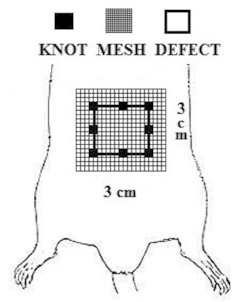
Twenty-four Wistar rats were submitted to an abdominal defect and corrected with Vicryl(c) mesh. They were distributed into two groups: control and copaíba via gavage, administered for seven days after surgery. The analysis of the animals took place on 8, 15 and 22 postoperative days. It analyzed the amount of adhesions and microscopic analysis of the mesh.
There was no statistical difference regarding the amount of adhesions. All animals had signs of acute inflammation. In the control group, there were fewer macrophages in animals of the 8th compared to other days and greater amount of necrosis on day 8 than on day 22. In the copaiba group, the number of gigantocytes increased compared to the days analyzed.
Copaiba oil showed an improvement in the inflammatory response accelerating its beginning; however, did not affect the amount of abdominal adhesions or collagen fibers.
疝修补手术中使用补片推动了外科领域的变革;然而,也出现了一些问题,如大面积纤维化、术后疼痛加剧和感染风险。应鼓励寻找能将这些影响降至最低的新物质。药用植物因其可能含有的能作用于这些问题的活性成分而备受关注。
研究巴西香脂油对用薇乔(Vicryl)补片修复大鼠腹部缺损的影响。
24只Wistar大鼠制造腹部缺损并用薇乔补片修复。将它们分为两组:对照组和经灌胃给予巴西香脂油组,术后给药7天。在术后第8、15和22天对动物进行分析。分析粘连数量并对补片进行显微镜分析。
粘连数量方面无统计学差异。所有动物均有急性炎症迹象。对照组中,与其他天数相比,第8天动物体内巨噬细胞较少,且第8天的坏死量多于第22天。在巴西香脂油组,与所分析的其他天数相比,巨细胞数量增加。
巴西香脂油显示出炎症反应有所改善,加速了炎症起始;然而,并未影响腹部粘连数量或胶原纤维。