Lee Nancy Raitano, Anand Payal, Will Elizabeth, Adeyemi Elizabeth I, Clasen Liv S, Blumenthal Jonathan D, Giedd Jay N, Daunhauer Lisa A, Fidler Deborah J, Edgin Jamie O
Child Psychiatry Branch, National Institute of Mental Health Bethesda, MD, USA ; Department of Psychology, Drexel University Philadelphia, PA, USA.
Department of Psychology, University of Arizona Tucson, AZ, USA.
Front Behav Neurosci. 2015 Oct 20;9:264. doi: 10.3389/fnbeh.2015.00264. eCollection 2015.
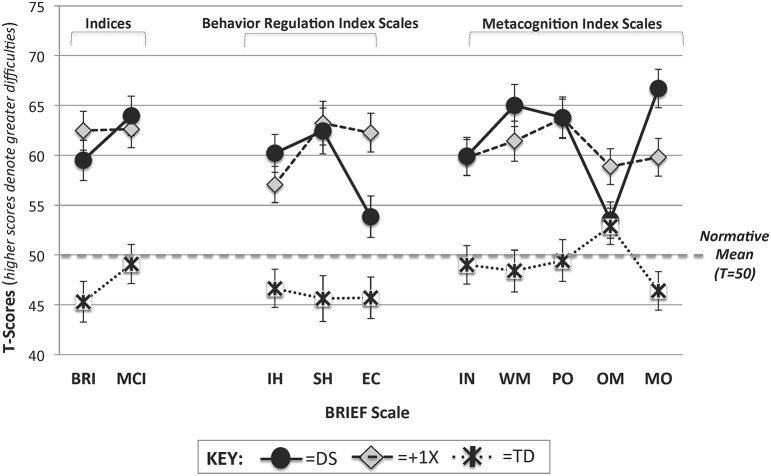
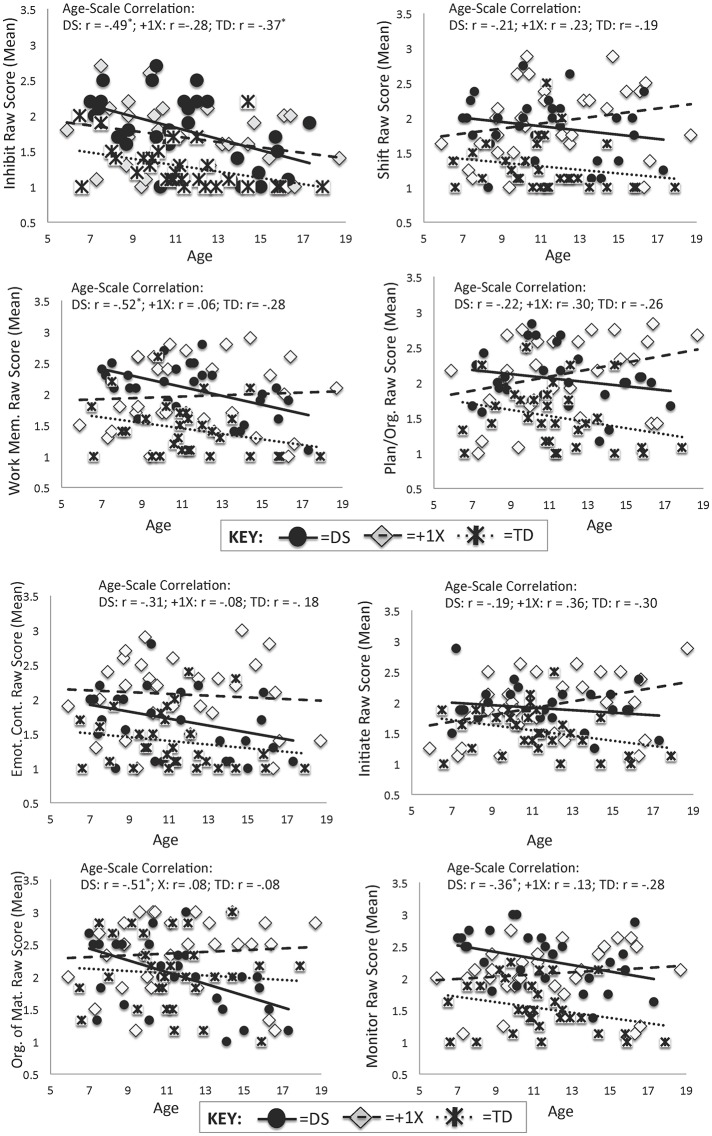
Executive functions (EF) are thought to be impaired in Down syndrome (DS) and sex chromosome trisomy (Klinefelter and Trisomy X syndromes; +1X). However, the syndromic specificity and developmental trajectories associated with EF difficulties in these groups are poorly understood. The current investigation (a) compared everyday EF difficulties in youth with DS, +1X, and typical development (TD); and (b) examined relations between age and EF difficulties in these two groups and a TD control group cross-sectionally. Study 1 investigated the syndromic specificity of EF profiles on the Behavior Rating Inventory of Executive Function (BRIEF) in DS (n = 30), +1X (n = 30), and a TD group (n = 30), ages 5-18 years. Study 2 examined age effects on EF in the same cross-sectional sample of participants included in Study 1. Study 3 sought to replicate Study 2's findings for DS by examining age-EF relations in a large independent sample of youth with DS (n = 85) and TD (n = 43), ages 4-24 years. Study 1 found evidence for both unique and shared EF impairments for the DS and +1X groups. Most notably, youth with +1X had relatively uniform EF impairments on the BRIEF scales, while the DS group showed an uneven BRIEF profile with relative strengths and weaknesses. Studies 2 and 3 provided support for fairly similar age-EF relations in the DS and TD groups. In contrast, for the +1X group, findings were mixed; 6 BRIEF scales showed similar age-EF relations to the TD group and 2 showed greater EF difficulties at older ages for +1X. These findings will be discussed within the context of efforts to identify syndrome specific cognitive-behavioral profiles for youth with different genetic syndromes in order to inform basic science investigations into the etiology of EF difficulties in these groups and to develop treatment approaches that are tailored to the needs of these groups.
人们认为,唐氏综合征(DS)和性染色体三体综合征(克兰费尔特综合征和三体X综合征;+1X)患者的执行功能(EF)受损。然而,对于这些群体中与执行功能困难相关的综合征特异性和发育轨迹,我们知之甚少。当前的研究(a)比较了患有DS、+1X的青少年与发育正常(TD)青少年在日常执行功能方面的困难;(b)横断面研究了这两组以及一个TD对照组中年龄与执行功能困难之间的关系。研究1调查了5至18岁的DS组(n = 30)、+1X组(n = 30)和TD组(n = 30)在执行功能行为评定量表(BRIEF)上执行功能概况的综合征特异性。研究2在与研究1相同的横断面样本中研究了年龄对执行功能的影响。研究3试图通过在一个由4至24岁的DS青少年(n = 85)和TD青少年(n = 43)组成的大型独立样本中研究年龄与执行功能的关系,来重复研究2关于DS的研究结果。研究1发现了DS组和+1X组存在独特和共同执行功能损害的证据。最值得注意的是,+1X组的青少年在BRIEF量表上的执行功能损害相对一致,而DS组在BRIEF量表上表现出不均衡的概况,有相对的优势和劣势。研究2和3为DS组和TD组中年龄与执行功能的关系相当相似提供了支持。相比之下 +1X组的研究结果则好坏参半;6个BRIEF量表显示出与TD组相似的年龄与执行功能关系,2个量表显示+1X组在年龄较大时执行功能困难更大。这些发现将在为患有不同遗传综合征的青少年确定综合征特异性认知行为概况的背景下进行讨论,以便为这些群体中执行功能困难的病因学基础科学研究提供信息,并开发适合这些群体需求的治疗方法。