Saracco Fabio, Di Clemente Riccardo, Gabrielli Andrea, Pietronero Luciano
Istituto dei Sistemi Complessi - ISC CNR UoS "Sapienza" Physics Department Università di Roma, P.le Aldo Moro 5, 00185, Rome, Italy.
IMT Institute for Advanced Studies Lucca, Piazza S. Ponziano 6, 55100, Lucca, Italy.
PLoS One. 2015 Nov 6;10(11):e0140420. doi: 10.1371/journal.pone.0140420. eCollection 2015.
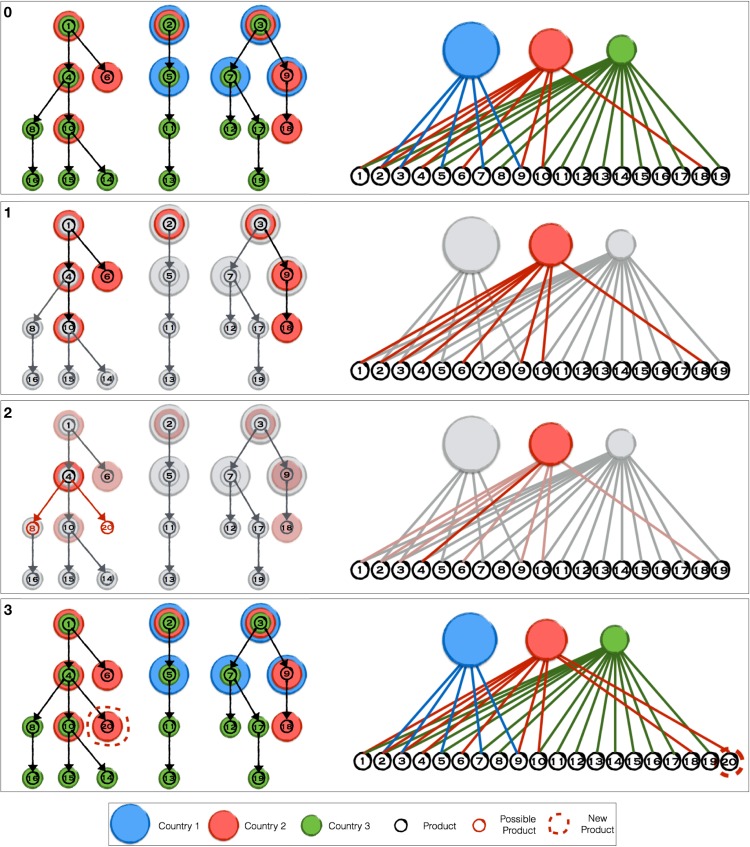
Few attempts have been proposed in order to describe the statistical features and historical evolution of the export bipartite matrix countries/products. An important standpoint is the introduction of a products network, namely a hierarchical forest of products that models the formation and the evolution of commodities. In the present article, we propose a simple dynamical model where countries compete with each other to acquire the ability to produce and export new products. Countries will have two possibilities to expand their export: innovating, i.e. introducing new goods, namely new nodes in the product networks, or copying the productive process of others, i.e. occupying a node already present in the same network. In this way, the topology of the products network and the country-product matrix evolve simultaneously, driven by the countries push toward innovation.
为了描述出口二分矩阵国家/产品的统计特征和历史演变,人们提出的尝试很少。一个重要的观点是引入产品网络,即一个对商品的形成和演变进行建模的分层产品森林。在本文中,我们提出了一个简单的动态模型,其中国家相互竞争以获得生产和出口新产品的能力。国家有两种扩大出口的可能性:创新,即引入新商品,也就是产品网络中的新节点;或者复制其他国家的生产过程,即占据同一网络中已有的节点。通过这种方式,产品网络的拓扑结构和国家-产品矩阵在国家对创新的推动下同时演变。