Katsuda Takeshi, Ochiya Takahiro
Division of Molecular and Cellular Medicine, National Cancer Center Research Institute, 5-1-1 Tsukiji, Chuo-ku, Tokyo, 104-0045, Japan.
Stem Cell Res Ther. 2015 Nov 11;6:212. doi: 10.1186/s13287-015-0214-y.
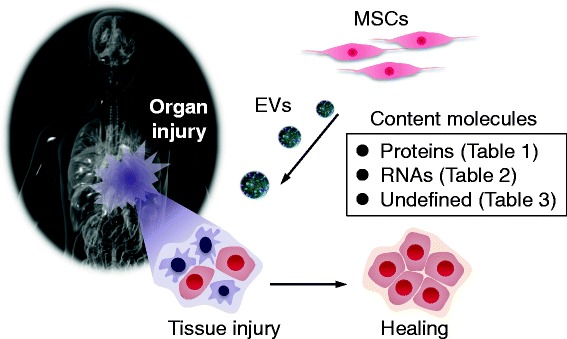
Extracellular vesicles (EVs) play important roles in intercellular communications via their content molecules, and mimic, at least in part, the roles that are played by their originating cells. Consistent with this notion, an increasing number of reports have suggested that EVs derived from mesenchymal stem cells (MSCs), which are therapeutically beneficial to a wide range of diseases, can serve as drugs to treat multiple diseases. EVs contain a variety of molecules, including proteins, microRNAs, and mRNAs, and are associated with biological processes in a content molecule-dependent manner. In this article, we review the latest reports regarding the therapeutic potential of MSC-EVs by focusing on the underlying molecular mechanisms of their effects. Specifically, we feature the effects of MSC-EVs in terms of their content molecules and of the tissue recovery processes endowed by these molecules.
细胞外囊泡(EVs)通过其所含分子在细胞间通讯中发挥重要作用,并且至少部分地模拟其起源细胞所发挥的作用。与这一观点一致,越来越多的报告表明,源自间充质干细胞(MSCs)的EVs对多种疾病具有治疗益处,可作为治疗多种疾病的药物。EVs包含多种分子,包括蛋白质、微小RNA和信使RNA,并以依赖于所含分子的方式参与生物学过程。在本文中,我们通过关注其作用的潜在分子机制,综述了有关MSCs-EVs治疗潜力的最新报告。具体而言,我们重点介绍了MSCs-EVs在其所含分子以及这些分子赋予的组织恢复过程方面的作用。