Buhse Susanne, Mühlhauser Ingrid, Heller Tabitha, Kuniss Nadine, Müller Ulrich Alfons, Kasper Jürgen, Lehmann Thomas, Lenz Matthias
Faculty of Mathematics, Informatics and Natural Sciences, Unit of Health Sciences and Education, University of Hamburg, Hamburg, Germany.
Department of Internal Medicine III, Endocrinology and Metabolic Diseases, Jena University Hospital, Jena, Germany.
BMJ Open. 2015 Nov 13;5(11):e009116. doi: 10.1136/bmjopen-2015-009116.
To evaluate an informed shared decision-making programme (ISDM-P) for people with type 2 diabetes under high fidelity conditions.
Randomised, single-blinded trial with sham control intervention and follow-up of 6 months.
Single-centre diabetes clinic providing care according to the national disease management programme in Germany.
154 people with type 2 diabetes without diagnosis of ischaemic heart disease or stroke.
The ISDM-P is executed by diabetes educators. Core component is a patient decision aid on the prevention of myocardial infarction supplemented by a 90 min group teaching session. The structurally equivalent control intervention addresses stress issues.
Primary outcome was risk comprehension, including realistic expectations about benefits and harms of interventions. It was assessed by a 12-item questionnaire after the teaching session when patients set and prioritise their treatment goals. Key secondary outcome was adherence to treatment goals, operationalised as achievement of individual goals and medication uptake. ISDM-P teaching sessions were video-taped to monitor intervention fidelity.
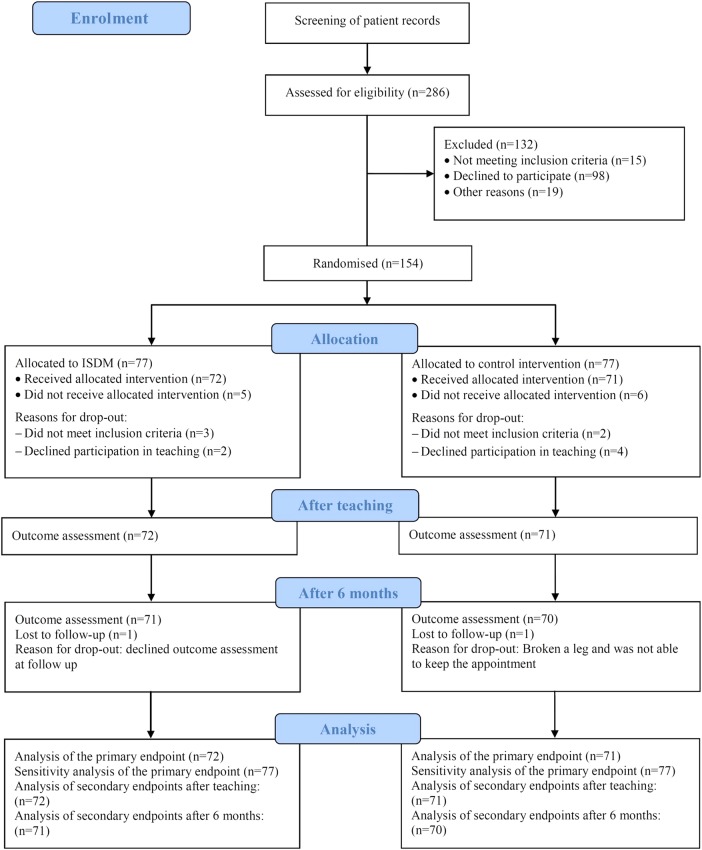
72 of 77 ISDM-P and 71 of 77 control patients completed the questionnaire (score 0-12). ISDM-P patients achieved higher levels of risk comprehension, mean score 8.25 vs 2.62, difference 5.63 (95% CI 4.82 to 6.44), and realistic expectations (score 0-6), 4.51 vs 0.85, 3.67 (3.23 to 4.11). More ISDM-P patients wished to take statins, 59.2% vs 30.4%, 28.7% (12.9% to 44.5%); more prioritised blood pressure control, 51.4% vs 25.7%, and fewer intensive glucose control, 33.3% vs 60%, p=0.002. More ISDM-P patients achieved their glycated haemoglobin goals, 95.8% vs 85.7%, 10.1% (0.6% to 19.5%). Achievement of prioritised goals and medication uptake were comparable between groups.
The ISDM-P on preventive measures in type 2 diabetes was effective under high fidelity conditions. Involvement of diabetes educators may facilitate implementation of the informed shared decision-making.
ISRCTN84636255.
在高保真条件下评估一项针对2型糖尿病患者的知情共享决策项目(ISDM-P)。
采用假对照干预的随机单盲试验,随访6个月。
根据德国国家疾病管理项目提供护理的单中心糖尿病诊所。
154例未诊断出缺血性心脏病或中风的2型糖尿病患者。
ISDM-P由糖尿病教育者执行。核心组成部分是一份关于预防心肌梗死的患者决策辅助工具,并辅以90分钟的小组教学课程。结构等效的对照干预措施关注压力问题。
主要结局是风险理解,包括对干预措施利弊的现实期望。在教学课程结束后,当患者设定并确定其治疗目标时,通过一份12项问卷进行评估。关键次要结局是对治疗目标的依从性,具体表现为实现个人目标和药物摄取情况。ISDM-P教学课程进行了录像,以监测干预的保真度。
77例ISDM-P患者中的72例和77例对照患者中的71例完成了问卷(评分0-12)。ISDM-P患者实现了更高水平的风险理解,平均得分8.25对2.62,差值5.63(95%CI 4.82至6.44),以及现实期望(评分0-6),4.51对0.85,3.67(3.23至4.11)。更多ISDM-P患者希望服用他汀类药物,59.2%对30.4%,差值28.7%(12.9%至44.5%);更多患者将血压控制列为优先事项,51.4%对25.7%,而将强化血糖控制列为优先事项的患者较少,33.3%对60%,p=0.002。更多ISDM-P患者实现了糖化血红蛋白目标,95.8%对85.7%,差值10.1%(0.6%至19.5%)。两组之间在实现优先目标和药物摄取方面相当。
2型糖尿病预防措施的ISDM-P在高保真条件下是有效的。糖尿病教育者的参与可能有助于实施知情共享决策。
ISRCTN84636255。