Buhse Susanne, Kuniss Nadine, Liethmann Kathrin, Müller Ulrich Alfons, Lehmann Thomas, Mühlhauser Ingrid
Health Sciences and Education, University of Hamburg, Hamburg, Germany.
Department of Internal Medicine III, Endocrinology and Metabolic Diseases, Jena University Hospital, Jena, Germany.
BMJ Open. 2018 Dec 14;8(12):e024004. doi: 10.1136/bmjopen-2018-024004.
To translate an informed shared decision-making programme (ISDM-P) for patients with type 2 diabetes from a specialised diabetes centre to the primary care setting.
Patient-blinded, two-arm multicentre, cluster randomised controlled trial of 6 months follow-up; concealed randomisation of practices after patient recruitment and acquisition of baseline data.
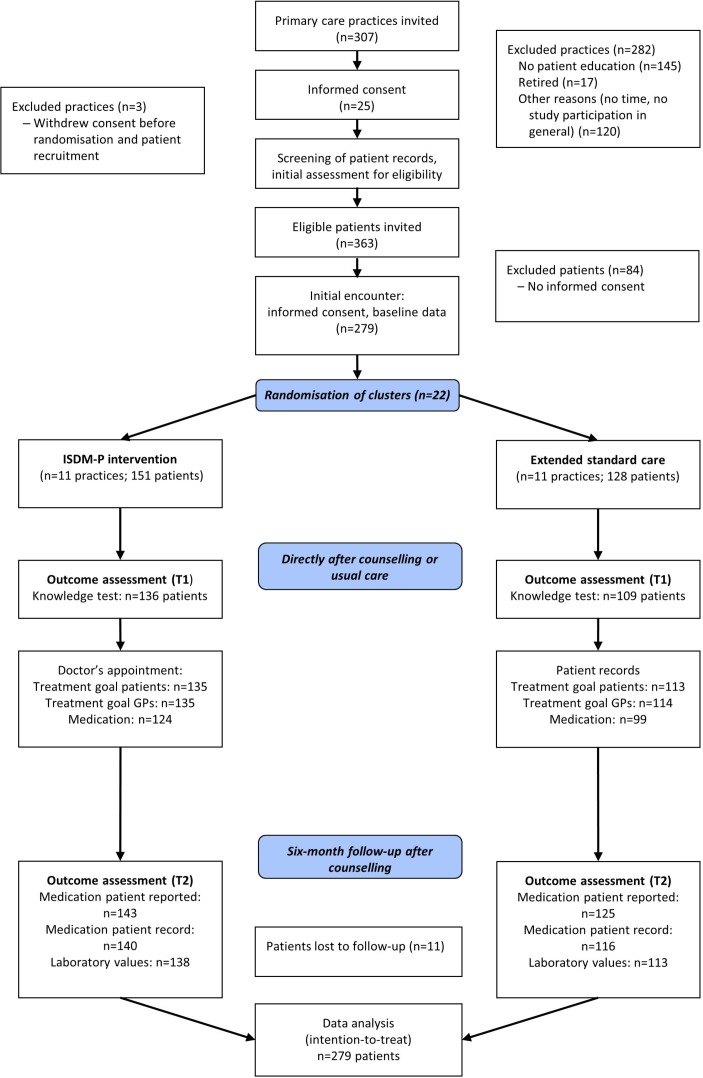
22 general practices providing care according to the German Disease Management Programme (DMP) for type 2 diabetes.
279 of 363 eligible patients without myocardial infarction or stroke.
The ISDM-P comprises a patient decision aid, a corresponding group teaching session provided by medical assistants and a structured patient-physician encounter.Control group received standard DMP care.
Primary endpoint was patient adherence to antihypertensive or statin drug therapy by comparing prescriptions and patient-reported uptake after 6 months. Secondary endpoints included informed choice, risk knowledge (score 0-11 from 11 questions) and prioritised treatment goals of patients and doctors.
ISDM-P: 11 practices with 151 patients; standard care: 11 practices with 128 patients; attrition rate: 3.9%. There was no difference between groups regarding the primary endpoint. Mean drug adherence rates were high for both groups (80% for antihypertensive and 91% for statin treatment). More ISDM-P patients made informed choices regarding statin intake, 34% vs 3%, OR 16.6 (95% CI 4.4 to 63.0), blood pressure control, 39% vs 3%, OR 22.2 (95% CI 5.3 to 93.3) and glycated haemoglobin, 43% vs 3%, OR 26.0 (95% CI 6.5 to 104.8). ISDM-P patients achieved higher levels of risk knowledge, with a mean score of 6.96 vs 2.86, difference 4.06 (95% CI 2.96 to 5.17). In the ISDM-P group, agreement on prioritised treatment goals between patients and doctors was higher, with 88.5% vs 57%.
The ISDM-P was successfully implemented in general practices. Adherence to medication was very high making improvements hardly detectable.
ISRCTN77300204; Results.
将一个针对2型糖尿病患者的共同决策项目(ISDM-P)从专业糖尿病中心推广至基层医疗环境。
患者盲法、双臂多中心、整群随机对照试验,随访6个月;在患者招募并获取基线数据后对医疗机构进行隐匿随机分组。
22家按照德国2型糖尿病疾病管理项目(DMP)提供医疗服务的普通医疗机构。
363名符合条件且无心肌梗死或中风的患者中的279名。
ISDM-P包括一份患者决策辅助工具、由医疗助理提供的相应小组教学课程以及结构化的医患交流。对照组接受标准DMP护理。
主要终点是通过比较6个月后的处方和患者报告的用药情况来评估患者对抗高血压或他汀类药物治疗的依从性。次要终点包括知情选择、风险知识(11个问题的得分0-11分)以及患者和医生对治疗目标的优先级排序。
ISDM-P组:11家医疗机构的151名患者;标准护理组:11家医疗机构的128名患者;损耗率:3.9%。两组在主要终点方面无差异。两组的平均药物依从率都很高(抗高血压药物为80%,他汀类治疗为91%)。更多ISDM-P组的患者在他汀类药物服用、血压控制和糖化血红蛋白方面做出了知情选择,分别为34%对3%,比值比16.6(95%置信区间4.4至63.0);39%对3%,比值比22.2(95%置信区间5.3至93.3);43%对3%,比值比26.0(95%置信区间6.5至104.8)。ISDM-P组患者的风险知识水平更高,平均得分为6.96分对2.86分,差值4.06(95%置信区间2.96至5.17)。在ISDM-P组中,患者和医生在治疗目标优先级上的一致性更高,为88.5%对57%。
ISDM-P在普通医疗机构中成功实施。药物依从性非常高,几乎难以检测到改善情况。
ISRCTN77300204;结果