Liao Enhui, Lu Wenfang, Yan Xiao-Hai, Jiang Yuwu, Kidwell Autumn
State Key Laboratory of Marine Environmental Science, College of Ocean and Earth Sciences, Xiamen University, Xiamen 361005, China.
Center for Remote Sensing, College of Earth, Ocean and Environment, University of Delaware, Newark, DE 19716, USA.
Sci Rep. 2015 Nov 16;5:16630. doi: 10.1038/srep16630.
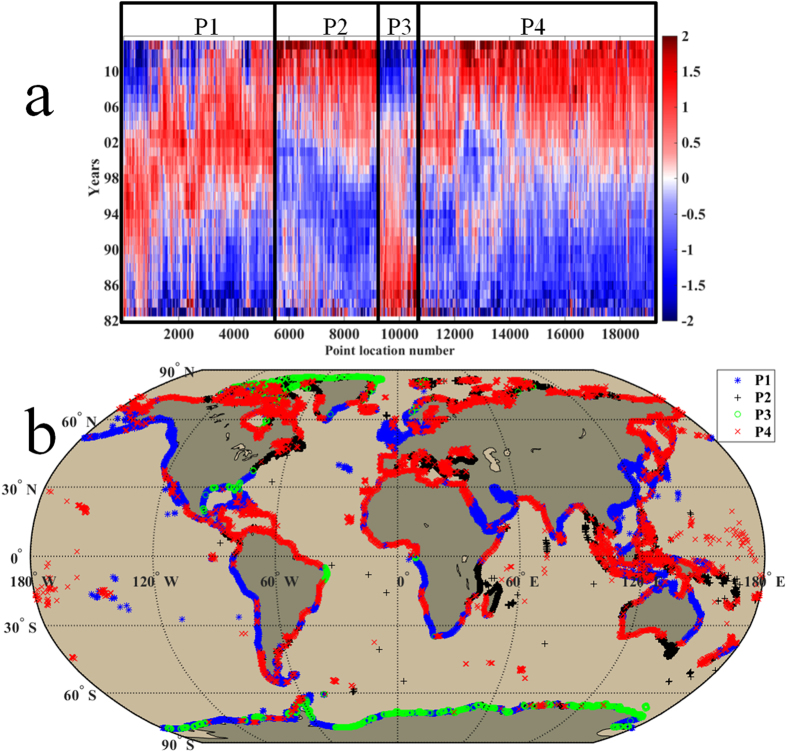
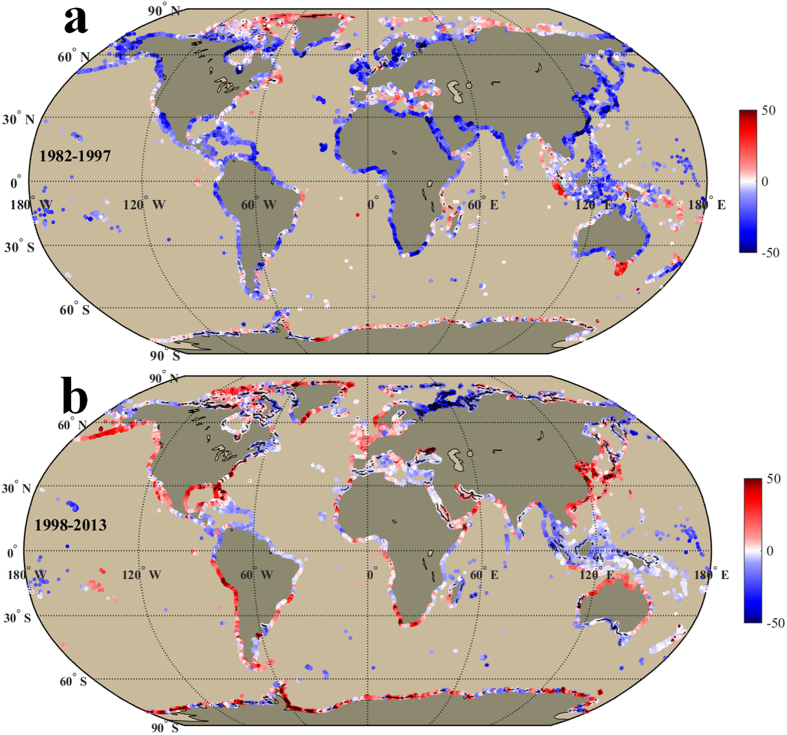
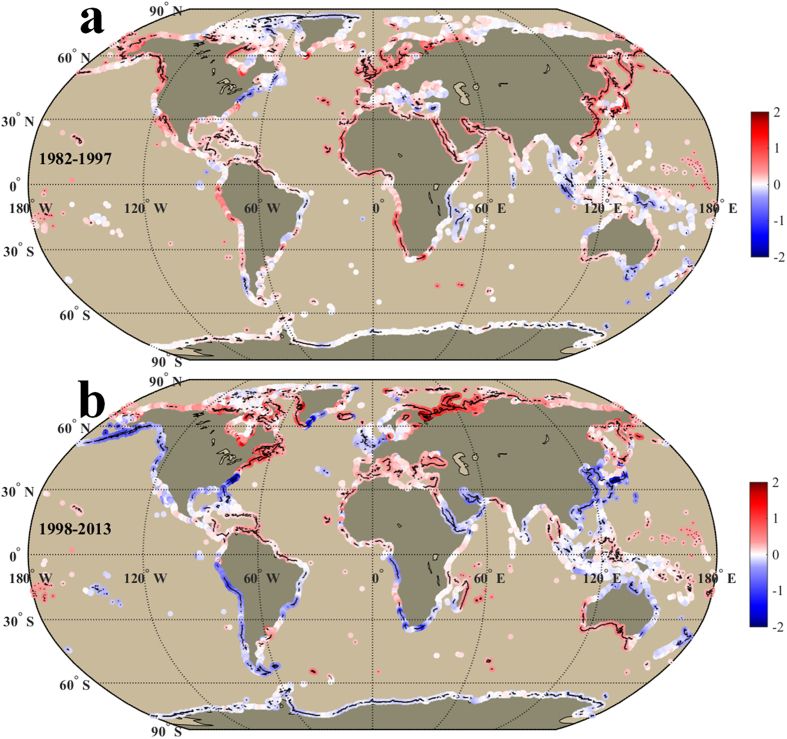
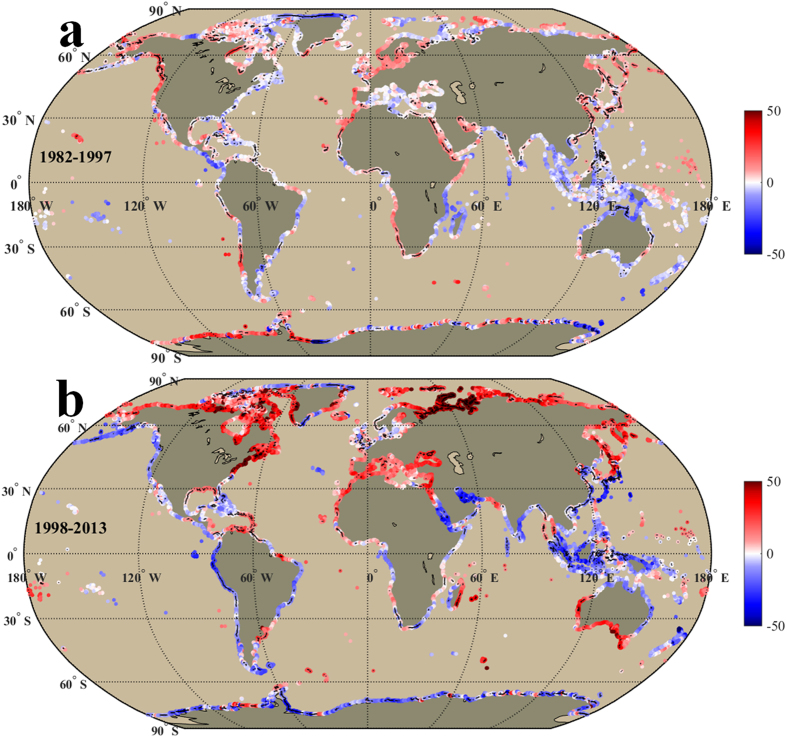
Coastlines are fundamental to humans for habitation, commerce, and natural resources. Many coastal ecosystem disasters, caused by extreme sea surface temperature (SST), were reported when the global climate shifted from global warming to global surface warming hiatus after 1998. The task of understanding the coastal SST variations within the global context is an urgent matter. Our study on the global coastal SST from 1982 to 2013 revealed a significant cooling trend in the low and mid latitudes (31.4% of the global coastlines) after 1998, while 17.9% of the global coastlines changed from a cooling trend to a warming trend concurrently. The trend reversals in the Northern Pacific and Atlantic coincided with the phase shift of Pacific Decadal Oscillation and North Atlantic Oscillation, respectively. These coastal SST changes are larger than the changes of the global mean and open ocean, resulting in a fast increase of extremely hot/cold days, and thus extremely hot/cold events. Meanwhile, a continuous increase of SST was detected for a considerable portion of coastlines (46.7%) with a strengthened warming along the coastlines in the high northern latitudes. This suggests the warming still continued and strengthened in some regions after 1998, but with a weaker pattern in the low and mid latitudes.
海岸线对人类的居住、商业和自然资源至关重要。1998年后全球气候从全球变暖转变为全球表面变暖停滞期时,有许多由极端海表面温度(SST)引发的沿海生态系统灾难被报道。在全球背景下了解沿海海表面温度变化的任务迫在眉睫。我们对1982年至2013年全球沿海海表面温度的研究表明,1998年后低纬度和中纬度地区(占全球海岸线的31.4%)出现了显著的降温趋势,而全球17.9%的海岸线同时从降温趋势转变为升温趋势。北太平洋和大西洋的趋势逆转分别与太平洋年代际振荡和北大西洋振荡的相位转变相吻合。这些沿海海表面温度变化大于全球平均和开阔海洋的变化,导致极热/极冷天数迅速增加,进而引发极热/极冷事件。与此同时,相当一部分海岸线(46.7%)的海表面温度持续上升,北半球高纬度地区沿海变暖加剧。这表明1998年后一些地区的变暖仍在持续且加剧,但在低纬度和中纬度地区模式较弱。