Chen Junlang, Chen Liang, Wang Yu, Wang Xiaogang, Zeng Songwei
School of Sciences, Zhejiang A &F University, Lin'an 311300, China.
Zhejiang Provincial Key Laboratory of Chemical Utilization of Forestry Biomass, Zhejiang A &F University, Lin'an 311300, China.
Sci Rep. 2015 Nov 25;5:17235. doi: 10.1038/srep17235.
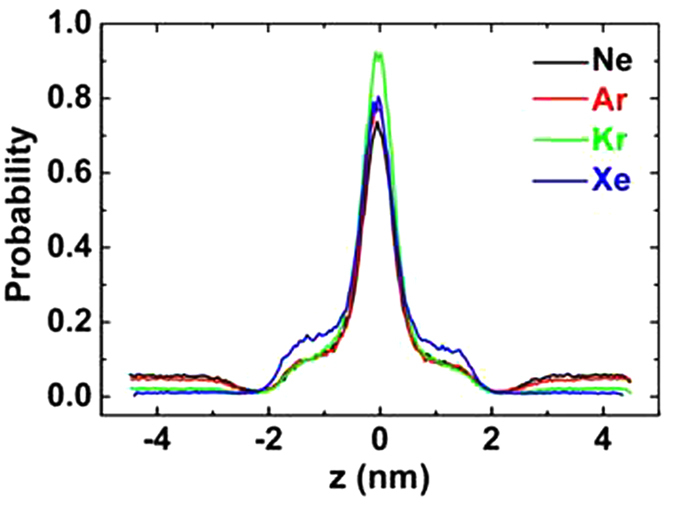
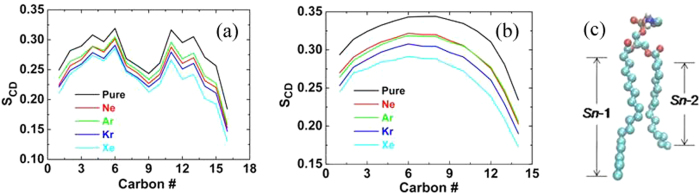
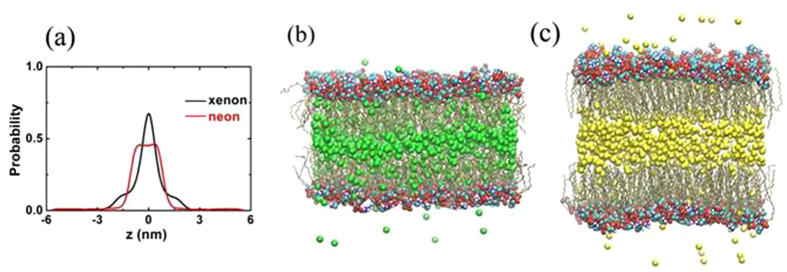
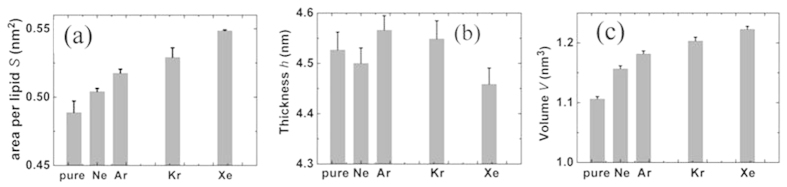
Noble gases seem to have no significant effect on the anesthetic targets due to their simple, spherical shape. However, xenon has strong narcotic efficacy and can be used clinically, while other noble gases cannot. The mechanism remains unclear. Here, we performed molecular dynamics simulations on phospholipid bilayers with four kinds of noble gases to elucidate the difference of their effects on the membrane. Our results showed that the sequence of effects on membrane exerted by noble gases from weak to strong was Ne, Ar, Kr and Xe, the same order as their relative narcotic potencies as well as their lipid/water partition percentages. Compared with the other three kinds of noble gases, more xenon molecules were distributed between the lipid tails and headgroups, resulting in membrane's lateral expansion and lipid tail disorder. It may contribute to xenon's strong anesthetic potency. The results are well consistent with the membrane mediated mechanism of general anesthesia.
由于稀有气体形状简单呈球形,它们似乎对麻醉靶点没有显著影响。然而,氙具有很强的麻醉效力且可用于临床,而其他稀有气体则不行。其机制仍不清楚。在此,我们对含有四种稀有气体的磷脂双层进行了分子动力学模拟,以阐明它们对膜的影响差异。我们的结果表明,稀有气体对膜产生影响的强度顺序从弱到强依次为氖、氩、氪和氙,这与它们的相对麻醉效能以及脂/水分配百分比顺序相同。与其他三种稀有气体相比,更多的氙分子分布在脂质尾部和头部基团之间,导致膜的横向扩张和脂质尾部无序。这可能有助于氙的强效麻醉作用。这些结果与全身麻醉的膜介导机制高度一致。