Rubin G J, Finn Y, Potts H W W, Michie S
King's College London, Department of Psychological Medicine, Weston Education Centre, Cutcombe Road, London SE5 9RJ, UK.
King's College London, Department of Psychological Medicine, Weston Education Centre, Cutcombe Road, London SE5 9RJ, UK.
Public Health. 2015 Dec;129(12):1553-62. doi: 10.1016/j.puhe.2015.09.004. Epub 2015 Oct 23.
Members of the public are often sceptical about warnings of an impending public health crisis. Breaking through this scepticism is important if we are to convince people to take urgent protective action. In this paper we explored correlates of perceiving that 'too much fuss' was being made about the 2009/10 influenza A H1N1v ('swine flu') pandemic.
A secondary analysis of data from 39 nationally representative telephone surveys conducted in the UK during the pandemic.
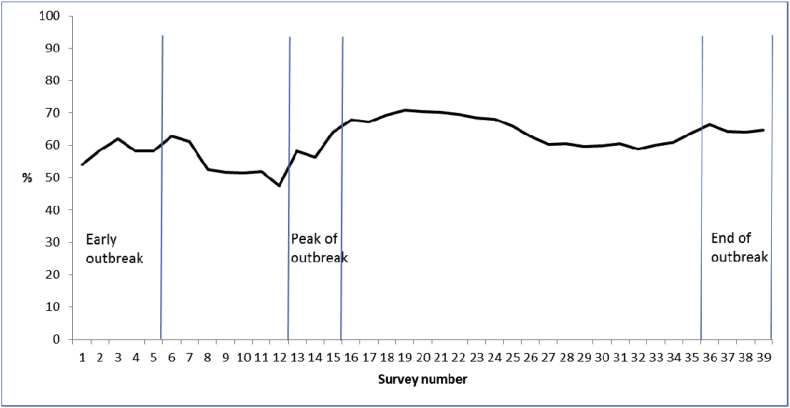
Each cross-sectional survey (combined n = 42,420) collected data over a three day period and asked participants to state whether they agreed or disagreed that 'too much fuss is being made about the risk of swine flu.'
Overall, 55.1% of people agreed or strongly agreed with this sentiment. Perceiving that too much fuss was being made was associated with: being male, being white, being generally healthy, trusting most in a primary care physician to provide advice, not knowing someone who had contracted the illness, believing you know a lot about the outbreak, not wishing to receive additional information about the outbreak and possessing worse factual knowledge about the outbreak than other people.
In future disease outbreaks merely providing factual information is unlikely to engage people who are sceptical about the need to take action. Instead, messages which challenge their perceived knowledge and which present case studies of people who have been affected may prove more effective, especially when delivered through trusted channels.
公众常常对即将发生的公共卫生危机的警告持怀疑态度。如果我们要说服人们采取紧急防护行动,突破这种怀疑至关重要。在本文中,我们探究了认为对2009/10甲型H1N1v流感(“猪流感”)大流行“大惊小怪”的相关因素。
对大流行期间在英国进行的39项具有全国代表性的电话调查数据进行二次分析。
每次横断面调查(样本总量n = 42,420)在三天时间内收集数据,并询问参与者是否同意“对猪流感风险大惊小怪”这一说法。
总体而言,55.1%的人同意或强烈同意这种观点。认为被“大惊小怪”与以下因素相关:男性、白人、总体健康、最信任初级保健医生提供建议、不认识感染该疾病的人、认为自己对疫情了解很多、不希望收到有关疫情的更多信息以及对疫情的事实性了解比其他人差。
在未来的疾病爆发中,仅仅提供事实信息不太可能让那些对采取行动的必要性持怀疑态度的人参与进来。相反,挑战他们认知并展示受影响人群案例的信息可能会更有效,尤其是通过可靠渠道传递时。