Hogue Ian B, Bosse Jens B, Engel Esteban A, Scherer Julian, Hu Jiun-Ruey, Del Rio Tony, Enquist Lynn W
Department of Molecular Biology & Princeton Neuroscience Institute, Princeton University, Princeton, NJ 08544, USA.
Viruses. 2015 Nov 19;7(11):5933-61. doi: 10.3390/v7112915.
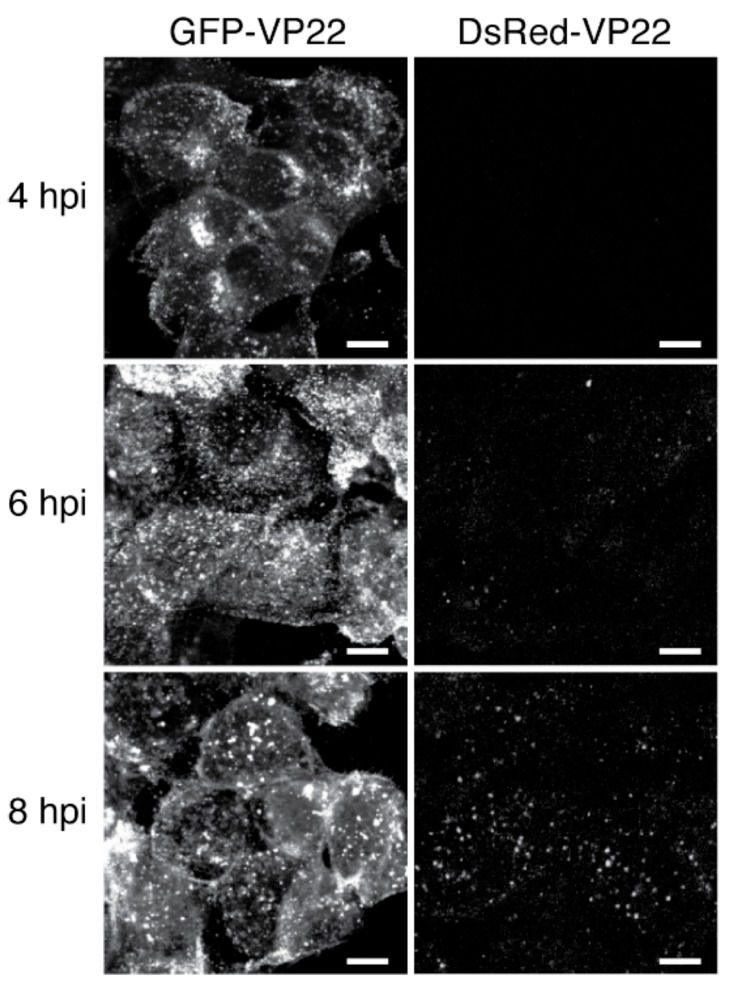
In the nearly two decades since the popularization of green fluorescent protein (GFP), fluorescent protein-based methodologies have revolutionized molecular and cell biology, allowing us to literally see biological processes as never before. Naturally, this revolution has extended to virology in general, and to the study of alpha herpesviruses in particular. In this review, we provide a compendium of reported fluorescent protein fusions to herpes simplex virus 1 (HSV-1) and pseudorabies virus (PRV) structural proteins, discuss the underappreciated challenges of fluorescent protein-based approaches in the context of a replicating virus, and describe general strategies and best practices for creating new fluorescent fusions. We compare fluorescent protein methods to alternative approaches, and review two instructive examples of the caveats associated with fluorescent protein fusions, including describing several improved fluorescent capsid fusions in PRV. Finally, we present our future perspectives on the types of powerful experiments these tools now offer.
自绿色荧光蛋白(GFP)普及以来的近二十年里,基于荧光蛋白的方法彻底改变了分子和细胞生物学,使我们能够以前所未有的方式直观地观察生物过程。自然而然地,这场革命已扩展到整个病毒学领域,尤其是α疱疹病毒的研究。在本综述中,我们汇总了已报道的与单纯疱疹病毒1型(HSV-1)和伪狂犬病病毒(PRV)结构蛋白的荧光蛋白融合体,讨论了在复制病毒背景下基于荧光蛋白的方法中未得到充分认识的挑战,并描述了创建新的荧光融合体的一般策略和最佳实践。我们将荧光蛋白方法与其他方法进行比较,并回顾了与荧光蛋白融合相关的注意事项的两个指导性实例,包括描述PRV中几种改进的荧光衣壳融合体。最后,我们对这些工具目前所能提供的强大实验类型给出了未来展望。