German Center for Neurodegenerative Diseases (DZNE), Sigmund-Freud-Straße 25, Gebäude 13, BMZ1, 53127, Bonn, Germany.
Department of Neurology, University of Bonn, Sigmund-Freud-Straße 25, 53105, Bonn, Germany.
Acta Neuropathol Commun. 2015 Nov 26;3:75. doi: 10.1186/s40478-015-0254-7.
Parkinson's disease (PD) and multiple system atrophy (MSA) are neurodegenerative diseases that are characterized by the intracellular accumulation of alpha-synuclein containing aggregates. Recent increasing evidence suggests that Parkinson's disease and MSA pathology spread throughout the nervous system in a spatiotemporal fashion, possibly by prion-like propagation of alpha-synuclein positive aggregates between synaptically connected areas. Concurrently, intracerebral injection of pathological alpha-synuclein into transgenic mice overexpressing human wild-type alpha-synuclein, or human alpha-synuclein with the familial A53T mutation, or into wild-type mice causes spreading of alpha-synuclein pathology in the CNS. Considering that wild-type mice naturally also express a threonine at codon 53 of alpha-synuclein, it has remained unclear whether human wild-type alpha-synuclein alone, in the absence of endogenously expressed mouse alpha-synuclein, would support a similar propagation of alpha-synuclein pathology in vivo.
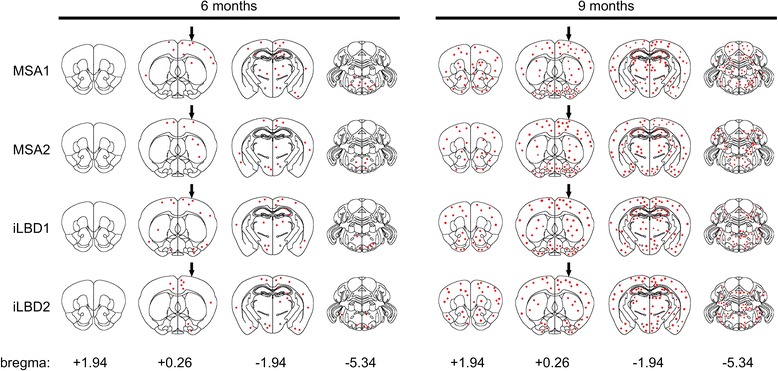
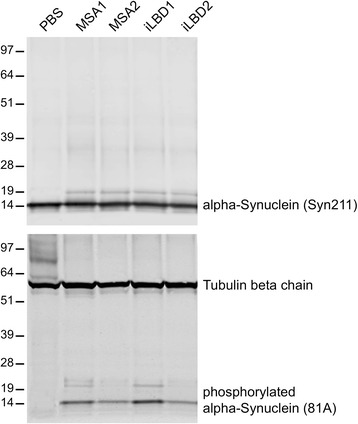
Here we show that brain extracts from two patients with MSA and two patients with probable incidental Lewy body disease (iLBD) but not phosphate-buffered saline induce prion-like spreading of pathological alpha-synuclein after intrastriatal injection into mice expressing human wild-type alpha-synuclein. Mice were sacrificed at 3, 6, and 9 months post injection and analyzed neuropathologically and biochemically. Mice injected with brain extracts from patients with MSA or probable iLBD both accumulated intraneuronal inclusion bodies, which stained positive for phosphorylated alpha-synuclein and appeared predominantly within the injected brain hemisphere after 6 months. After 9 months these intraneuronal inclusion bodies had spread to the contralateral hemisphere and more rostral and caudal areas. Biochemical analysis showed that brains of mice injected with brain extracts from patients with MSA and probable iLBD contained hyperphosphorylated alpha-synuclein that also seeded aggregation of recombinant human wild-type alpha-synuclein in a Thioflavin T binding assay.
Our results indicate that human wild-type alpha-synuclein supports the prion-like spreading of alpha-synuclein pathology in the absence of endogenously expressed mouse alpha-synuclein in vivo.
帕金森病(PD)和多系统萎缩(MSA)是神经退行性疾病,其特征是含有α-突触核蛋白的聚集物在细胞内积累。最近越来越多的证据表明,帕金森病和 MSA 病理学通过α-突触核蛋白阳性聚集物在突触连接区域之间以类朊病毒样的方式在时空上传播。同时,将病理性α-突触核蛋白颅内注射到过表达人野生型α-突触核蛋白的转基因小鼠中,或人α-突触核蛋白的家族性 A53T 突变,或野生型小鼠中,会导致中枢神经系统中α-突触核蛋白病理学的传播。考虑到野生型小鼠天然也在α-突触核蛋白的第 53 位密码子处表达苏氨酸,因此仍不清楚是否仅在没有内源性表达的小鼠α-突触核蛋白的情况下,人野生型α-突触核蛋白是否会支持体内类似的α-突触核蛋白病理学的传播。
在这里,我们显示来自 2 名 MSA 患者和 2 名可能的偶然路易体病(iLBD)患者的脑提取物在向表达人野生型α-突触核蛋白的小鼠纹状体内注射后诱导病理性α-突触核蛋白的类朊病毒样传播。在注射后 3、6 和 9 个月时处死小鼠,并进行神经病理学和生物化学分析。用 MSA 或可能的 iLBD 患者脑提取物注射的小鼠均积累了神经元内包涵体,这些包涵体对磷酸化α-突触核蛋白呈阳性反应,并且在 6 个月后主要出现在注射脑半球内。9 个月后,这些神经元内包涵体已扩散到对侧半球以及更远的额极和尾极区域。生化分析表明,用 MSA 和可能的 iLBD 患者脑提取物注射的小鼠脑中含有高度磷酸化的α-突触核蛋白,该蛋白还在 Thioflavin T 结合测定中引发重组人野生型α-突触核蛋白的聚集。
我们的结果表明,在体内没有内源性表达的小鼠α-突触核蛋白的情况下,人野生型α-突触核蛋白支持α-突触核蛋白病理学的类朊病毒样传播。