McNally Janet, Hugh-Jones Siobhan, Caton Samantha, Vereijken Carel, Weenen Hugo, Hetherington Marion
Institute of Psychological Sciences, University of Leeds, Leeds, UK.
School of Health and Related Research (ScHARR), University of Sheffield, Sheffield, UK.
Matern Child Nutr. 2016 Apr;12(2):205-28. doi: 10.1111/mcn.12230. Epub 2015 Dec 1.
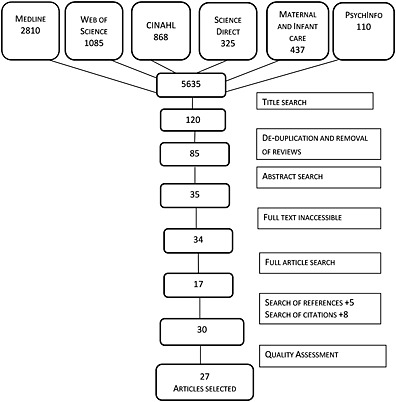
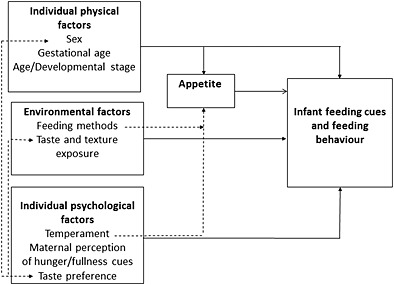
Responsive feeding has been identified as important in preventing overconsumption by infants. However, this is predicated on an assumption that parents recognise and respond to infant feeding cues. Despite this, relatively little is understood about how infants engage parental feeding responses. Therefore, the aim of this systematic review was to identify what is known about infant communication of hunger and satiation and what issues impact on the expression and perception of these states. A search of Medline, CINAHL, Web of Science, PsycINFO, Science Direct and Maternal and Infant care produced 27 papers. Eligibility criteria included peer reviewed qualitative and/or quantitative publications on feeding behaviours, hunger, and satiation/satiety cues of typically developing children in the first 2 years of life. Papers published between 1966 and 2013 were included in the review. The review revealed that feeding cues and behaviours are shaped by numerous issues, such as infants' physical attributes, individual psychological factors and environmental factors. Meanwhile, infant characteristics, external cues and mothers' own characteristics affect how feeding cues are perceived. The existing literature provides insights into many aspects of hunger and satiation in infancy; however, there are significant gaps in our knowledge. There is a lack of validated tools for measuring hunger and satiation, a need to understand how different infant characteristics impact on feeding behaviour and a need to extricate the respective contributions of infant and maternal characteristics to perceptions of hunger and satiation. Further research is also recommended to differentiate between feeding driven by liking and that driven by hunger.
响应式喂养已被认为对防止婴儿过度进食很重要。然而,这是基于父母能够识别并回应婴儿喂养信号的假设。尽管如此,对于婴儿如何促使父母做出喂养反应,我们了解得相对较少。因此,本系统综述的目的是确定关于婴儿饥饿和饱腹感交流的已知信息,以及哪些问题会影响这些状态的表达和感知。对Medline、CINAHL、科学网、心理学文摘数据库、科学Direct和母婴护理数据库进行检索后,共得到27篇论文。纳入标准包括经同行评审的关于0至2岁正常发育儿童喂养行为、饥饿和饱腹感信号的定性和/或定量出版物。发表于1966年至2013年间的论文被纳入本综述。该综述表明,喂养信号和行为受到诸多因素的影响,如婴儿的身体特征、个体心理因素和环境因素。同时,婴儿特征、外部信号和母亲自身特征会影响对喂养信号的感知。现有文献对婴儿期饥饿和饱腹感的多个方面提供了见解;然而,我们的知识仍存在重大空白。缺乏用于测量饥饿和饱腹感的有效工具,需要了解不同的婴儿特征如何影响喂养行为,以及需要厘清婴儿和母亲特征对饥饿和饱腹感感知的各自贡献。还建议进一步开展研究,以区分由喜好驱动的喂养和由饥饿驱动的喂养。