Xu Haigen, Cao Mingchang, Wu Jun, Cai Lei, Ding Hui, Lei Juncheng, Wu Yi, Cui Peng, Chen Lian, Le Zhifang, Cao Yun
Nanjing Institute of Environmental Sciences, Ministry of Environmental Protection, Nanjing 210042, China.
Department of Natural Ecology Conservation, Ministry of Environmental Protection, Beijing 100035, China.
PLoS One. 2015 Dec 2;10(12):e0143996. doi: 10.1371/journal.pone.0143996. eCollection 2015.
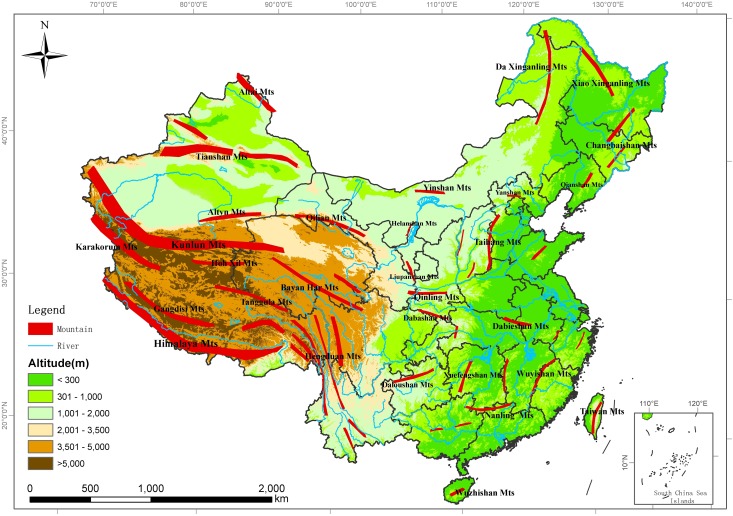
Understanding the spatial patterns in species richness is a central issue in macroecology and biogeography. Analyses that have traditionally focused on overall species richness limit the generality and depth of inference. Spatial patterns of species richness and the mechanisms that underpin them in China remain poorly documented. We created a database of the distribution of 580 mammal species and 849 resident bird species from 2376 counties in China and established spatial linear models to identify the determinants of species richness and test the roles of five hypotheses for overall mammals and resident birds and the 11 habitat groups among the two taxa. Our result showed that elevation variability was the most important determinant of species richness of overall mammal and bird species. It is indicated that the most prominent predictors of species richness varied among different habitat groups: elevation variability for forest and shrub mammals and birds, temperature annual range for grassland and desert mammals and wetland birds, net primary productivity for farmland mammals, maximum temperature of the warmest month for cave mammals, and precipitation of the driest quarter for grassland and desert birds. Noteworthily, main land cover type was also found to obviously influence mammal and bird species richness in forests, shrubs and wetlands under the disturbance of intensified human activities. Our findings revealed a substantial divergence in the species richness patterns among different habitat groups and highlighted the group-specific and disparate environmental associations that underpin them. As we demonstrate, a focus on overall species richness alone might lead to incomplete or misguided understanding of spatial patterns. Conservation priorities that consider a broad spectrum of habitat groups will be more successful in safeguarding the multiple services of biodiversity.
了解物种丰富度的空间格局是宏观生态学和生物地理学的核心问题。传统上侧重于总体物种丰富度的分析限制了推断的普遍性和深度。中国物种丰富度的空间格局及其背后的机制仍缺乏充分的记录。我们创建了一个包含中国2376个县580种哺乳动物和849种留鸟分布的数据库,并建立了空间线性模型,以确定物种丰富度的决定因素,并检验关于总体哺乳动物和留鸟以及这两个类群中11个栖息地组的五个假设的作用。我们的结果表明,海拔变异性是总体哺乳动物和鸟类物种丰富度的最重要决定因素。结果表明,物种丰富度最显著的预测因子在不同栖息地组之间存在差异:森林和灌木哺乳动物及鸟类为海拔变异性,草原和荒漠哺乳动物及湿地鸟类为年温度范围,农田哺乳动物为净初级生产力,洞穴哺乳动物为最暖月最高温度,草原和荒漠鸟类为最干燥季度降水量。值得注意的是,在人类活动加剧的干扰下,主要土地覆盖类型也被发现对森林、灌木和湿地中的哺乳动物和鸟类物种丰富度有明显影响。我们的研究结果揭示了不同栖息地组之间物种丰富度模式的显著差异,并突出了支撑这些差异的特定组和不同的环境关联。正如我们所证明的,仅关注总体物种丰富度可能会导致对空间格局的理解不完整或产生误导。考虑广泛栖息地组的保护优先事项在保护生物多样性的多种服务方面将更成功。