Xia Wenqing, Rao Hengyi, Spaeth Andrea M, Huang Rong, Tian Sai, Cai Rongrong, Sun Jie, Wang Shaohua
From the Department of Endocrinology, Affiliated Zhongda Hospital of Southeast University, No. 87 Dingjiaqiao Road, Nanjing (WX, RH, ST, RC, JS, SW); Medical School of Southeast University, No.87 Dingjiaqiao Road, Nanjing, China (WX, SW); Center for functional Neuroimaging, University of Pennsylvania, 3710 Hamilton Walk, Philadelphia, PA (WX, HR); and Center for Sleep and Circadian Neurobiology, Perelman School of Medicine, University of Pennsylvania, 3710 Hamilton Walk, Philadelphia, PA (AMS).
Medicine (Baltimore). 2015 Dec;94(48):e2231. doi: 10.1097/MD.0000000000002231.
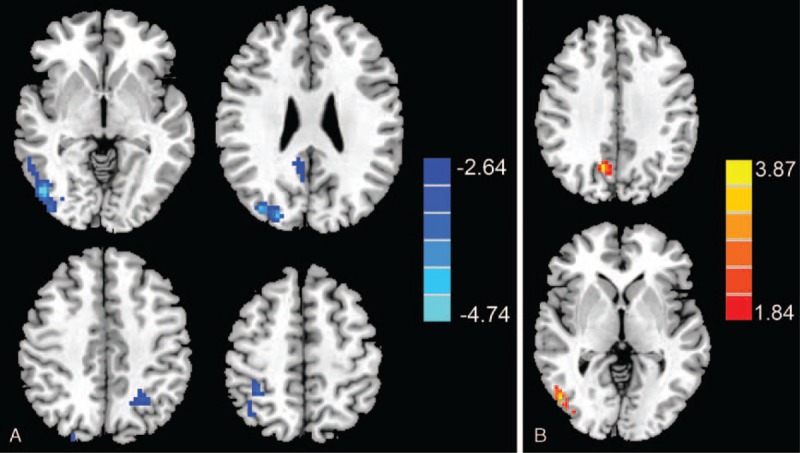
Type 2 diabetes mellitus (T2DM) and hypertension are both associated with cognitive impairment and brain function abnormalities. We investigated whether abnormal cerebral blood flow (CBF) patterns exists in T2DM patients and possible relationships between aberrant CBF and cognitive performance. Furthermore, we examined the influence of hypertension on CBF alterations in T2DM patients. T2DM patients (n = 38) and non-T2DM subjects (n = 40) were recruited from clinics, hospitals, and normal community health screenings. Cerebral blood flow images were collected and analyzed using arterial spin labeling perfusion functional magnetic resonance imaging (fMRI). Regions with major CBF differences between T2DM patients and non-T2DM controls were detected via 1-way ANOVA. The interaction effects between hypertension and T2DM for CBF alterations were also examined. Correlation analyses illustrated the association between CBF values and cognitive performance and between CBF and blood pressure. Compared with non-T2DM controls, T2DM patients exhibited decreased CBF, primarily in the visual area and the default mode network (DMN); decreased CBF in these regions was correlated with cognitive performance. There was a significant interaction effect between hypertension and diabetes for CBF in the precuneus and the middle occipital gyrus. Additionally, blood pressure correlated negatively with CBF in T2DM patients.T2DM patients exhibited reduced CBF in the visual area and DMN. Hypertension may facilitate a CBF decrease in the setting of diabetes. T2DM patients may benefit from blood pressure control to maintain their brain perfusion through CBF preservation.
2型糖尿病(T2DM)和高血压均与认知障碍及脑功能异常相关。我们研究了T2DM患者是否存在异常脑血流(CBF)模式,以及异常CBF与认知表现之间的可能关系。此外,我们还研究了高血压对T2DM患者CBF改变的影响。从诊所、医院和正常社区健康筛查中招募了T2DM患者(n = 38)和非T2DM受试者(n = 40)。使用动脉自旋标记灌注功能磁共振成像(fMRI)收集并分析脑血流图像。通过单因素方差分析检测T2DM患者和非T2DM对照之间存在主要CBF差异的区域。还研究了高血压与T2DM对CBF改变的交互作用。相关性分析阐明了CBF值与认知表现之间以及CBF与血压之间的关联。与非T2DM对照相比,T2DM患者的CBF降低,主要在视觉区域和默认模式网络(DMN);这些区域CBF降低与认知表现相关。在楔前叶和枕中回,高血压与糖尿病对CBF存在显著交互作用。此外,T2DM患者的血压与CBF呈负相关。T2DM患者在视觉区域和DMN的CBF降低。高血压可能会促使糖尿病患者的CBF降低。T2DM患者可能受益于血压控制,通过保留CBF来维持脑灌注。