Nouvellet Pierre, Garske Tini, Mills Harriet L, Nedjati-Gilani Gemma, Hinsley Wes, Blake Isobel M, Van Kerkhove Maria D, Cori Anne, Dorigatti Ilaria, Jombart Thibaut, Riley Steven, Fraser Christophe, Donnelly Christl A, Ferguson Neil M
MRC Centre for Outbreak Analysis and Modelling, Department of Infectious Disease Epidemiology, Faculty of Medicine, Imperial College London, Norfolk Place, London W2 1PG, UK.
Center for Global Health, Institut Pasteur, 25 rue du Docteur Roux, 75724 Paris Cedex 15, France.
Nature. 2015 Dec 3;528(7580):S109-16. doi: 10.1038/nature16041.
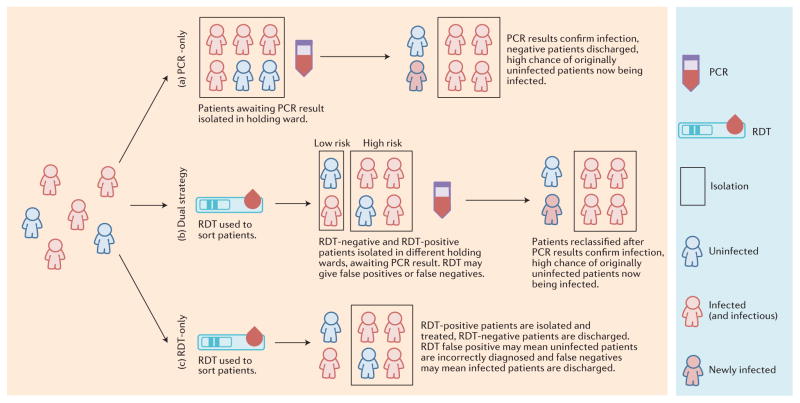
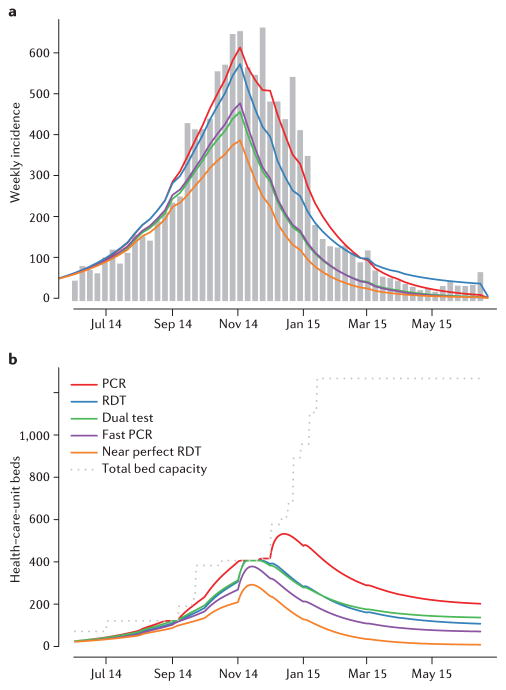
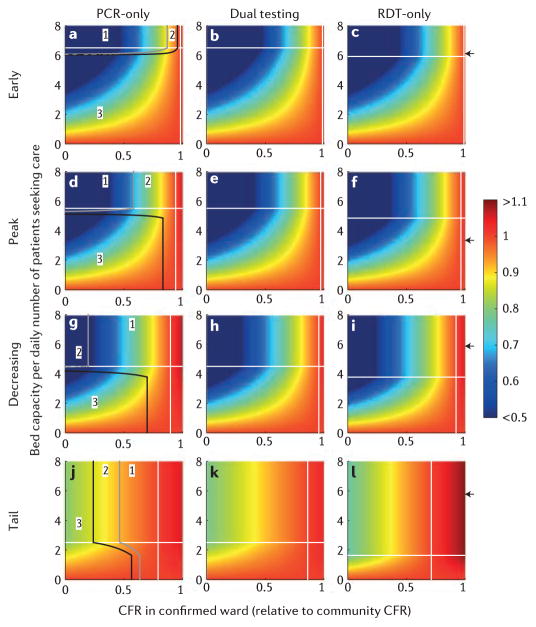
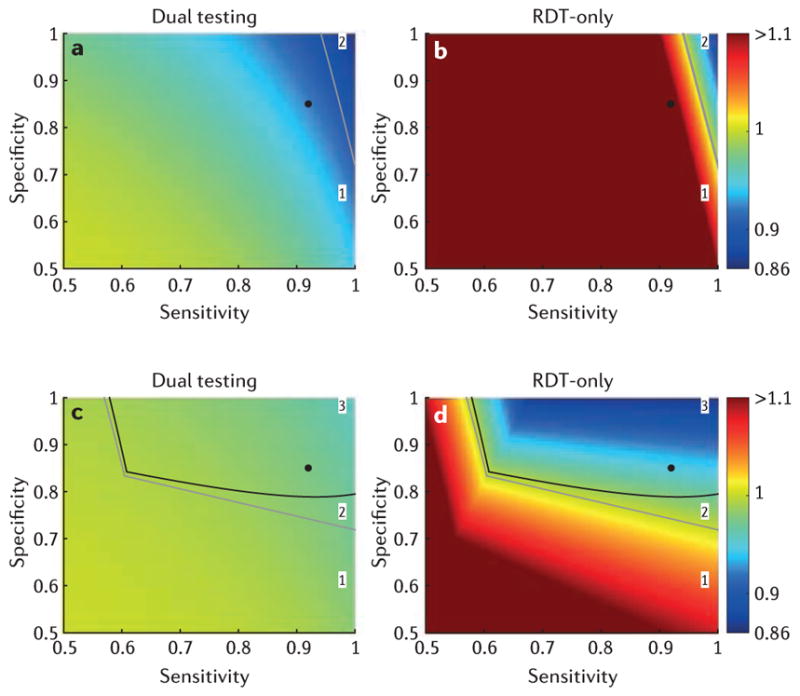
Ebola emerged in West Africa around December 2013 and swept through Guinea, Sierra Leone and Liberia, giving rise to 27,748 confirmed, probable and suspected cases reported by 29 July 2015. Case diagnoses during the epidemic have relied on polymerase chain reaction-based tests. Owing to limited laboratory capacity and local transport infrastructure, the delays from sample collection to test results being available have often been 2 days or more. Point-of-care rapid diagnostic tests offer the potential to substantially reduce these delays. We review Ebola rapid diagnostic tests approved by the World Health Organization and those currently in development. Such rapid diagnostic tests could allow early triaging of patients, thereby reducing the potential for nosocomial transmission. In addition, despite the lower test accuracy, rapid diagnostic test-based diagnosis may be beneficial in some contexts because of the reduced time spent by uninfected individuals in health-care settings where they may be at increased risk of infection; this also frees up hospital beds. We use mathematical modelling to explore the potential benefits of diagnostic testing strategies involving rapid diagnostic tests alone and in combination with polymerase chain reaction testing. Our analysis indicates that the use of rapid diagnostic tests with sensitivity and specificity comparable with those currently under development always enhances control, whether evaluated at a health-care-unit or population level. If such tests had been available throughout the recent epidemic, we estimate, for Sierra Leone, that their use in combination with confirmatory polymerase chain-reaction testing might have reduced the scale of the epidemic by over a third.
埃博拉病毒于2013年12月左右在西非出现,并席卷了几内亚、塞拉利昂和利比里亚,截至2015年7月29日,共报告了27748例确诊、可能和疑似病例。疫情期间的病例诊断依赖于基于聚合酶链反应的检测。由于实验室能力有限和当地交通基础设施薄弱,从样本采集到获得检测结果的延迟通常长达两天或更长时间。即时快速诊断检测有可能大幅减少这些延迟。我们回顾了世界卫生组织批准的埃博拉快速诊断检测以及目前正在研发的检测。此类快速诊断检测可实现对患者的早期分流,从而降低医院内传播的可能性。此外,尽管检测准确性较低,但基于快速诊断检测的诊断在某些情况下可能是有益的,因为未感染个体在医疗环境中停留的时间减少了,而在这些环境中他们感染风险可能会增加;这也能腾出医院床位。我们使用数学模型来探索仅涉及快速诊断检测以及与聚合酶链反应检测相结合的诊断检测策略的潜在益处。我们的分析表明,使用灵敏度和特异性与目前正在研发的检测相当的快速诊断检测总能加强防控,无论是在医疗单位层面还是人群层面进行评估。我们估计,如果在最近的疫情期间一直有此类检测可用,那么在塞拉利昂,将其与聚合酶链反应确证检测结合使用可能会使疫情规模缩小三分之一以上。