Rezvani Katayoun, Rouce Rayne H
Department of Stem Cell Transplantation, Division of Cancer Medicine, The University of Texas MD Anderson Cancer Center , Houston, TX , USA.
Department of Pediatrics, Texas Children's Cancer and Hematology Centers, Baylor College of Medicine , Houston, TX , USA ; Center for Cell and Gene Therapy, Baylor College of Medicine Houston Methodist Hospital and Texas Children's Hospital , Houston, TX , USA.
Front Immunol. 2015 Nov 17;6:578. doi: 10.3389/fimmu.2015.00578. eCollection 2015.
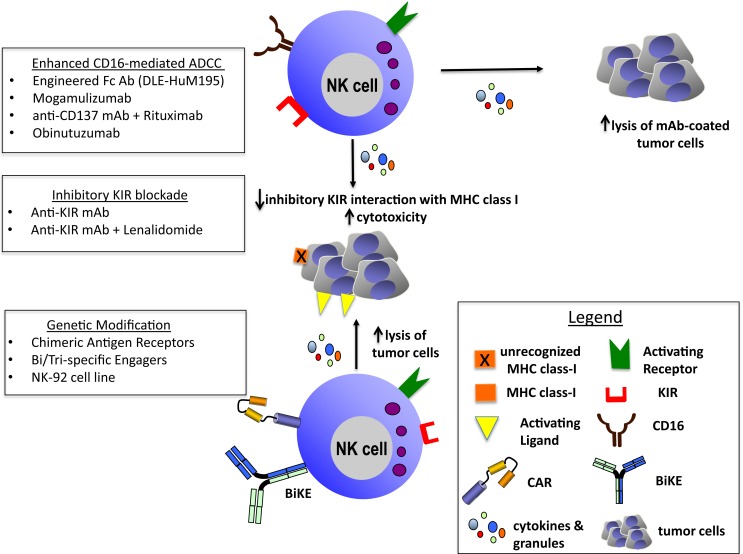
Natural killer (NK) cells are essential components of the innate immune system and play a critical role in host immunity against cancer. Recent progress in our understanding of NK cell immunobiology has paved the way for novel NK cell-based therapeutic strategies for the treatment of cancer. In this review, we will focus on recent advances in the field of NK cell immunotherapy, including augmentation of antibody-dependent cellular cytotoxicity, manipulation of receptor-mediated activation, and adoptive immunotherapy with ex vivo-expanded, chimeric antigen receptor (CAR)-engineered, or engager-modified NK cells. In contrast to T lymphocytes, donor NK cells do not attack non-hematopoietic tissues, suggesting that an NK-mediated antitumor effect can be achieved in the absence of graft-vs.-host disease. Despite reports of clinical efficacy, a number of factors limit the application of NK cell immunotherapy for the treatment of cancer, such as the failure of infused NK cells to expand and persist in vivo. Therefore, efforts to enhance the therapeutic benefit of NK cell-based immunotherapy by developing strategies to manipulate the NK cell product, host factors, and tumor targets are the subject of intense research. In the preclinical setting, genetic engineering of NK cells to express CARs to redirect their antitumor specificity has shown significant promise. Given the short lifespan and potent cytolytic function of mature NK cells, they are attractive candidate effector cells to express CARs for adoptive immunotherapies. Another innovative approach to redirect NK cytotoxicity towards tumor cells is to create either bispecific or trispecific antibodies, thus augmenting cytotoxicity against tumor-associated antigens. These are exciting times for the study of NK cells; with recent advances in the field of NK cell biology and translational research, it is likely that NK cell immunotherapy will move to the forefront of cancer immunotherapy over the next few years.
自然杀伤(NK)细胞是先天免疫系统的重要组成部分,在宿主抗癌症免疫中发挥关键作用。我们对NK细胞免疫生物学认识的最新进展为基于NK细胞的新型癌症治疗策略铺平了道路。在本综述中,我们将聚焦于NK细胞免疫治疗领域的最新进展,包括增强抗体依赖性细胞毒性、调控受体介导的激活,以及采用体外扩增、嵌合抗原受体(CAR)工程化或衔接子修饰的NK细胞进行过继性免疫治疗。与T淋巴细胞不同,供体NK细胞不会攻击非造血组织,这表明在无移植物抗宿主病的情况下可实现NK介导的抗肿瘤效应。尽管有临床疗效的报道,但一些因素限制了NK细胞免疫治疗在癌症治疗中的应用,例如输注的NK细胞在体内无法扩增和持续存在。因此,通过制定策略来操控NK细胞产物、宿主因素和肿瘤靶点,以提高基于NK细胞的免疫治疗的治疗效益,是当前深入研究的课题。在临床前研究中,对NK细胞进行基因工程改造以表达CAR来重新定向其抗肿瘤特异性已显示出巨大潜力。鉴于成熟NK细胞寿命短且具有强大的细胞溶解功能,它们是用于过继性免疫治疗表达CAR的有吸引力的候选效应细胞。另一种将NK细胞细胞毒性重新导向肿瘤细胞的创新方法是制备双特异性或三特异性抗体,从而增强对肿瘤相关抗原的细胞毒性。对于NK细胞研究而言,这是激动人心的时代;随着NK细胞生物学和转化研究领域的最新进展,NK细胞免疫治疗在未来几年很可能会走向癌症免疫治疗的前沿。