So Suzanne Ho-wai, Tang Venus, Leung Patrick Wing-leung
Department of Psychology, The Chinese University of Hong Kong, New Territories, Hong Kong Special Administrative Region, China.
Department of Clinical Psychology, Prince of Wales Hospital, Shatin, Hong Kong Special Administrative Region, China.
PLoS One. 2015 Dec 7;10(12):e0144558. doi: 10.1371/journal.pone.0144558. eCollection 2015.
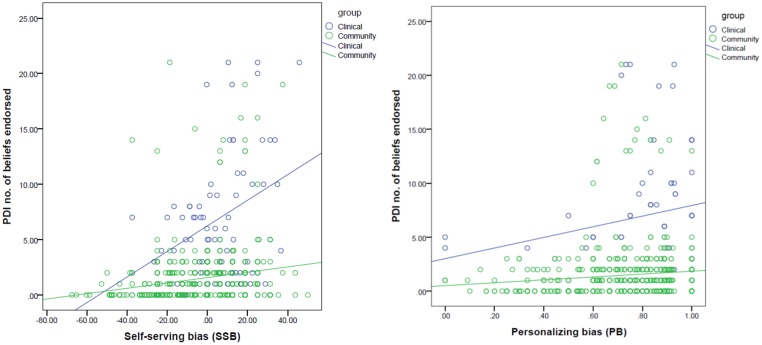
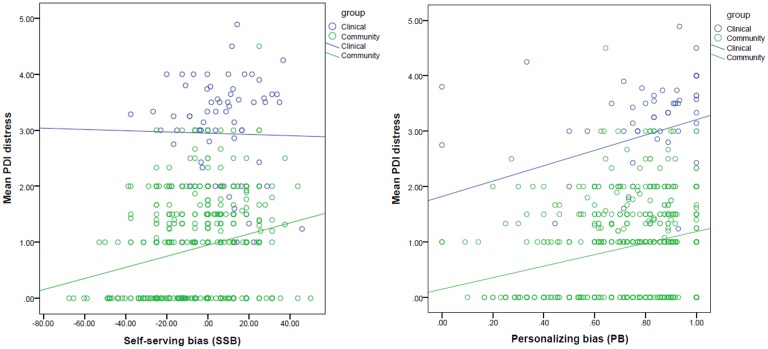
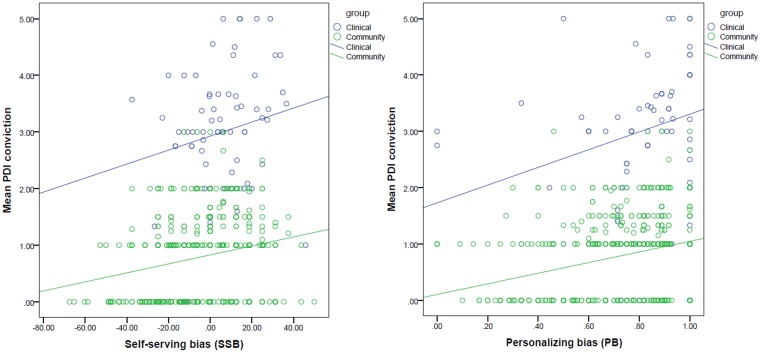
This study compared delusional dimensions and attribution biases along the continuum of psychosis. Participants completed questionnaires on delusion-like beliefs and attributions. Although patients with first-episode psychosis (N = 70) endorsed fewer delusion-like beliefs than non-clinical individuals with psychotic-like experiences (N = 12), they scored highest on delusional conviction, distress and preoccupation, followed by non-clinical individuals with psychotic-like experiences, and then healthy controls (N = 642). Self-serving bias was found in patients and non-clinical individuals with psychotic-like experiences, but not in healthy controls. Personalizing bias for negative events was not significantly different across the three groups. When compared with healthy controls, non-clinical individuals with psychotic-like experiences had an exaggerated self-serving bias, but were not more marked in personalizing bias. Self-serving bias and personalizing bias were both associated with delusional dimensions. However, the association between self-serving bias and number of delusion-like beliefs was stronger among patients than non-clinical participants. Future research could investigate the extent to which self-serving bias, in combination with an appraisal of delusional ideation as convincing, distress, and preoccupying, contributes to the development of clinical delusions.
本研究比较了精神病连续体上的妄想维度和归因偏差。参与者完成了关于类妄想信念和归因的问卷。虽然首发精神病患者(N = 70)认可的类妄想信念比有类精神病体验的非临床个体(N = 12)少,但他们在妄想确信、痛苦和专注方面得分最高,其次是有类精神病体验的非临床个体,然后是健康对照组(N = 642)。在患者和有类精神病体验的非临床个体中发现了自利偏差,但在健康对照组中未发现。三组在对负面事件的个性化偏差方面没有显著差异。与健康对照组相比,有类精神病体验的非临床个体有夸大的自利偏差,但在个性化偏差方面并不更明显。自利偏差和个性化偏差均与妄想维度相关。然而,患者中自利偏差与类妄想信念数量之间的关联比非临床参与者更强。未来的研究可以调查自利偏差与将妄想观念评估为令人信服、痛苦和专注相结合在多大程度上促成临床妄想的发展。