Rutten N B M M, Rijkers G T, Meijssen C B, Crijns C E, Oudshoorn J H, van der Ent C K, Vlieger A M
Department of Pediatrics, St Antonius Hospital, PO Box 2500, 3430 EM, Nieuwegein, The Netherlands.
Department of Sciences, University College Roosevelt Academy, PO Box 94, 4330 AB, Middelburg, The Netherlands.
BMC Pediatr. 2015 Dec 9;15:204. doi: 10.1186/s12887-015-0519-0.
The acquisition and development of infant gut microbiota can be influenced by numerous factors, of which early antibiotic treatment is an important one. However, studies on the effects of antibiotic treatment in early life on clinical outcomes and establishment and development of the gut microbiota of term infants are limited. Disturbed microbiota composition is hypothesized to be an underlying mechanism of an aberrant development of the immune system. This study aims to investigate the potential clinical and microbial consequences of empiric antibiotic use in early life.
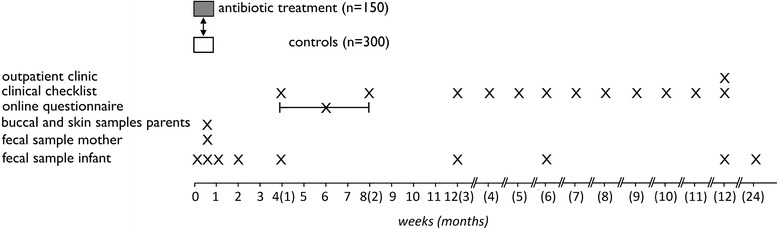
METHODS/DESIGN: 450 term born infants, of whom 150 are exposed to antibiotic treatment in early life and 300 are not (control group), are included in this observational cohort study with a one-year follow-up. Clinical outcomes, including coughing, wheezing, fever >38 °C, runny nose, glue ear, rash, diarrhea and >3 crying hours a day, are recorded daily by parents and examined by previously defined doctor's diagnosis. A blood sample is taken at closure to investigate the infant's vaccination response and sensitization for food and inhalant allergens. Fecal samples are obtained at eight time points during the first year of life. Potential differences in microbial profiles of infants treated with antibiotics versus healthy controls will be determined by use of 16S-23S rRNA gene analysis (IS-pro). Microbiota composition will be described by means of abundance, diversity and (dis)similarity. Diversity is calculated using the Shannon index. Dissimilarities between samples are calculated as the cosine distance between each pair of samples and analyzed with principal coordinate analysis. Clinical variables and possible associations are assessed by appropriate statistics.
Both clinical quantitative and qualitative microbial effects of antibiotic treatment in early life may be demonstrated. These findings can be important, since there is evidence that manipulation of the infant microbiota by using pre- or probiotics can restore the ecological balance of the microbiota and may mitigate potential negative effects on the developing immune system, when use of antibiotics cannot be avoided.
ClinicalTrials.gov NCT02536560. Registered 28 August 2015.
婴儿肠道微生物群的获得与发育会受到多种因素影响,其中早期抗生素治疗是重要因素之一。然而,关于生命早期抗生素治疗对足月儿临床结局及肠道微生物群建立与发育影响的研究有限。微生物群组成紊乱被认为是免疫系统异常发育的潜在机制。本研究旨在调查生命早期经验性使用抗生素的潜在临床和微生物学后果。
方法/设计:本观察性队列研究纳入450名足月儿,其中150名在生命早期接受抗生素治疗,300名未接受治疗(对照组),随访一年。家长每天记录咳嗽、喘息、体温>38°C、流鼻涕、中耳炎、皮疹、腹泻及每日哭闹>3小时等临床结局,并由预先定义的医生诊断进行检查。在随访结束时采集血样,以调查婴儿的疫苗接种反应及对食物和吸入性过敏原的致敏情况。在生命的第一年中,于八个时间点采集粪便样本。使用16S - 23S rRNA基因分析(IS - pro)确定接受抗生素治疗的婴儿与健康对照在微生物谱方面的潜在差异。将通过丰度、多样性和(不)相似性来描述微生物群组成。使用香农指数计算多样性。样本间的差异计算为每对样本之间的余弦距离,并通过主坐标分析进行分析。通过适当的统计学方法评估临床变量及可能的关联。
可能会证明生命早期抗生素治疗在临床和微生物学方面的定量和定性影响。这些发现可能很重要,因为有证据表明,在无法避免使用抗生素时,使用益生元或益生菌来调节婴儿微生物群可恢复微生物群的生态平衡,并可能减轻对发育中免疫系统的潜在负面影响。
ClinicalTrials.gov NCT02536560。于2015年8月28日注册。