Van Daele Emmy, Kamphorst Kim, Vlieger Arine M, Hermes Gerben, Milani Christian, Ventura Marco, Belzer Clara, Smidt Hauke, van Elburg Ruurd M, Knol Jan
Laboratory of Microbiology, Wageningen University & Research, Wageningen, The Netherlands.
Pediatrics, Amsterdam Gastroenterology, Metabolism & Nutrition, Amsterdam Reproduction & Development, Amsterdam UMC Locatie AMC, Amsterdam, The Netherlands.
Arch Dis Child Fetal Neonatal Ed. 2022 May 9;107(6):603-10. doi: 10.1136/archdischild-2021-322861.
Infants are frequently exposed to antibiotics (AB) in the first week of life for suspected bacterial infections. Little is known about the effect of AB on the developing intestinal microbiota. Therefore, we studied intestinal microbiota development with and without AB exposure in the first week of life in term born infants.
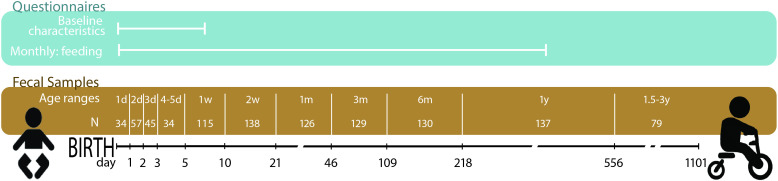
We analysed the faecal microbiota from birth until 2.5 years of age by 16S rRNA gene amplicon sequencing in a cohort with 56 term born infants, exposed to AB in the first week of life (AB+) (AB for 2-3 days (AB2, n=20), AB for 7 days (AB7, n=36)), compared with 126 healthy controls (AB-). The effects of AB and duration were examined in relation to delivery and feeding mode.
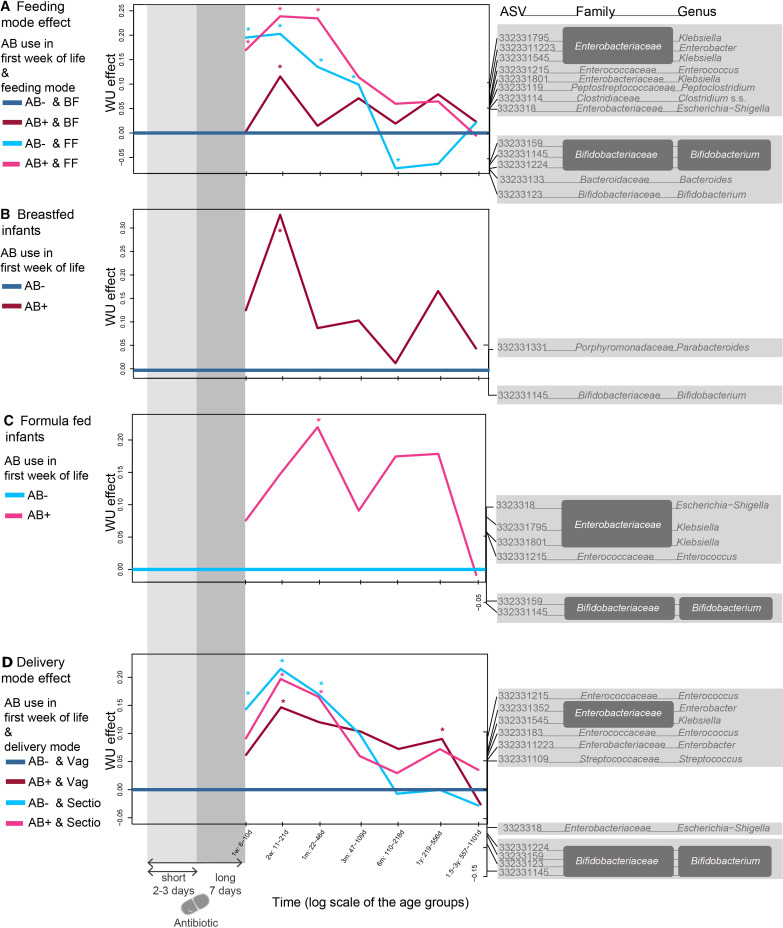
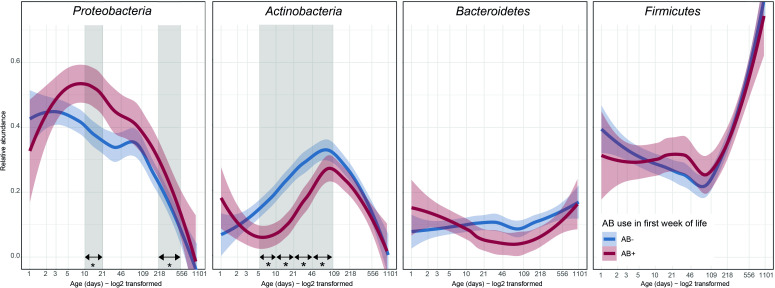
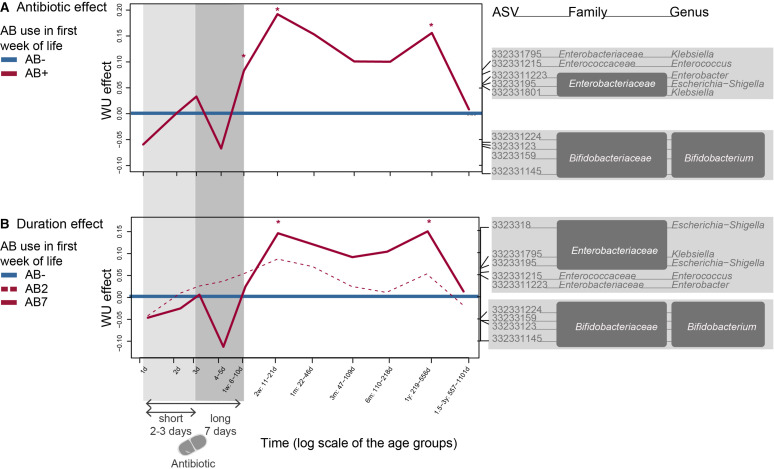
AB+ was associated with significantly increased relative abundance of at 3 weeks and 1 year and a decrease of , from 1 week until 3 months of age only in vaginally delivered, but not in C-section born infants. Similar deviations were noted in AB7, but not in AB2. After AB, breastfed infants had lower relative abundance of potentially pathogenic compared with formula fed infants and recovered 2 weeks faster towards controls.
AB exposure in the first week of life alters faecal microbiota development with deviations in the relative abundance of individual taxa until 1 year of age. These alterations can have long-term health consequences, which emphasises the need for future studies aiming at restoring intestinal microbiota after AB administration.
因怀疑有细菌感染,婴儿在出生后第一周经常接触抗生素。关于抗生素对发育中的肠道微生物群的影响知之甚少。因此,我们研究了足月儿出生后第一周接触和未接触抗生素情况下的肠道微生物群发育情况。
我们通过16S rRNA基因扩增子测序分析了56名足月儿队列从出生到2.5岁的粪便微生物群,这些足月儿在出生后第一周接触抗生素(AB+)(使用抗生素2 - 3天(AB2,n = 20),使用抗生素7天(AB7,n = 36)),并与126名健康对照(AB-)进行比较。研究了抗生素及其使用时长对分娩方式和喂养方式的影响。
仅在阴道分娩的婴儿中,AB+与3周和1岁时特定菌群相对丰度显著增加以及从1周到3个月特定菌群相对丰度降低有关,剖宫产出生的婴儿未出现这种情况。AB7组也有类似偏差,但AB2组没有。使用抗生素后,与配方奶喂养的婴儿相比,母乳喂养的婴儿潜在致病菌的相对丰度较低,且恢复至对照水平的速度快2周。
出生后第一周接触抗生素会改变粪便微生物群的发育,直到1岁时个别分类群的相对丰度仍存在偏差。这些改变可能会产生长期健康后果,这突出了未来旨在恢复抗生素使用后肠道微生物群的研究的必要性。