Bortz Martin, Kano Megumi, Ramroth Heribert, Barcellos Christovam, Weaver Scott R, Rothenberg Richard, Magalhães Monica
Institute of Public Health, University of Heidelberg, Heidelberg, Germany.
Centre for Health Development, WHO, Kobe, Japan.
Cad Saude Publica. 2015 Nov;31 Suppl 1(0 1):107-19. doi: 10.1590/0102-311X00081214.
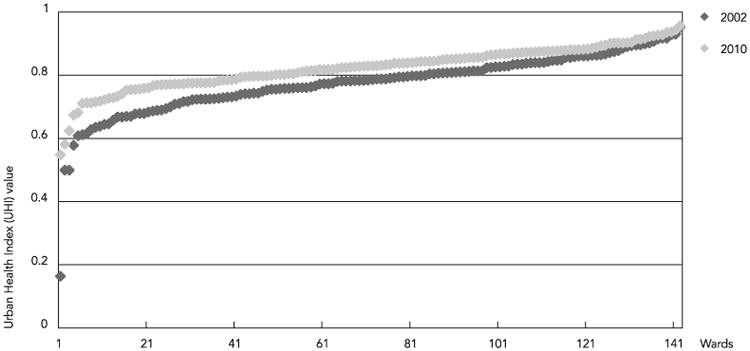
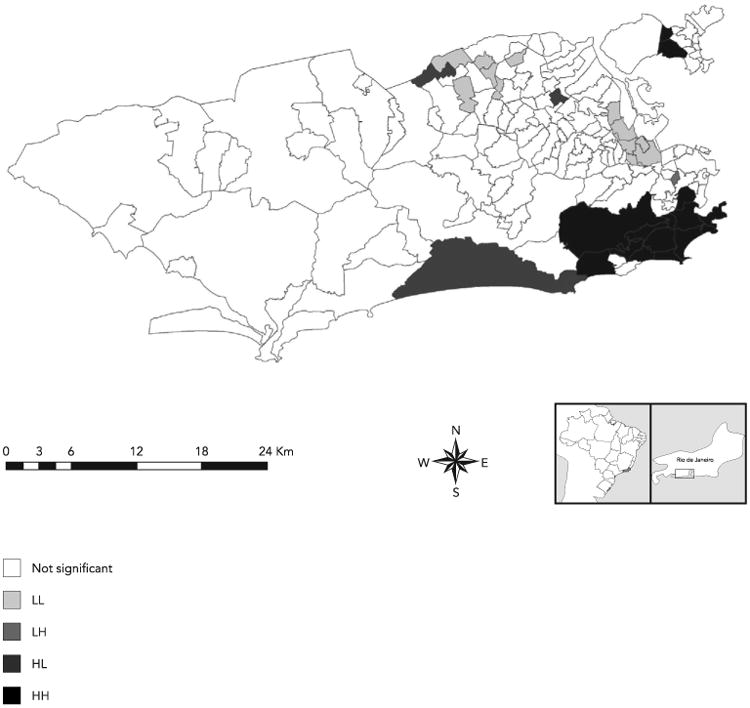
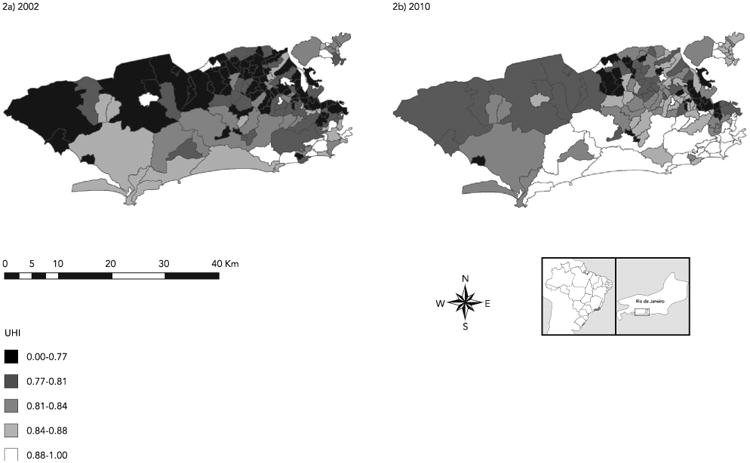
An urban health index (UHI) was used to quantify health inequalities within Rio de Janeiro, Brazil, for the years 2002-2010. Eight main health indicators were generated at the ward level using mortality data. The indicators were combined to form the index. The distribution of the rank ordered UHI-values provides information on inequality among wards, using the ratio of the extremes and the gradient of the middle values. Over the decade the ratio of extremes in 2010 declined relative to 2002 (1.57 vs. 1.32) as did the slope of the middle values (0.23 vs. 0.16). A spatial division between the affluent south and the deprived north and east is still visible. The UHI correlated on an ecological ward-level with socioeconomic and urban environment indicators like square meter price of apartments (0.54, p < 0.01), low education of mother (-0.61, p < 0.01), low income (-0.62, p < 0.01) and proportion of black ethnicity (-0.55, p < 0.01). The results suggest that population health and equity have improved in Rio de Janeiro in the last decade though some familiar patterns of spatial inequality remain.
2002年至2010年期间,巴西里约热内卢使用城市健康指数(UHI)来量化健康不平等状况。利用死亡率数据在病房层面生成了八项主要健康指标。这些指标被综合起来形成该指数。通过极端值之比和中间值梯度,排序后的UHI值分布提供了各病房间不平等的信息。在这十年间,2010年的极端值之比相对于2002年有所下降(1.57对1.32),中间值斜率也是如此(0.23对0.16)。富裕的南部与贫困的北部和东部之间的空间划分仍然明显。UHI在病房生态层面与社会经济和城市环境指标相关,如公寓每平方米价格(0.54,p<0.01)、母亲低教育程度(-0.61,p<0.01)、低收入(-0.62,p<0.01)以及黑人种族比例(-0.55,p<0.01)。结果表明,里约热内卢的人口健康和公平状况在过去十年有所改善,尽管一些常见的空间不平等模式依然存在。