
利用激光显微切割技术和液相色谱-四极杆/飞行时间质谱联用技术对西洋参进行组织特异性代谢物分析和人参皂苷定量分析。
Tissue-specific metabolite profiling and quantitative analysis of ginsenosides in Panax quinquefolium using laser microdissection and liquid chromatography-quadrupole/time of flight-mass spectrometry.
作者信息
Chen Yujie, Xu Liang, Zhao Yuancen, Zhao Zhongzhen, Chen Hubiao, Yi Tao, Qin Minjian, Liang Zhitao
机构信息
School of Chinese Medicine, Hong Kong Baptist University, Kowloon, Hong Kong Special Administrative Region People's Republic of China ; Department of Resources Science of Traditional Chinese Medicines, State Key Laboratory of Modern Chinese Medicines, College of Traditional Chinese Medicines, China Pharmaceutical University, Tongjiaxiang-24, Gulou District, Nanjing, 210009 People's Republic of China.
School of Pharmacy, Liaoning University of Traditional Chinese Medicine, Dalian, China.
出版信息
Chem Cent J. 2015 Dec 9;9:66. doi: 10.1186/s13065-015-0141-0. eCollection 2015.
BACKGROUND
The root of Panax quinquefolium L., famous as American ginseng all over the world, is one of the most widely-used medicinal or edible materials. Ginsenosides are recognized as the main bioactive chemical components responsible for various functions of American ginseng. In this study, tissue-specific chemicals of P. quinquefolium were analyzed by laser microdissection and ultra-high performance liquid chromatography- quadrupole/time-of-flight-mass spectrometry (UHPLC-Q/TOF-MS) to elucidate the distribution pattern of ginsenosides in tissues. The contents of ginsenosides in various tissues were also compared.
RESULTS
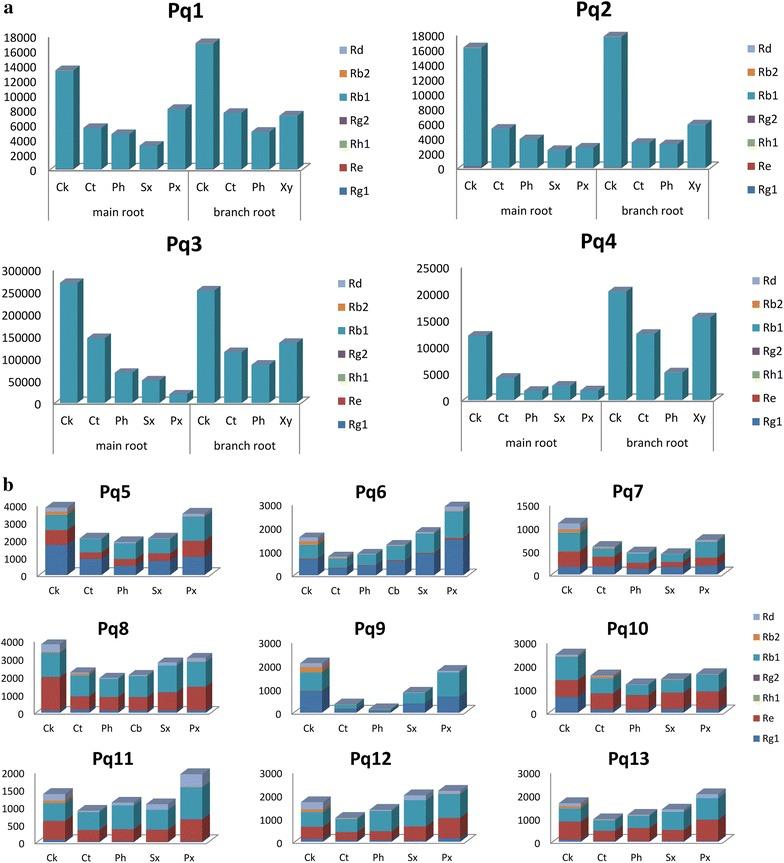
A total of 34 peaks were identified or temporarily identified in the chromatograms of tissue extractions. The cork, primary xylem or cortex contained higher contents of ginsenosides than phloem, secondary xylem and cambium. Thus, it would be reasonable to deduce that the ratio of total areas of cork, primary xylem and the cortex to the area of the whole transection could help to judge the quality of American ginseng by microscopic characteristics.
CONCLUSION
This study sheds new light on the role of microscopic research in quality evaluation, and provides useful information for probing the biochemical pathways of ginsenosides. Graphical abstract.
背景
西洋参的根是世界著名的人参,是应用最为广泛的药用或食用材料之一。人参皂苷被认为是负责西洋参各种功能的主要生物活性化学成分。在本研究中,采用激光显微切割和超高效液相色谱-四极杆/飞行时间质谱联用技术(UHPLC-Q/TOF-MS)分析西洋参的组织特异性化学成分,以阐明人参皂苷在组织中的分布模式。同时还比较了不同组织中人参皂苷的含量。
结果
在组织提取物的色谱图中总共鉴定或初步鉴定出34个峰。栓皮、初生木质部或皮层中的人参皂苷含量高于韧皮部、次生木质部和形成层。因此,可以合理推断,栓皮、初生木质部和皮层的总面积与整个横截面积的比值有助于通过微观特征判断西洋参的质量。
结论
本研究为微观研究在质量评价中的作用提供了新的视角,并为探究人参皂苷的生化途径提供了有用信息。图形摘要。



 Zotero 插件