Stigell Erik, Schantz Peter
Research Unit for Movement, Health and Environment, The Swedish School of Sport and Health Sciences, GIH, Stockholm SE-114 86, Sweden.
Unit for Occupational and Environmental Medicine, Department of Public Health and Clinical Medicine, Umeå University, Umeå SE-901 87, Sweden.
Int J Environ Res Public Health. 2015 Dec 9;12(12):15626-48. doi: 10.3390/ijerph121215008.
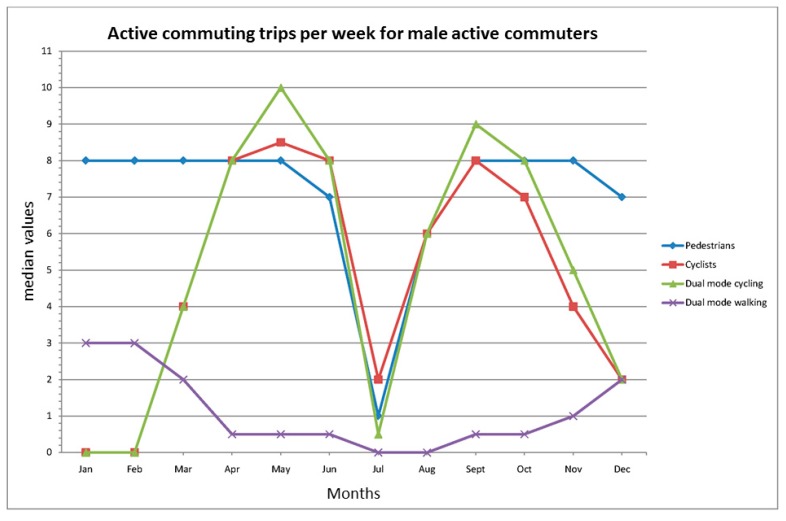
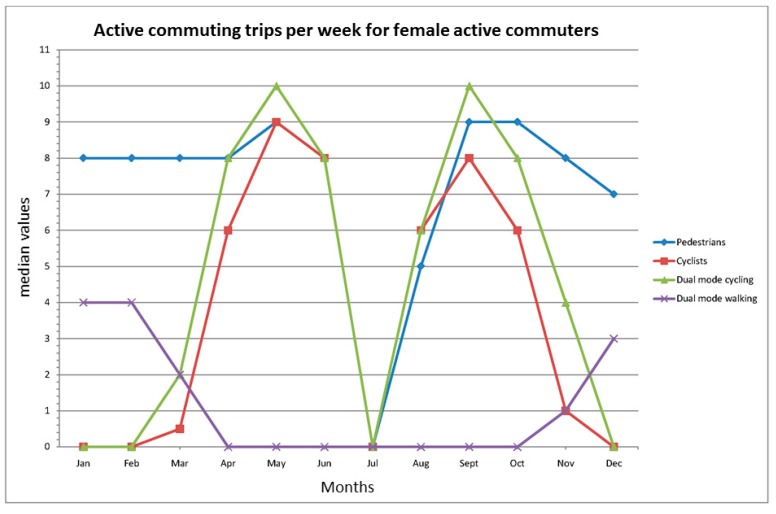
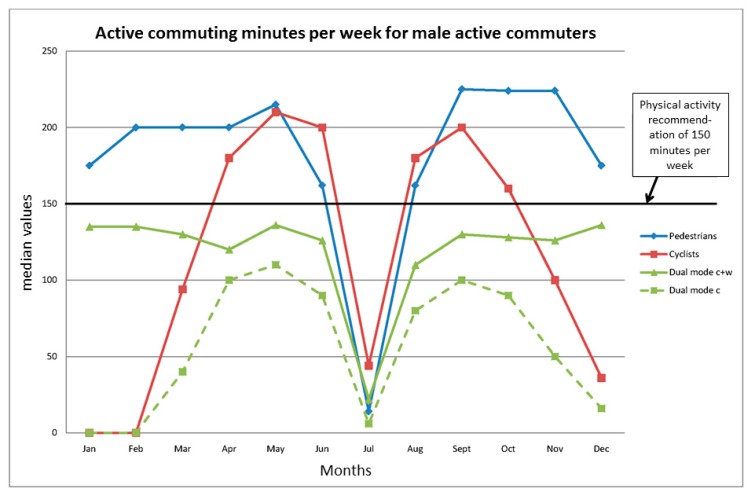
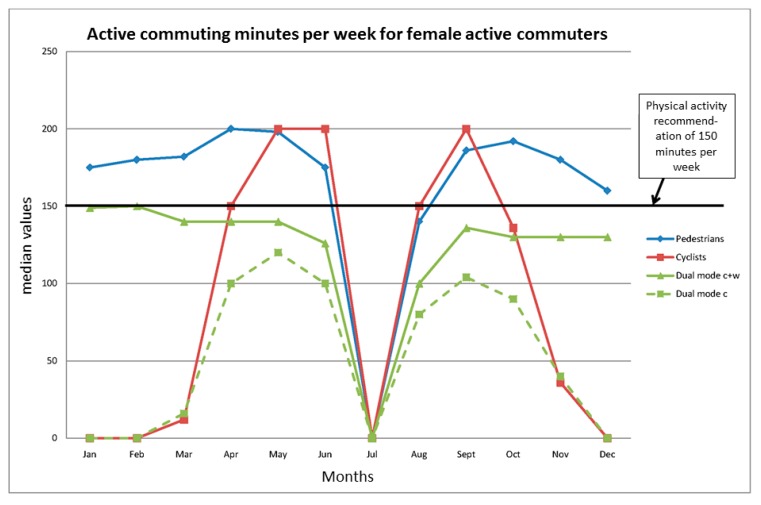
Active commuting between home and place of work or study is often cited as an interesting source of physical activity in a public health perspective. However, knowledge about these behaviors is meager. This was therefore studied in adult active commuters (n = 1872) in Greater Stockholm, Sweden, a Nordic metropolitan setting. They received questionnaires and individually adjusted maps to draw their normal commuting route. Three different modality groups were identified in men and women: single-mode cyclists and pedestrians (those who only cycle or walk, respectively) and dual-mode commuters (those who alternately walk or cycle). Some gender differences were observed in trip distances, frequencies, and velocities. A large majority of the commuting trip durations met the minimum health recommendation of at least 10-minute-long activity bouts. The median single-mode pedestrians and dual-mode commuters met or were close to the recommended weekly physical activity levels of at least 150 minutes most of the year, whereas the single-mode cyclists did so only during spring-mid-fall. A high total number of trips per year (range of medians: 230-390) adds to the value in a health perspective. To fully grasp active commuting behaviors in future studies, both walking and cycling should be assessed over different seasons and ideally over the whole year.
从公共卫生角度来看,往返于家庭与工作或学习场所之间的主动通勤通常被视为一种有趣的身体活动来源。然而,关于这些行为的了解却十分匮乏。因此,在瑞典斯德哥尔摩大区(一个北欧大都市地区)的成年主动通勤者(n = 1872)中开展了此项研究。他们收到了问卷以及用于绘制其日常通勤路线的个性化地图。在男性和女性中识别出了三种不同的出行方式组:单模式骑行者和步行者(分别指仅骑自行车或仅步行的人)以及双模式通勤者(即交替步行或骑行的人)。在出行距离、频率和速度方面观察到了一些性别差异。绝大多数通勤行程时长达到了至少10分钟的活动时长这一最低健康建议标准。大多数年份里,单模式步行者和双模式通勤者的中位数达到或接近每周至少150分钟的推荐身体活动水平,而单模式骑行者仅在春季至秋季中期达到该水平。从健康角度来看,每年较高的出行总次数(中位数范围:230 - 390次)增加了其价值。为了在未来研究中全面掌握主动通勤行为,应在不同季节,理想情况下是全年,对步行和骑行情况都进行评估。