Larsen Flemming H, Engelsen Søren B
Spectroscopy and Chemometrics, Department of Food Science, University of Copenhagen Frederiksberg, Denmark.
Front Microbiol. 2015 Dec 8;6:1374. doi: 10.3389/fmicb.2015.01374. eCollection 2015.
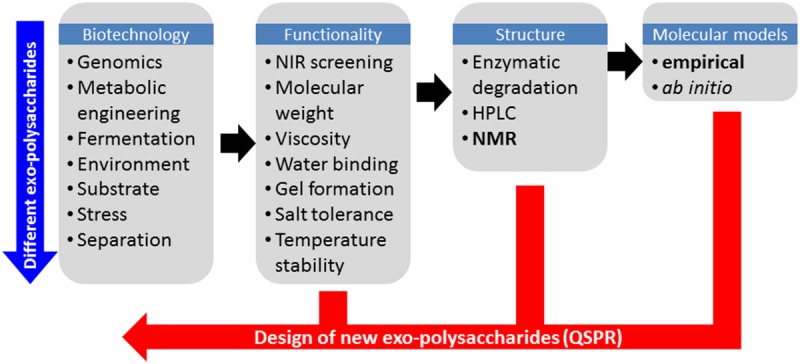
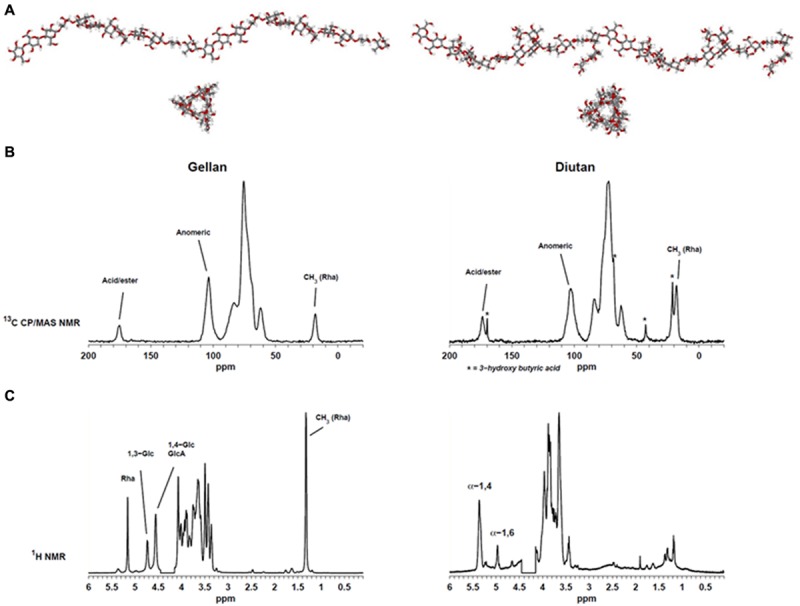
Microbial polysaccharides represent an important class of microbial polymers with diverse functions such as biofilm formation, thickening, and gelling properties as well as health-promoting properties. The broad range of exopolysaccharide (EPS) functionalities has sparked a renewed interest in this class of molecules. Chemical, enzymatic as well as genetic modifications by metabolic engineering can be used to create large numbers of analogous EPS variants with respect to EPS functionality. While this top-down approach is effective in finding new candidates for desired functionality, there seems to be a lack of the corresponding bottom-up approach. The molecular mechanisms of the desired functionalities can be established from Nuclear Magnetic Resonance (NMR) and molecular models and it is proposed that these models can be fed back into the biotechnology by using a quantitative structure-property approach. In this way it will be possible to tailor specific functionality within a given design space. This perspective will include two well-known commercial microbial EPS examples namely gellan and diutan and show how even a limited use of multiphase NMR and molecular modeling can increase the insight into their different properties, which are based on only minor structural differences.
微生物多糖是一类重要的微生物聚合物,具有多种功能,如生物膜形成、增稠和胶凝特性以及促进健康的特性。胞外多糖(EPS)功能的广泛多样性引发了人们对这类分子的新兴趣。通过代谢工程进行化学、酶促以及基因修饰,可用于创造大量具有不同EPS功能的类似物。虽然这种自上而下的方法在寻找具有所需功能的新候选物方面很有效,但似乎缺乏相应的自下而上的方法。所需功能的分子机制可以通过核磁共振(NMR)和分子模型来建立,并且有人提出,可以通过使用定量结构-性质方法将这些模型反馈到生物技术中。通过这种方式,将有可能在给定的设计空间内定制特定功能。这一观点将包括两个著名的商业微生物EPS实例,即结冷胶和迪特胶,并展示即使有限地使用多相NMR和分子建模,如何能够增加对它们不同性质的了解,而这些性质仅基于微小的结构差异。