Thibeau Sherilyn, McFall G Peggy, Wiebe Sandra A, Anstey Kaarin J, Dixon Roger A
Department of Psychology, University of Alberta.
Centre for Research on Ageing, Health and Wellbeing, Australian National University.
Neuropsychology. 2016 Jan;30(1):6-17. doi: 10.1037/neu0000217.
Everyday physical activity (EPA) is an important modifiable contributor to age-related variability in executive functioning (EF). However, its role may be moderated by nonmodifiable genetic factors. We tested independent and interactive effects of brain-derived neurotrophic factor (BDNF rs6265) and insulin degrading enzyme (IDE rs6583817) on EF and EPA-EF relationships.
The sample consisted of genotyped older adults (N = 577; M age = 70.47 years) over 3 waves (∼9 years) of the Victoria Longitudinal Study. Analyses included (a) confirmatory factor analysis establishing a single latent EF factor from 4 standard EF tasks, (b) latent growth modeling over a 40-year band of aging (ages 53 to 95), and (c) structural regression to investigate the independent and interactive effects of BDNF, IDE, and EPA.
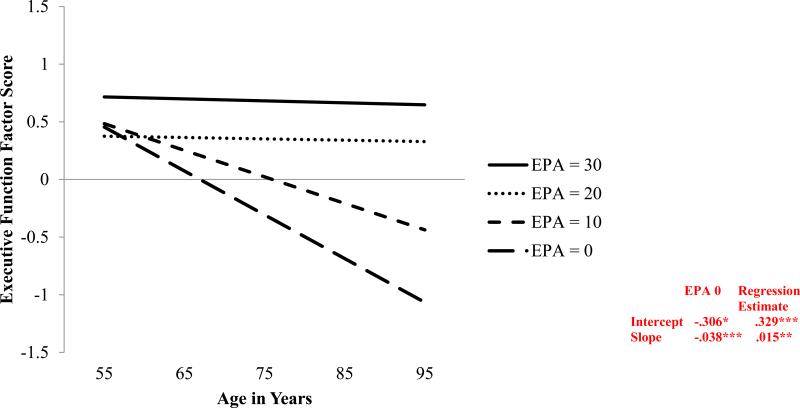
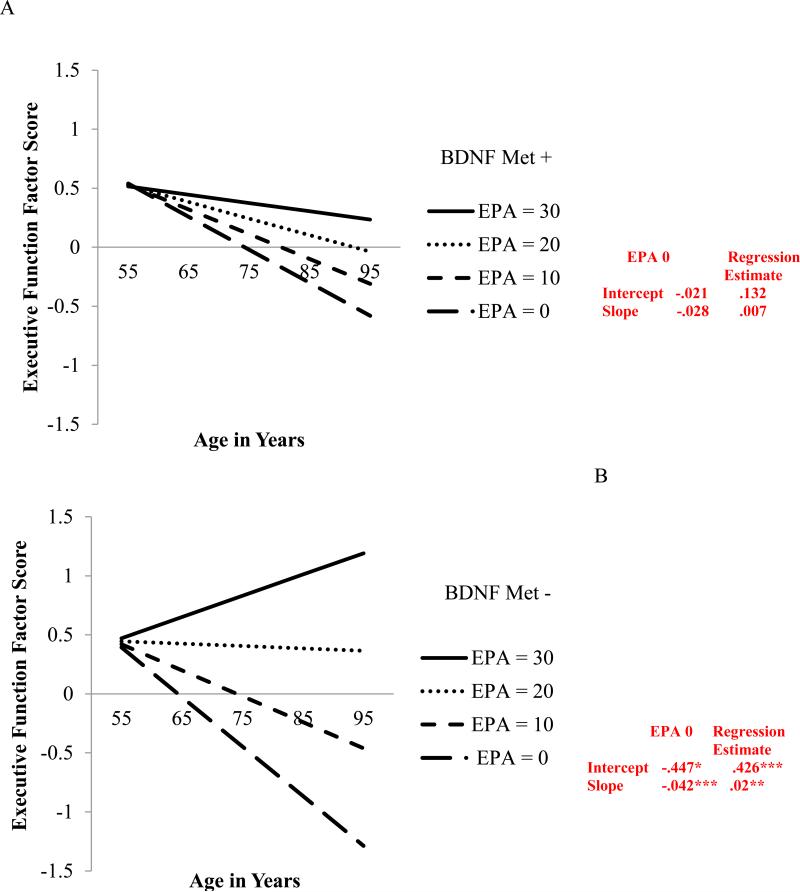
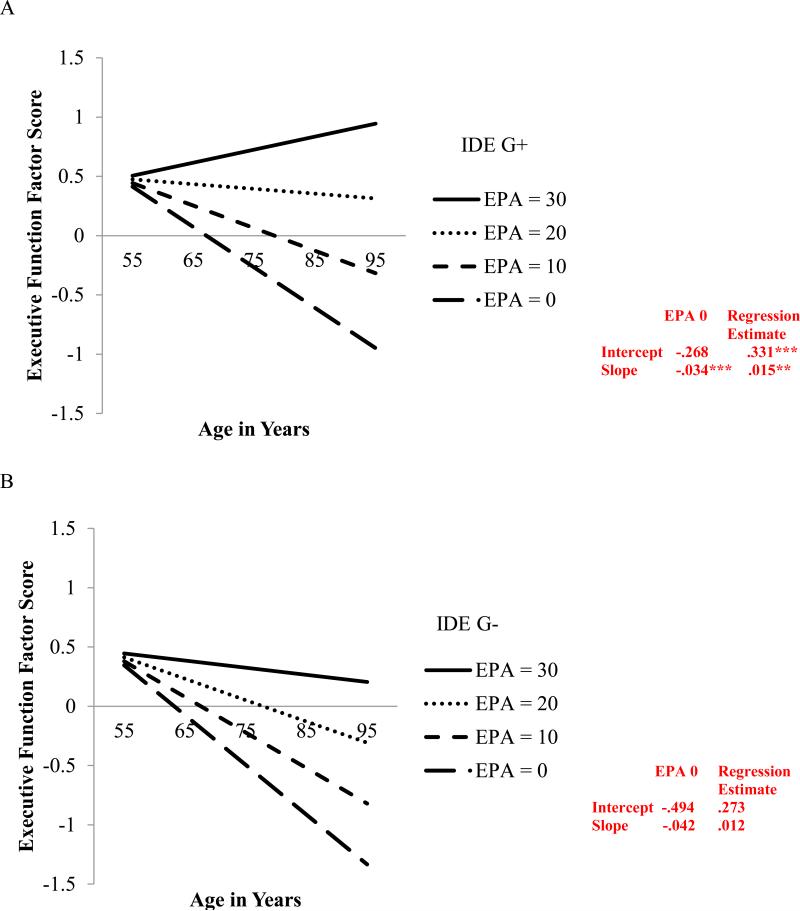
First, higher levels of EPA were associated with better EF performance at the centering age (75 years) and less EF decline. Second, IDE G+ (protective) carriers exhibited better EF performance at Age 75 than their G- (nonprotective) peers. Third, within the IDE G+ carrier group, those with higher EPA exhibited better EF performance and slower decline over time than those with lower EPA. Fourth, for the BDNF homozygote Val group, higher EPA was associated with better EF performance and more gradual EF change; however, this beneficial effect was not seen for Met carriers.
The effect of modifiable physical health factors on EF is moderated by biological mechanisms associated with risk-protection genetic polymorphisms.
日常身体活动(EPA)是导致执行功能(EF)出现与年龄相关变化的一个重要的可改变因素。然而,其作用可能会受到不可改变的遗传因素的调节。我们测试了脑源性神经营养因子(BDNF rs6265)和胰岛素降解酶(IDE rs6583817)对EF以及EPA-EF关系的独立和交互作用。
样本来自维多利亚纵向研究中3个时间点(约9年)的老年基因分型成年人(N = 577;平均年龄 = 70.47岁)。分析包括:(a)验证性因素分析,从4项标准EF任务中建立一个单一的潜在EF因素;(b)在40年的衰老区间(53至95岁)进行潜在增长建模;(c)结构回归,以研究BDNF、IDE和EPA的独立和交互作用。
首先,较高水平的EPA与中年(75岁)时更好的EF表现以及较小的EF下降相关。其次,IDE G+(保护性)携带者在75岁时的EF表现优于其G-(非保护性)同龄人。第三,在IDE G+携带者组中,EPA较高者比EPA较低者表现出更好的EF表现,且随着时间推移下降更慢。第四,对于BDNF纯合子Val组,较高的EPA与更好的EF表现以及更缓慢的EF变化相关;然而,对于Met携带者未观察到这种有益效果。
可改变的身体健康因素对EF的影响受到与风险-保护基因多态性相关的生物学机制的调节。