Grout Lise, Martinez-Pino Isabel, Ciglenecki Iza, Keita Sakoba, Diallo Alpha Amadou, Traore Balla, Delamou Daloka, Toure Oumar, Nicholas Sarala, Rusch Barbara, Staderini Nelly, Serafini Micaela, Grais Rebecca F, Luquero Francisco J
Epicentre, Paris, France.
World Health Organization, Geneva, Switzerland.
PLoS Negl Trop Dis. 2015 Dec 29;9(12):e0004274. doi: 10.1371/journal.pntd.0004274. eCollection 2015 Dec.
Since 2010, WHO has recommended oral cholera vaccines as an additional strategy for cholera control. During a cholera episode, pregnant women are at high risk of complications, and the risk of fetal death has been reported to be 2-36%. Due to a lack of safety data, pregnant women have been excluded from most cholera vaccination campaigns. In 2012, reactive campaigns using the bivalent killed whole-cell oral cholera vaccine (BivWC), included all people living in the targeted areas aged ≥ 1 year regardless of pregnancy status, were implemented in Guinea. We aimed to determine whether there was a difference in pregnancy outcomes between vaccinated and non-vaccinated pregnant women.
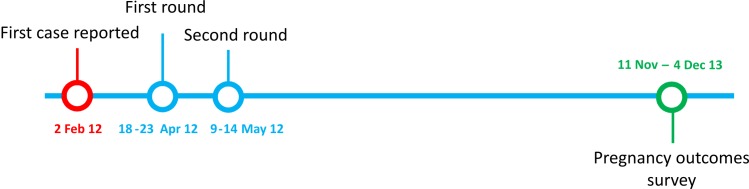
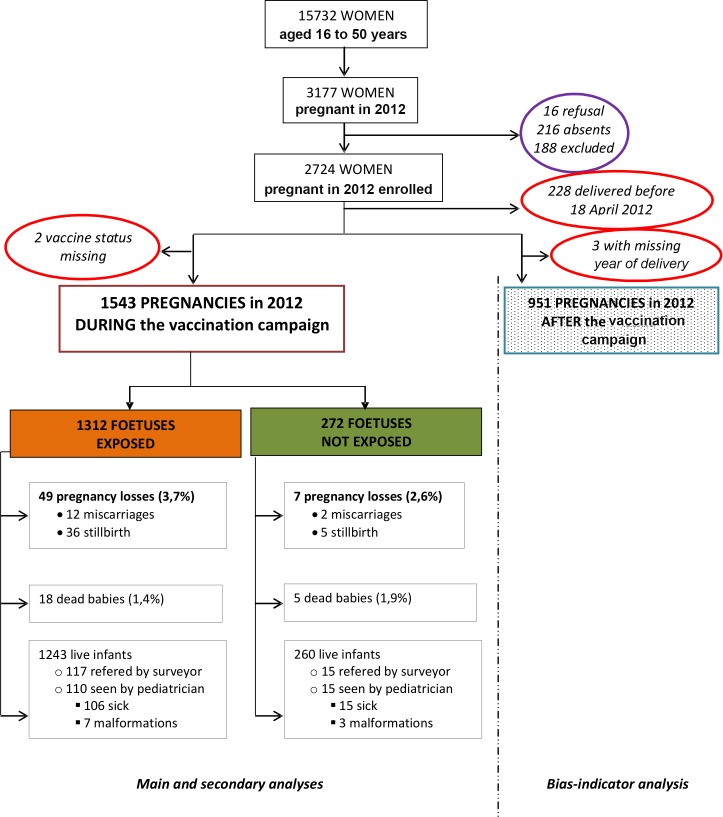
From 11 November to 4 December 2013, we conducted a retrospective cohort study in Boffa prefecture among women who were pregnant in 2012 during or after the vaccination campaign. The primary outcome was pregnancy loss, as reported by the mother, and fetal malformations, after clinical examination. Primary exposure was the intake of the BivWC vaccine (Shanchol) during pregnancy, as determined by a vaccination card or oral history. We compared the risk of pregnancy loss between vaccinated and non-vaccinated women through binomial regression analysis. A total of 2,494 pregnancies were included in the analysis. The crude incidence of pregnancy loss was 3.7% (95%CI 2.7-4.8) for fetuses exposed to BivWC vaccine and 2.6% (0.7-4.5) for non-exposed fetuses. The incidence of malformation was 0.6% (0.1-1.0) and 1.2% (0.0-2.5) in BivWC-exposed and non-exposed fetuses, respectively. In both crude and adjusted analyses, fetal exposure to BivWC was not significantly associated with pregnancy loss (adjusted risk ratio (aRR = 1.09 [95%CI: 0.5-2.25], p = 0.818) or malformations (aRR = 0.50 [95%CI: 0.13-1.91], p = 0.314).
In this large retrospective cohort study, we found no association between fetal exposure to BivWC and risk of pregnancy loss or malformation. Despite the weaknesses of a retrospective design, we can conclude that if a risk exists, it is very low. Additional prospective studies are warranted to add to the evidence base on OCV use during pregnancy. Pregnant women are particularly vulnerable during cholera episodes and should be included in vaccination campaigns when the risk of cholera is high, such as during outbreaks.
自2010年以来,世界卫生组织推荐口服霍乱疫苗作为霍乱控制的一项补充策略。在霍乱疫情期间,孕妇出现并发症的风险很高,据报道胎儿死亡风险为2%-36%。由于缺乏安全性数据,大多数霍乱疫苗接种活动都将孕妇排除在外。2012年,几内亚开展了反应性疫苗接种活动,使用双价全细胞口服霍乱灭活疫苗(BivWC),目标地区所有年龄≥1岁的居民,无论其妊娠状态如何,均在接种范围内。我们旨在确定接种疫苗和未接种疫苗的孕妇在妊娠结局上是否存在差异。
2013年11月11日至12月4日,我们在博法省对2012年疫苗接种活动期间或之后怀孕的妇女进行了一项回顾性队列研究。主要结局是母亲报告的妊娠丢失以及临床检查后的胎儿畸形情况。主要暴露因素是根据接种卡或口述病史确定的孕期摄入BivWC疫苗(Shanchol)情况。我们通过二项式回归分析比较了接种疫苗和未接种疫苗妇女的妊娠丢失风险。共有2494例妊娠纳入分析。暴露于BivWC疫苗的胎儿妊娠丢失的粗发病率为3.7%(95%CI 2.7-4.8),未暴露胎儿为2.6%(0.7-4.5)。暴露于BivWC疫苗和未暴露胎儿的畸形发病率分别为0.6%(0.1-1.0)和1.2%((0.0-2.5)。在粗分析和校正分析中,胎儿暴露于BivWC疫苗与妊娠丢失(校正风险比(aRR)=1.09[95%CI:0.5-2.25],p=0.818)或畸形(aRR=0.50[95%CI:0.13-1.91],p=0.314)均无显著关联。
在这项大型回顾性队列研究中,我们发现胎儿暴露于BivWC疫苗与妊娠丢失或畸形风险之间无关联。尽管回顾性设计存在局限性,但我们可以得出结论,即使存在风险,也非常低。有必要开展更多前瞻性研究,以增加孕期使用口服霍乱疫苗的证据基础。孕妇在霍乱疫情期间特别脆弱,在霍乱风险较高时,如疫情暴发期间,应将其纳入疫苗接种活动。