Pan Yupeng, Bo Kailiang, Cheng Zhihui, Weng Yiqun
Horticulture Department, University of Wisconsin, Madison, WI, 53706, USA.
Horticulture College, Northwest A&F University, Yangling, 712100, China.
BMC Plant Biol. 2015 Dec 29;15:302. doi: 10.1186/s12870-015-0693-0.
Trichomes, developed from the protodermal cells (the outermost cell layer of the embryo), are hair-like structures covering the aerial parts of plants. The genetic network regulating trichome development has been extensively studied and well understood in the model species Arabidopsis thaliana, which bears unicellular, non-glandular and branched trichomes. However, little is known about the genetic and molecular basis of organogenesis of multi-cellular trichomes in plant species like cucumber (Cucumis sativus L.), which are likely different from Arabidopsis.
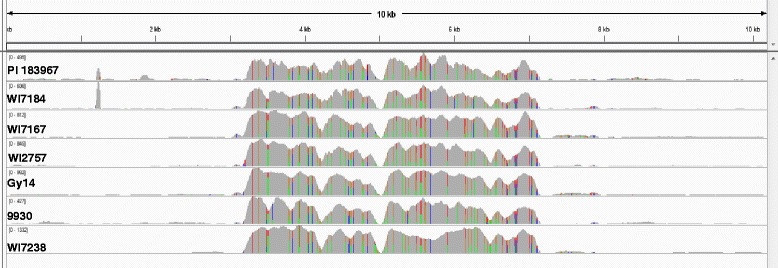
We identified a new trichome mutant in cucumber which exhibited a completely glabrous phenotype on all aerial organs. Genetic analysis indicated that the glabrous phenotype was inherited as a single recessive gene, csgl3. Fine genetic mapping delimited the csgl3 locus into a 68.4 kb region with 12 predicted genes. Genetic analysis, sequence alignment and allelic variation survey in natural populations identified Csa6G514870 encoding a class IV homeodomain-associated leucine zipper (HD-ZIP) transcription factor as the only candidate for CsGL3, which was 5188 bp in length with 10 predicted exons. Gene expression analysis revealed the loss-of-function of CsGL3 in the mutant due to the insertion of a 5-kb long terminal repeat (LTR) retrotransposon in the 4th exon of CsGL3. Linkage analysis in a segregating population and gene expression analysis of the CsGL1 and CsGL3 genes in csgl1, csgl3, and csgl1 + 3 genetic backgrounds uncovered interactions between the two genes. Phylogenetic analysis among 28 class IV HD-ZIP protein sequences from five species placed cucumber CsGL3 into the same clade with 7 other members that play important roles in trichome initiation.
The new glabrous mutation in cucumber was controlled by a single recessive locus csgl3, which was phenotypically and genetically distinct from two previously reported glabrous mutants csgl1 and csgl2. The glabrous phenotype in csgl3 was due to insertion of an autonomous, active, class I transposable element in CsGL3, a class IV HD-ZIP transcription factor. CsGL3 was epistatic to CsGL1. CsGL3 seemed to play important roles in cucumber trichome initiation whereas CsGL1 may act downstream in the trichome development pathway(s). Findings from the present study provide new insights into genetic control of trichome development in cucumber.
表皮毛由原表皮细胞(胚胎的最外层细胞层)发育而来,是覆盖植物地上部分的毛发状结构。在模式植物拟南芥中,调控表皮毛发育的遗传网络已得到广泛研究且被充分理解,拟南芥具有单细胞、非腺毛且有分支的表皮毛。然而,对于黄瓜(Cucumis sativus L.)等植物中多细胞表皮毛器官发生的遗传和分子基础知之甚少,这些植物的表皮毛可能与拟南芥不同。
我们在黄瓜中鉴定出一个新的表皮毛突变体,其所有地上器官均表现出完全无毛的表型。遗传分析表明,无毛表型由单个隐性基因csgl3遗传。精细遗传定位将csgl3基因座定位到一个68.4 kb的区域,该区域有12个预测基因。通过遗传分析、序列比对以及自然群体中的等位基因变异调查,确定编码IV类同源异型结构域相关亮氨酸拉链(HD-ZIP)转录因子的Csa6G514870为CsGL3的唯一候选基因,其长度为5188 bp,有10个预测外显子。基因表达分析表明,由于在CsGL3的第4外显子中插入了一个5 kb的长末端重复(LTR)反转录转座子,突变体中CsGL3功能丧失。在一个分离群体中的连锁分析以及在csgl1、csgl3和csgl1 + 3遗传背景下对CsGL1和CsGL3基因的表达分析揭示了这两个基因之间的相互作用。对来自五个物种的28个IV类HD-ZIP蛋白序列进行系统发育分析,将黄瓜CsGL3与其他7个在表皮毛起始中起重要作用的成员置于同一进化枝中。
黄瓜中的新无毛突变由单个隐性基因座csgl3控制,其表型和遗传特征与之前报道的两个无毛突变体csgl1和csgl2不同。csgl3中的无毛表型是由于在IV类HD-ZIP转录因子CsGL3中插入了一个自主、活跃的I类转座元件。CsGL3对CsGL1具有上位性。CsGL3似乎在黄瓜表皮毛起始中起重要作用,而CsGL1可能在表皮毛发育途径中起下游作用。本研究结果为黄瓜表皮毛发育的遗传控制提供了新的见解。