Succurro Elena, Segura-Garcia Cristina, Ruffo Mariafrancesca, Caroleo Mariarita, Rania Marianna, Aloi Matteo, De Fazio Pasquale, Sesti Giorgio, Arturi Franco
From the Department of Medical and Surgical Sciences (ES, MR, GS, FA) and the Department of Health Sciences (CS-G, MC, MR, MA, PDF), University "Magna Graecia" of Catanzaro, Catanzaro, Italy.
Medicine (Baltimore). 2015 Dec;94(52):e2098. doi: 10.1097/MD.0000000000002098.
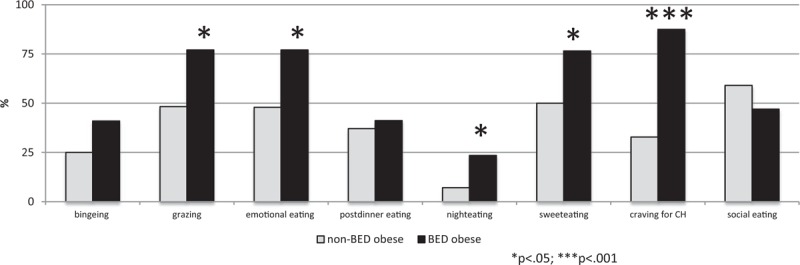
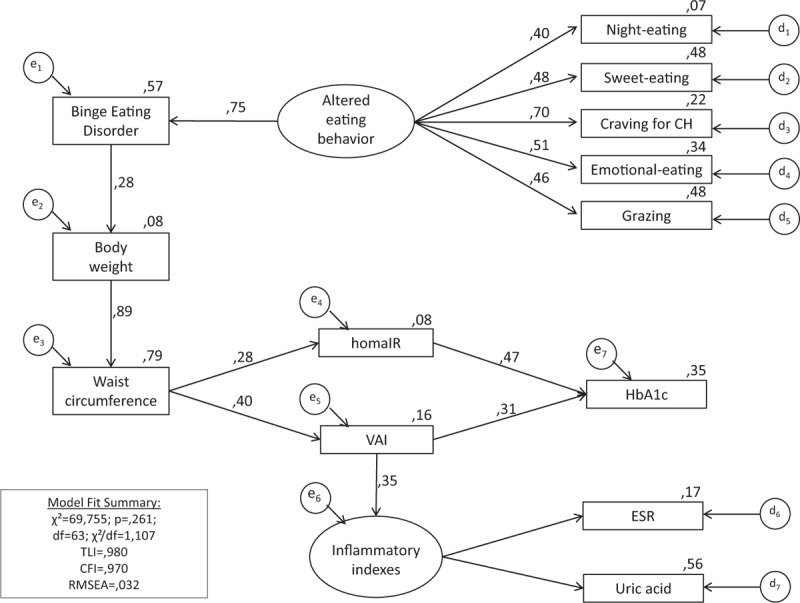
To evaluate whether obese patients with a binge eating disorder (BED) have an altered metabolic and inflammatory profile related to their eating behaviors compared with non-BED obese.A total of 115 White obese patients consecutively recruited underwent biochemical, anthropometrical evaluation, and a 75-g oral glucose tolerance test. Patients answered the Binge Eating Scale and were interviewed by a psychiatrist. The patients were subsequently divided into 2 groups according to diagnosis: non-BED obese (n = 85) and BED obese (n = 30). Structural equation modeling analysis was performed to elucidate the relation between eating behaviors and metabolic and inflammatory profile.BED obese exhibited significantly higher percentages of altered eating behaviors, body mass index (P < 0.001), waist circumference (P < 0.01), fat mass (P < 0.001), and a lower lean mass (P < 0.001) when compared with non-BED obese. Binge eating disorder obese also had a worse metabolic and inflammatory profile, exhibiting significantly lower high-density lipoprotein cholesterol levels (P < 0.05), and higher levels of glycated hemoglobin (P < 0.01), uric acid (P < 0.05), erythrocyte sedimentation rate (P < 0.001), high-sensitive C-reactive protein (P < 0.01), and white blood cell counts (P < 0.01). Higher fasting insulin (P < 0.01) and higher insulin resistance (P < 0.01), assessed by homeostasis model assessment index and visceral adiposity index (P < 0.001), were observed among BED obese. All differences remained significant after adjusting for body mass index. No significant differences in fasting plasma glucose or 2-hour postchallenge plasma glucose were found. Structural equation modeling analysis confirmed the relation between the altered eating behaviors of BED and the metabolic and inflammatory profile.Binge eating disorder obese exhibited an unfavorable metabolic and inflammatory profile, which is related to their characteristic eating habits.
为评估与非暴食症肥胖患者相比,患有暴食症(BED)的肥胖患者是否具有与其饮食行为相关的代谢和炎症特征改变。连续招募的115名白人肥胖患者接受了生化、人体测量学评估以及75克口服葡萄糖耐量试验。患者回答了暴食量表问题,并接受了精神科医生的访谈。随后根据诊断将患者分为两组:非BED肥胖组(n = 85)和BED肥胖组(n = 30)。进行结构方程模型分析以阐明饮食行为与代谢和炎症特征之间的关系。与非BED肥胖患者相比,BED肥胖患者的饮食行为改变、体重指数(P < 0.001)、腰围(P < 0.01)、脂肪量(P < 0.001)百分比显著更高,而瘦体重更低(P < 0.001)。暴食症肥胖患者的代谢和炎症特征也更差,表现为高密度脂蛋白胆固醇水平显著更低(P < 0.05),糖化血红蛋白、尿酸(P < 0.05)、红细胞沉降率(P < 0.001)、高敏C反应蛋白(P < 0.01)和白细胞计数水平更高(P < 0.01)。在BED肥胖患者中观察到更高的空腹胰岛素水平(P < 0.01)和更高的胰岛素抵抗(P < 0.01),通过稳态模型评估指数和内脏脂肪指数评估(P < 0.001)。在调整体重指数后,所有差异仍然显著。未发现空腹血糖或餐后2小时血糖有显著差异。结构方程模型分析证实了BED饮食行为改变与代谢和炎症特征之间的关系。暴食症肥胖患者表现出不良的代谢和炎症特征,这与其特有的饮食习惯有关。