Vasseur Guillaume, Fagot-Revurat Yannick, Sicot Muriel, Kierren Bertrand, Moreau Luc, Malterre Daniel, Cardenas Luis, Galeotti Gianluca, Lipton-Duffin Josh, Rosei Federico, Di Giovannantonio Marco, Contini Giorgio, Le Fèvre Patrick, Bertran François, Liang Liangbo, Meunier Vincent, Perepichka Dmitrii F
Institut Jean Lamour, UMR 7198, Université de Lorraine/CNRS, BP 70239, F-54506 Vandoeuvre-les-Nancy, France.
Centre Énergie, Matériaux et Télécommunications, Institut National de la Recherche Scientifique, 1650 Boulevard Lionel-Boulet, Varennes, Quebec, Canada J3X 1S2.
Nat Commun. 2016 Jan 4;7:10235. doi: 10.1038/ncomms10235.
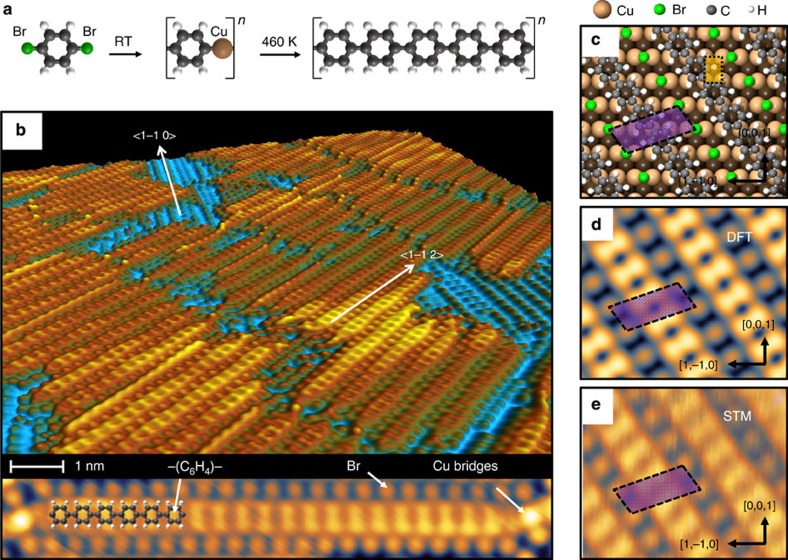
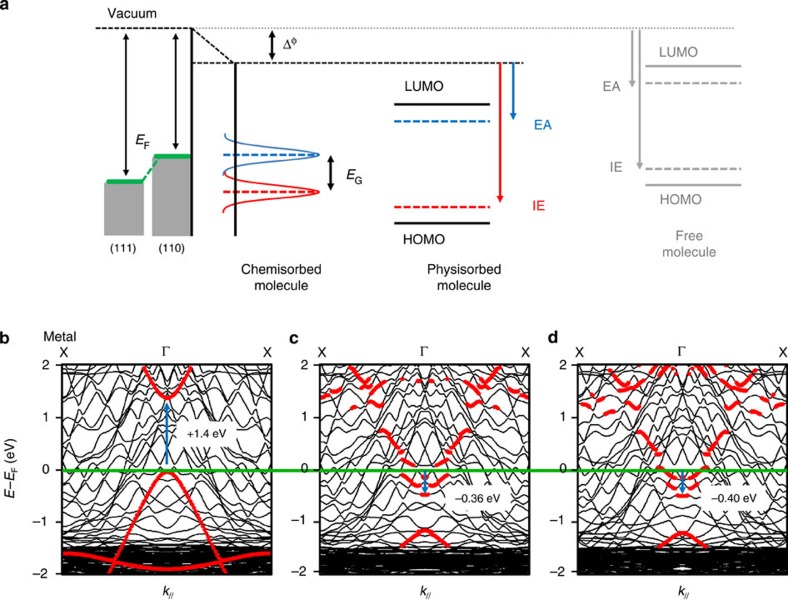
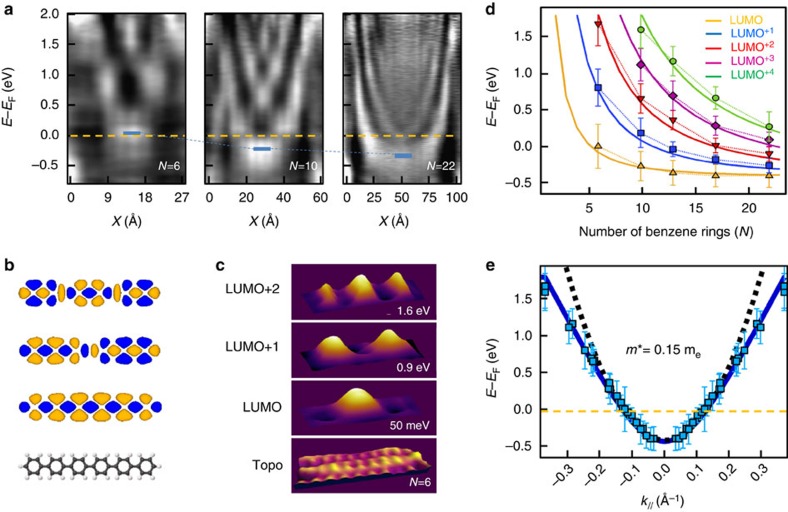
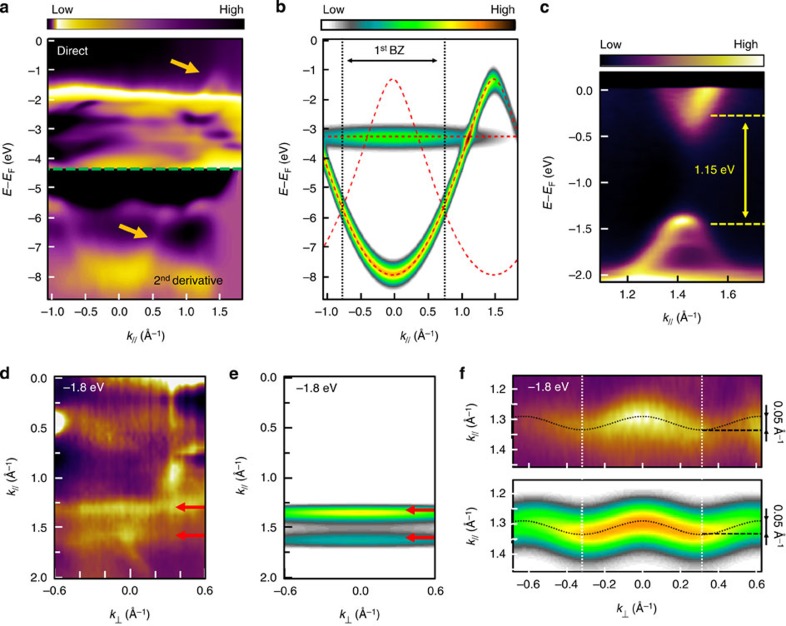
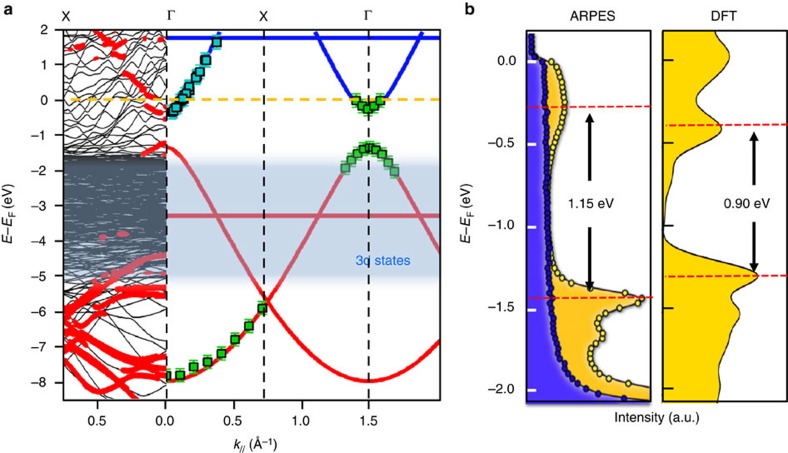
On-surface covalent self-assembly of organic molecules is a very promising bottom-up approach for producing atomically controlled nanostructures. Due to their highly tuneable properties, these structures may be used as building blocks in electronic carbon-based molecular devices. Following this idea, here we report on the electronic structure of an ordered array of poly(para-phenylene) nanowires produced by surface-catalysed dehalogenative reaction. By scanning tunnelling spectroscopy we follow the quantization of unoccupied molecular states as a function of oligomer length, with Fermi level crossing observed for long chains. Angle-resolved photoelectron spectroscopy reveals a quasi-1D valence band as well as a direct gap of 1.15 eV, as the conduction band is partially filled through adsorption on the surface. Tight-binding modelling and ab initio density functional theory calculations lead to a full description of the band structure, including the gap size and charge transfer mechanisms, highlighting a strong substrate-molecule interaction that drives the system into a metallic behaviour.
有机分子的表面共价自组装是一种非常有前景的自下而上的方法,用于制备原子级可控的纳米结构。由于其高度可调节的性质,这些结构可用作基于碳的电子分子器件的构建块。基于这一想法,我们在此报告通过表面催化脱卤反应制备的聚对苯撑纳米线有序阵列的电子结构。通过扫描隧道光谱,我们跟踪未占据分子态的量子化随低聚物长度的变化,观察到长链的费米能级交叉。角分辨光电子能谱揭示了一个准一维价带以及1.15 eV的直接带隙,因为导带通过吸附在表面上而部分填充。紧束缚建模和从头算密度泛函理论计算对能带结构进行了全面描述,包括带隙大小和电荷转移机制,突出了驱动系统进入金属行为的强烈的底物-分子相互作用。