de Gier Brechje, Campos Ponce Maiza, Perignon Marlene, Fiorentino Marion, Khov Kuong, Chamnan Chhoun, de Boer Michiel R, Parker Megan E, Burja Kurt, Dijkhuizen Marjoleine A, Berger Jacques, Polman Katja, Wieringa Frank T
Section Health and Life Sciences, Athena Institute, Faculty of Earth and Life Sciences, VU University Amsterdam, Amsterdam, The Netherlands.
Section Infectious Diseases, department of Health Sciences, Faculty of Earth and Life Sciences, VU University Amsterdam, Amsterdam, The Netherlands.
PLoS One. 2016 Jan 6;11(1):e0145351. doi: 10.1371/journal.pone.0145351. eCollection 2016.
Fortification of staple foods is considered an effective and safe strategy to combat micronutrient deficiencies, thereby improving health. While improving micronutrient status might be expected to have positive effects on immunity, some studies have reported increases in infections or inflammation after iron supplementation.
To study effects of micronutrient-fortified rice on hookworm infection in Cambodian schoolchildren.
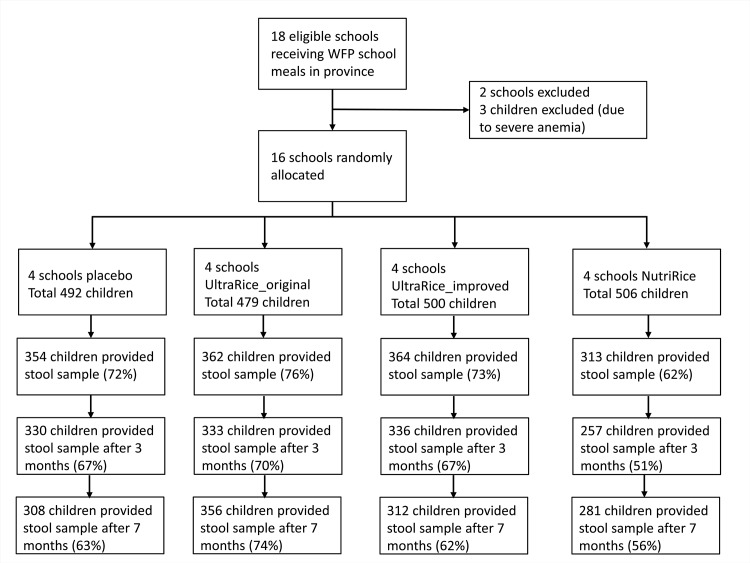
A double-blinded, cluster-randomized trial was conducted in 16 Cambodian primary schools partaking in the World Food Program school meal program. Three types of multi-micronutrient fortified rice were tested against placebo rice within the school meal program: UltraRice_original, UltraRice_improved and NutriRice. Four schools were randomly assigned to each study group (placebo n = 492, UltraRice_original n = 479, UltraRice_improved n = 500, NutriRice n = 506). Intestinal parasite infection was measured in fecal samples by Kato-Katz method at baseline and after three and seven months. In a subgroup (N = 330), fecal calprotectin was measured by ELISA as a marker for intestinal inflammation.
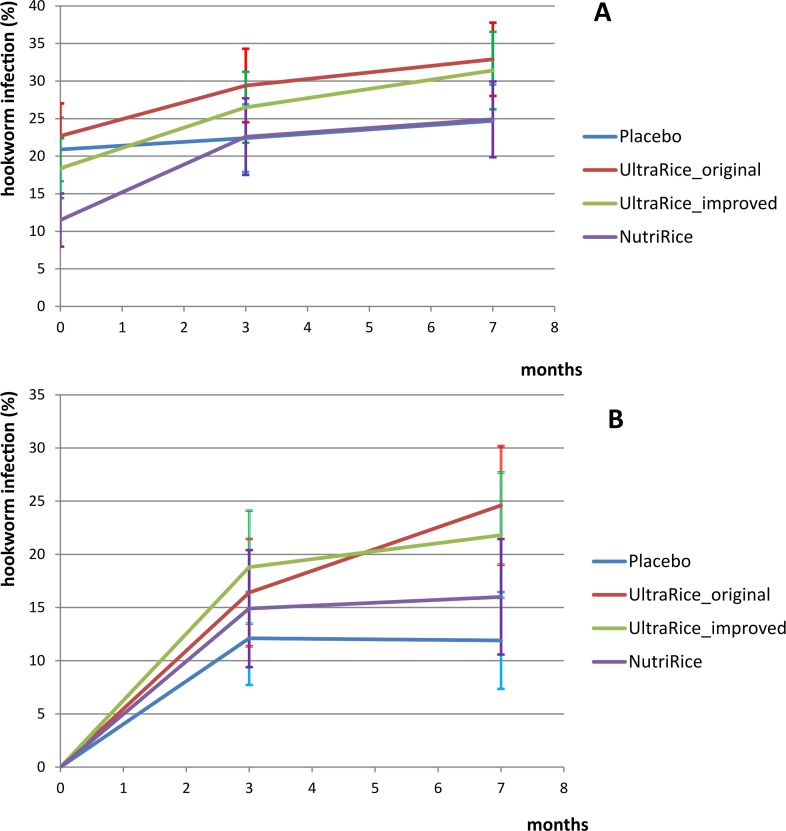
Baseline prevalence of hookworm infection was 18.6%, but differed considerably among schools (range 0%- 48.1%).Micronutrient-fortified rice significantly increased risk of new hookworm infection. This effect was modified by baseline hookworm prevalence at the school; hookworm infection risk was increased by all three types of fortified rice in schools where baseline prevalence was high (>15%), and only by UltraRice_original in schools with low baseline prevalence. Neither hookworm infection nor fortified rice was related to fecal calprotectin.
Consumption of rice fortified with micronutrients can increase hookworm prevalence, especially in environments with high infection pressure. When considering fortification of staple foods, a careful risk-benefit analysis is warranted, taking into account severity of micronutrient deficiencies and local prevalence of parasitic infections.
ClinicalTrials.gov NCT01706419.
主食强化被认为是对抗微量营养素缺乏从而改善健康状况的一种有效且安全的策略。虽然改善微量营养素状况可能会对免疫力产生积极影响,但一些研究报告称补铁后感染或炎症有所增加。
研究微量营养素强化米对柬埔寨学童钩虫感染的影响。
在参与世界粮食计划署学校供餐计划的16所柬埔寨小学进行了一项双盲、整群随机试验。在学校供餐计划中,将三种类型的多种微量营养素强化米与安慰剂米进行对比测试:原始型超级米、改良型超级米和营养米。四所学校被随机分配到每个研究组(安慰剂组n = 492,原始型超级米组n = 479,改良型超级米组n = 500,营养米组n = 506)。在基线以及三个月和七个月后,通过加藤-厚涂片法检测粪便样本中的肠道寄生虫感染情况。在一个亚组(N = 330)中,通过酶联免疫吸附测定法检测粪便钙卫蛋白作为肠道炎症的标志物。
钩虫感染的基线患病率为18.6%,但在各学校之间差异很大(范围为0% - 48.1%)。微量营养素强化米显著增加了新的钩虫感染风险。这种效应因学校的钩虫基线患病率而有所改变;在基线患病率高(>15%)的学校中,所有三种类型的强化米都会增加钩虫感染风险,而在基线患病率低的学校中,只有原始型超级米会增加感染风险。钩虫感染和强化米均与粪便钙卫蛋白无关。
食用微量营养素强化米会增加钩虫患病率,尤其是在感染压力高的环境中。在考虑主食强化时,有必要进行仔细的风险效益分析,同时考虑微量营养素缺乏的严重程度和当地寄生虫感染的患病率。
ClinicalTrials.gov NCT01706419。