Wong Lydia, Huang Chiung Hui, Lee Bee Wah
Pediatrics, Khoo Teck Puat-National University Children's Medical Institute, National University Health System, Singapore.
Pediatrics, Yong Loo Lin School of Medicine, National University of Singapore, Singapore.
Allergy Asthma Immunol Res. 2016 Mar;8(2):101-6. doi: 10.4168/aair.2016.8.2.101. Epub 2015 Jul 14.
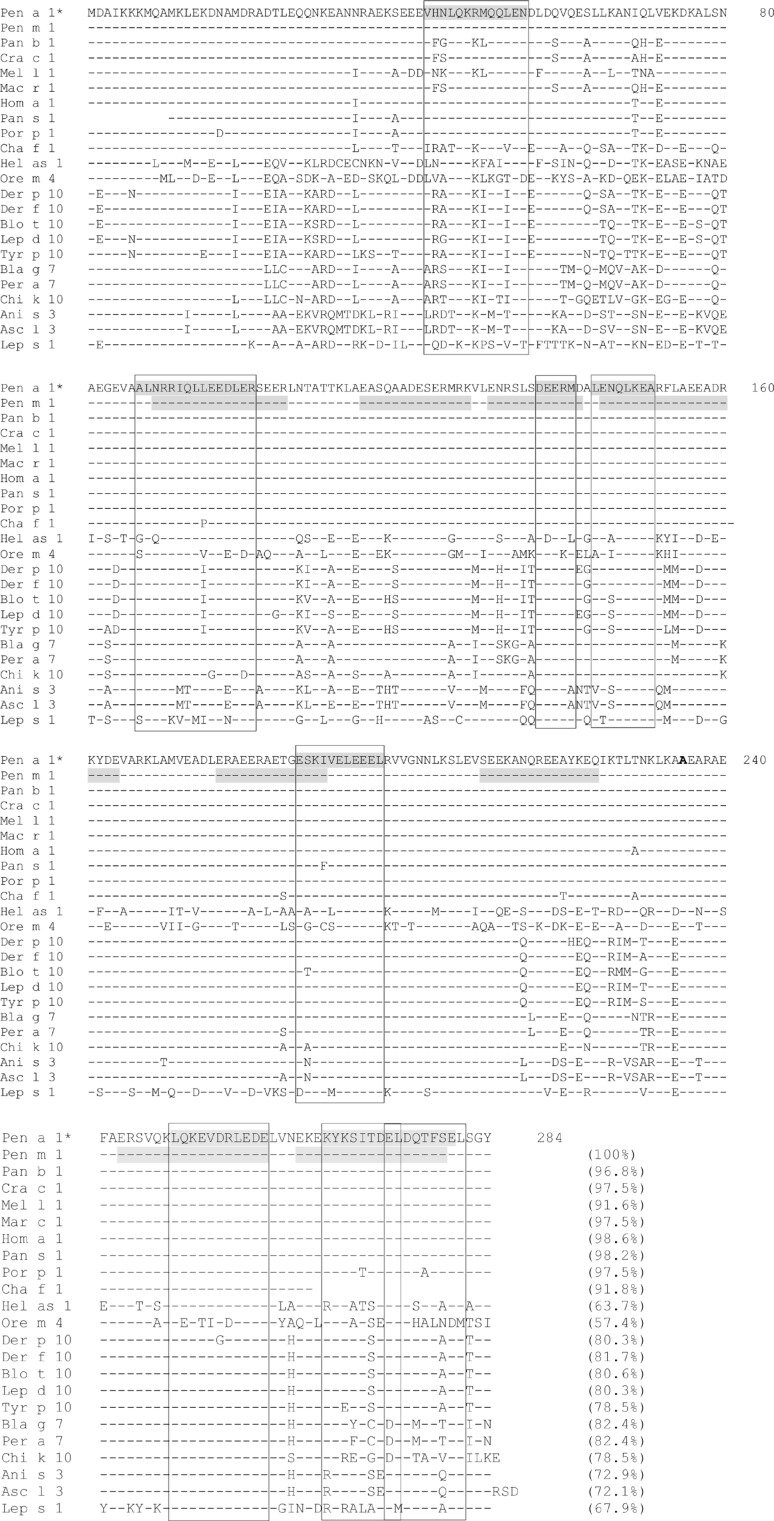
Crustacean shellfish allergy is an important cause of food allergy and anaphylaxis in Asia. The major allergen in shellfish allergy is tropomyosin, a pan-allergen that is also found in house dust mites and cockroaches. Tropomyosins from house dust mites (HDMs) have a high sequence homology to shellfish tropomyosins, and cross-reactivity between HDM and shrimp tropomyosins has been demonstrated. Exposure to inhaled tropomyosins from house dust mites has been postulated to be the primary sensitizer for shellfish allergy, in a reaction analogous to the oral allergy (inhalant-food) syndrome. This notion is supported by indirect data from the effects of HDM immunotherapy on shellfish allergy, and strong correlations of shellfish and HDM sensitization. HDM immunotherapy has been reported to induce both shrimp allergy in non-allergic patients and shrimp tolerance in shrimp-allergic patients. Epidemiological surveys have also demonstrated a strong correlation between shellfish and HDM sensitization in both hospital-based and community-based studies. Unexposed populations have also been shown to develop sensitization-shellfish sensitization in orthodox Jews with no history of shellfish consumption was associated with HDM sensitization. Reciprocally, HDM sensitization in an Icelandic population living in a HDM-free environment was associated with shrimp sensitization. In vitro IgE inhibition studies on sera in shrimp-allergic Spanish patients indicate that mites are the primary sensitizer in shrimp-allergic patients living in humid and warm climates. Current data supports the hypothesis that tropomyosin is the link between HDM and shellfish allergies. The role of tropomyosin in HDM and shellfish allergies is a fertile field for investigation as it may provide novel immunotherapeutic strategies for shellfish allergy.
甲壳类贝类过敏是亚洲食物过敏和过敏反应的一个重要原因。贝类过敏的主要过敏原是原肌球蛋白,这是一种泛过敏原,在屋尘螨和蟑螂中也有发现。屋尘螨(HDM)的原肌球蛋白与贝类原肌球蛋白具有高度的序列同源性,并且已经证实HDM和虾原肌球蛋白之间存在交叉反应性。据推测,吸入屋尘螨的原肌球蛋白是贝类过敏的主要致敏原,这一反应类似于口腔过敏(吸入性食物)综合征。HDM免疫疗法对贝类过敏的影响的间接数据以及贝类和HDM致敏的强相关性支持了这一观点。据报道,HDM免疫疗法既能在非过敏患者中诱发虾过敏,也能在虾过敏患者中诱导虾耐受性。流行病学调查也表明,在基于医院和基于社区的研究中,贝类和HDM致敏之间存在很强的相关性。未接触过的人群也被证明会产生致敏——在没有食用贝类历史的正统犹太人群中,贝类致敏与HDM致敏有关。相反,生活在无HDM环境中的冰岛人群中的HDM致敏与虾致敏有关。对西班牙虾过敏患者血清的体外IgE抑制研究表明,螨虫是生活在潮湿温暖气候中的虾过敏患者的主要致敏原。目前的数据支持原肌球蛋白是HDM和贝类过敏之间联系的假设。原肌球蛋白在HDM和贝类过敏中的作用是一个有待深入研究的领域,因为它可能为贝类过敏提供新的免疫治疗策略。