Dobrovolskaia Marina A, Shurin Michael, Shvedova Anna A
Nanotechnology Characterization Laboratory, Cancer Research Technology Program, Leidos Biomedical Research Inc., Frederick National Laboratory for Cancer Research, NCI at Frederick, Frederick, MD 21702, USA.
Department of Pathology, University of Pittsburgh Medical Center, Pittsburgh, PA 15213, USA; Department of Immunology, University of Pittsburgh Medical Center, Pittsburgh, PA 15213, USA.
Toxicol Appl Pharmacol. 2016 May 15;299:78-89. doi: 10.1016/j.taap.2015.12.022. Epub 2015 Dec 29.
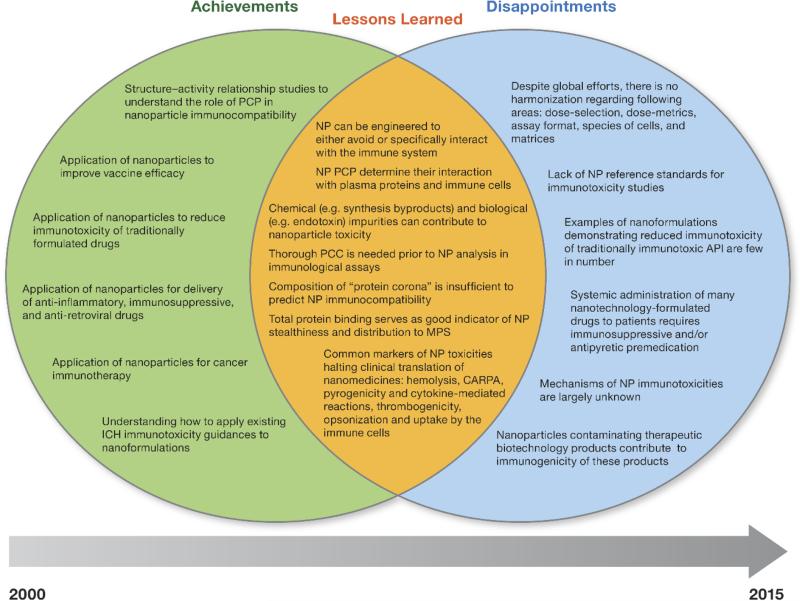
The delivery of drugs, antigens, and imaging agents benefits from using nanotechnology-based carriers. The successful translation of nanoformulations to the clinic involves thorough assessment of their safety profiles, which, among other end-points, includes evaluation of immunotoxicity. The past decade of research focusing on nanoparticle interaction with the immune system has been fruitful in terms of understanding the basics of nanoparticle immunocompatibility, developing a bioanalytical infrastructure to screen for nanoparticle-mediated immune reactions, beginning to uncover the mechanisms of nanoparticle immunotoxicity, and utilizing current knowledge about the structure-activity relationship between nanoparticles' physicochemical properties and their effects on the immune system to guide safe drug delivery. In the present review, we focus on the most prominent pieces of the nanoparticle-immune system puzzle and discuss the achievements, disappointments, and lessons learned over the past 15years of research on the immunotoxicity of engineered nanomaterials.
药物、抗原和成像剂的递送得益于基于纳米技术的载体。纳米制剂成功转化至临床需要对其安全性进行全面评估,其中包括免疫毒性评估等多个终点指标。过去十年对纳米颗粒与免疫系统相互作用的研究在理解纳米颗粒免疫相容性的基础、开发用于筛选纳米颗粒介导的免疫反应的生物分析基础设施、开始揭示纳米颗粒免疫毒性机制以及利用有关纳米颗粒物理化学性质与其对免疫系统影响之间结构-活性关系的现有知识来指导安全药物递送方面成果丰硕。在本综述中,我们聚焦于纳米颗粒-免疫系统难题中最突出的部分,并讨论过去15年关于工程纳米材料免疫毒性研究的成就、失望之处及经验教训。