Seki Masayasu, Otaki Junji, Breugelmans Raoul, Komoda Takayuki, Nagata-Kobayashi Shizuko, Akaishi Yu, Hiramoto Jun, Ohno Iwao, Harada Yoshimi, Hirayama Yoji, Izumi Miki
Department of Medical Education, Tokyo Medical University, 6-7-1 Nishi-Shinjuku, Shinjuku-ku, Tokyo, 160-0023, Japan.
Department of Primary Care and General Medicine, Tokyo Medical University, 6-7-1 Nishi-Shinjuku, Shinjuku-ku, Tokyo, 160-0023, Japan.
BMC Med Educ. 2016 Jan 13;16:12. doi: 10.1186/s12909-016-0531-6.
Various techniques have been developed to enable preceptors to teach residents effectively in outpatient settings to promote active learning, including SNAPPS and the One-Minute Preceptor (OMP). This study aimed to ascertain the differences between SNAPPS and the OMP in case presentation content and learner evaluation when used to teach residents about case presentation.
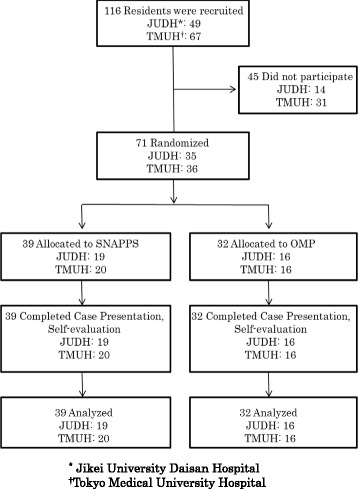
From 2011 to 2013, participants were 71 junior clinical residents employed in two hospitals for clinical training. They were randomly allocated to two groups, one using SNAPPS and the other the OMP. From recorded discussions, the "differential diagnoses", "questions and uncertainties", "treatment plans", and "learning issues" were counted. Also, a self-evaluation form was distributed at the end of the study to evaluate the residents' satisfaction with the case presentation.
Members of the SNAPPS group used significantly more meaning units related to questions and uncertainties compared with those of the OMP group (P < 0.001). Self-evaluation sheets revealed that members of the SNAPPS group had significantly higher positive responses than those of the OMP group in terms of the following evaluations: "It was easy to bring up questions and uncertainties" (P = 0.046), "It was easy to present the case efficiently" (P = 0.002), "It was easy to present the case in the sequence given" (P = 0.029), and "I was able to give an in-depth case presentation" (P = 0.005).
SNAPPS may induce more meaning units related to questions and uncertainties and give more satisfaction to residents than the OMP.
已开发出各种技术,以使带教老师能够在门诊环境中有效地教授住院医师,以促进主动学习,包括SNAPPS和一分钟带教法(OMP)。本研究旨在确定在用于教授住院医师病例汇报时,SNAPPS和OMP在病例汇报内容和学习者评估方面的差异。
2011年至2013年,参与者为两家医院中71名接受临床培训的初级临床住院医师。他们被随机分为两组,一组使用SNAPPS,另一组使用OMP。从记录的讨论中,统计“鉴别诊断”“问题与不确定性”“治疗计划”和“学习问题”。此外,在研究结束时发放了一份自我评估表,以评估住院医师对病例汇报的满意度。
与OMP组相比,SNAPPS组的成员使用与问题和不确定性相关的意义单元明显更多(P<0.001)。自我评估表显示,在以下评估方面,SNAPPS组的成员比OMP组有明显更高的积极反馈:“提出问题和不确定性很容易”(P=0.046),“有效汇报病例很容易”(P=0.002),“按照给定顺序汇报病例很容易”(P=0.029),以及“我能够进行深入的病例汇报”(P=0.005)。
与OMP相比,SNAPPS可能会引发更多与问题和不确定性相关的意义单元,并使住院医师更满意。