Saha Kamalika, Adhikary Gautam, Eckert Richard L
Department of Biochemistry and Molecular Biology, University of Maryland School of Medicine, Baltimore, Maryland, USA.
Department of Biochemistry and Molecular Biology, University of Maryland School of Medicine, Baltimore, Maryland, USA; Department of Dermatology, University of Maryland School of Medicine, Baltimore, Maryland, USA; Department of Obstetrics and Gynecology, University of Maryland School of Medicine, Baltimore, Maryland, USA; Marlene and Stewart Greenebaum Cancer Center, University of Maryland School of Medicine, Baltimore, Maryland, USA.
J Invest Dermatol. 2016 Jan;136(1):214-224. doi: 10.1038/JID.2015.400.
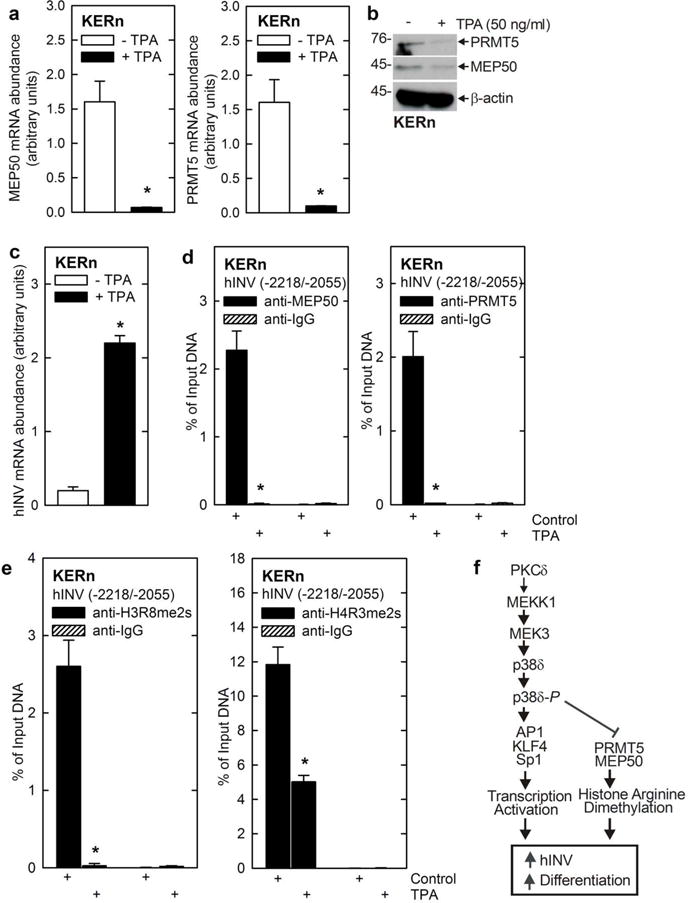
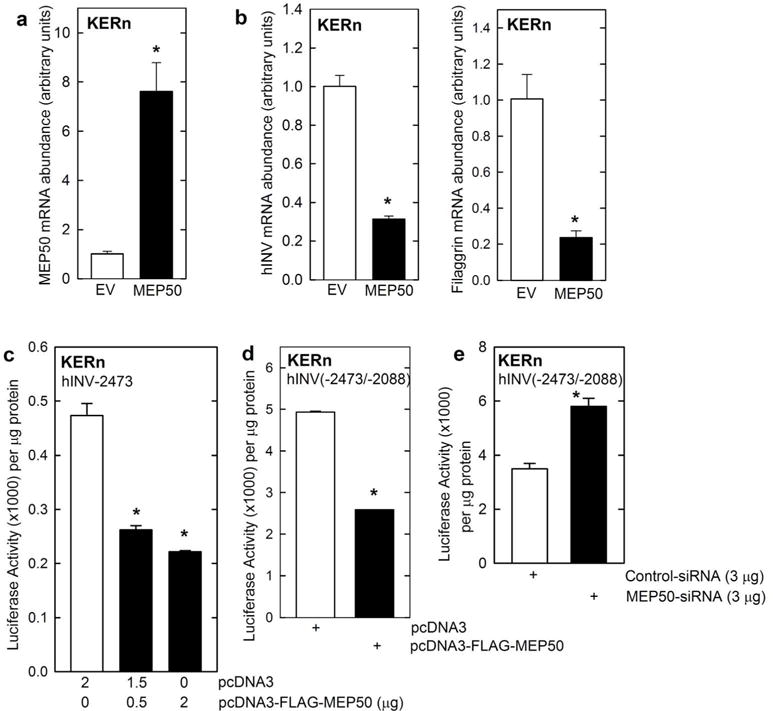
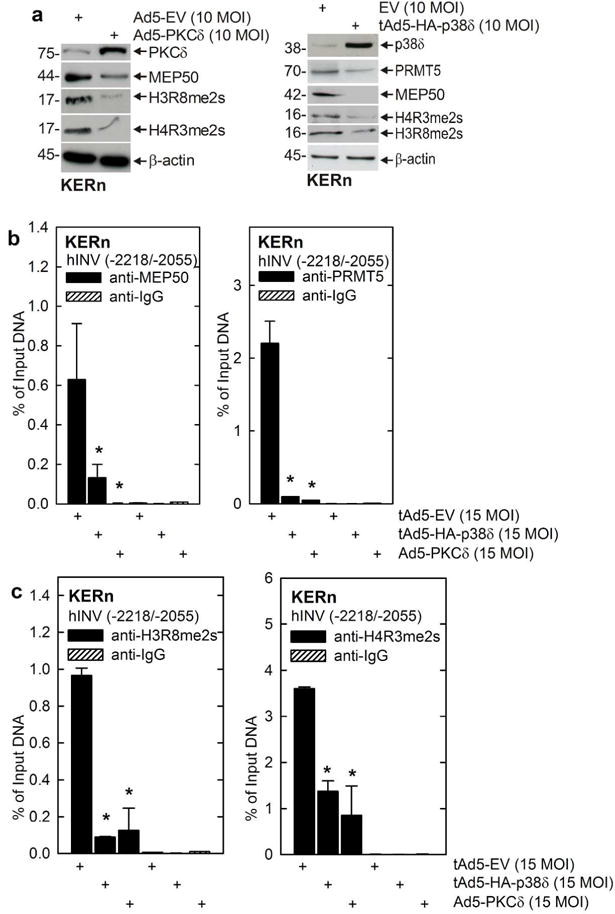
Protein kinase C δ (PKCδ) and p38δ are key proteins in a cascade that stimulates keratinocyte differentiation. This cascade activates transcription of involucrin (hINV) and other genes associated with differentiation. Protein arginine methyltransferase 5 (PRMT5) is an arginine methyltransferase that symmetrically dimethylates arginine residues. This protein interacts with a cofactor, methylosome protein 50 (MEP50), and symmetrically dimethylates arginine eight of histone 3 (H3R8me2s) and arginine three of histone 4 (H4R3me2s) to silence gene expression. We use the hINV gene as a tool to understand the relationship between PKCδ/p38δ and PRMT5/MEP50 signaling. MEP50 suppresses hINV mRNA level and promoter activity. This is associated with increased arginine dimethylation of hINV gene-associated H3/H4. We further show that the PKCδ/p38δ keratinocyte differentiation cascade reduces PRMT5 and MEP50 expression, association with the hINV gene promoter, and H3R8me2s and H4R2me2s formation. We propose that PRMT5/MEP50-dependent methylation is an epigenetic mechanism that assists in silencing of hINV expression, and that PKCδ signaling activates gene expression by directly activating transcription and by suppressing PRMT5/MEP50-dependent arginine dimethylation of promoter-associated histones. This is an example of crosstalk between PKCδ/p38δ signaling and PRMT5/MEP50 epigenetic silencing.
蛋白激酶Cδ(PKCδ)和p38δ是刺激角质形成细胞分化的级联反应中的关键蛋白。该级联反应激活了内披蛋白(hINV)和其他与分化相关基因的转录。蛋白精氨酸甲基转移酶5(PRMT5)是一种精氨酸甲基转移酶,可对称地使精氨酸残基发生二甲基化。该蛋白与辅因子甲基osome蛋白50(MEP50)相互作用,并对称地使组蛋白3的精氨酸8(H3R8me2s)和组蛋白4的精氨酸3(H4R3me2s)发生二甲基化,从而使基因表达沉默。我们使用hINV基因作为工具来了解PKCδ/p38δ与PRMT5/MEP50信号传导之间的关系。MEP50抑制hINV mRNA水平和启动子活性。这与hINV基因相关的H3/H4精氨酸二甲基化增加有关。我们进一步表明,PKCδ/p38δ角质形成细胞分化级联反应降低了PRMT5和MEP50的表达、与hINV基因启动子的结合以及H3R8me2s和H4R2me2s的形成。我们提出,PRMT5/MEP50依赖性甲基化是一种表观遗传机制,有助于hINV表达的沉默,并且PKCδ信号传导通过直接激活转录以及抑制启动子相关组蛋白的PRMT5/MEP50依赖性精氨酸二甲基化来激活基因表达。这是PKCδ/p38δ信号传导与PRMT5/MEP50表观遗传沉默之间相互作用的一个例子。