Jeon Sang Won, Han Changsu, Lee Jongha, Lim JaeHyoung, Jeong Hyun-Ghang, Park Moon Ho, Ko Young-Hoon, Pae Chi-Un, Kim Seung Hyun, Joe Sook-Haeng, Steffens David C
Department of Psychiatry, Korea University Ansan Hospital, Ansan, Republic of Korea.
Department of Psychiatry, Korea University Guro Hospital, Seoul, Republic of Korea.
Psychiatry Investig. 2016 Jan;13(1):50-7. doi: 10.4306/pi.2016.13.1.50. Epub 2015 Oct 27.
A community survey was performed to investigate the factors and perspectives associated with happiness among the elderly in Korea (≥60 years).
Eight hundred volunteers selected from participants in the Ansan Geriatric study (AGE study) were enrolled, and 706 completed the survey. The Happiness Questionnaire (HQ), which asks four questions about happiness, was administered. To explore the relationship between happiness and depression, the Geriatric Depression Scale (GDS) and the Beck Depression Inventory (BDI) also were administered.
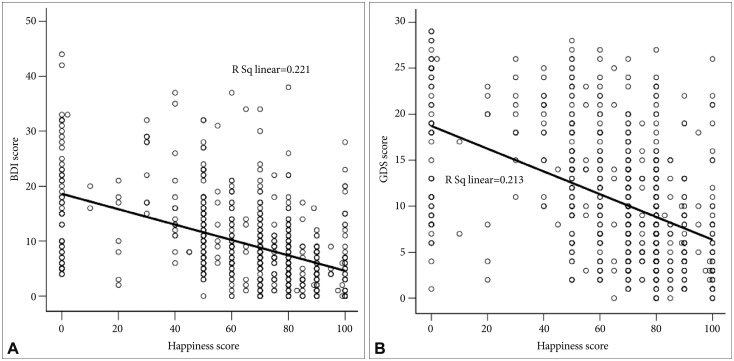
The participants' average level of happiness, determined using a 100-mm visual analogue scale (VAS) of the HQ, was 64.7±26.0. The happiest situations for most people were "getting together with family" (23.8%) and "living in peace with family members (well-being)" (13.2%). Frequent reasons for not being happy were "worsened health condition" (28.7% of the not-happy group), "economic problems of their own" (16.5%), and "economic problems of their children" (14.8%). The participants' choices regarding the essential conditions for happiness were "good health" (65.3%) and "being with family" (20.5%). The BDI and GDS scores were negatively related to the happiness score. A preliminary scale [Happy (Haeng-Bok, ) aging scale] based on the HQ for measuring the happiness level of the Korean elderly was suggested for follow-up studies.
The most important factors determining the happiness of the community-dwelling elderly in Korea were good family relationships, economic stability, and good health. A higher depression score negatively impacted happiness among Korean elders. Further studies on the factors in their happiness are required.
开展一项社区调查,以探究韩国60岁及以上老年人幸福相关的因素和观点。
从安山老年研究(AGE研究)的参与者中选取800名志愿者,706人完成了调查。使用幸福问卷(HQ)进行调查,该问卷包含四个关于幸福的问题。为探究幸福与抑郁之间的关系,还使用了老年抑郁量表(GDS)和贝克抑郁量表(BDI)。
使用HQ的100毫米视觉模拟量表(VAS)确定,参与者的平均幸福水平为64.7±26.0。大多数人最幸福的情况是“与家人团聚”(23.8%)和“与家人和睦相处(幸福安康)”(13.2%)。不幸福的常见原因是“健康状况恶化”(不幸福组的28.7%)、“自身经济问题”(16.5%)和“子女经济问题”(14.8%)。参与者对幸福必要条件的选择是“身体健康”(65.3%)和“与家人在一起”(20.5%)。BDI和GDS得分与幸福得分呈负相关。建议在后续研究中使用基于HQ的初步量表[幸福(Haeng - Bok, )老龄化量表]来测量韩国老年人的幸福水平。
决定韩国社区居住老年人幸福的最重要因素是良好的家庭关系、经济稳定和身体健康。较高的抑郁得分对韩国老年人的幸福有负面影响。需要对他们幸福的因素进行进一步研究。