Yoo Minsang, Lim Youn-Hee, Kim Taeshik, Lee Dongwook, Hong Yun-Chul
Department of Preventive Medicine, Seoul National University College of Medicine, Seoul, Republic of Korea.
Environmental Health Center, Seoul National University College of Medicine, Seoul, Republic of Korea ; Institute of Environmental Medicine, Seoul National University Medical Research Center, Seoul, Republic of Korea.
Ann Occup Environ Med. 2016 Jan 13;28:2. doi: 10.1186/s40557-015-0079-7. eCollection 2016.
According to US-EPA report, the use of pyrethrins and pyrethroids has increased during the past decade, and their area of use included not only in agricultural settings, but in commerce, and individual household. It is known that urinary 3-PBA, major metabolite of pyrethroid, have some associations with health effect in nervous and endocrine system, however, there's no known evidence that urinary 3-PBA have associations with obesity.
We used data of 3671 participants aged above 19 from the Korean National Environmental Health Survey in 2009-2011. In our analysis, multivariate piece-wise regression and logistic regression analysis were used to investigate the association between urinary 3-PBA (3-Phenoxybenzoic Acid) and BMI.
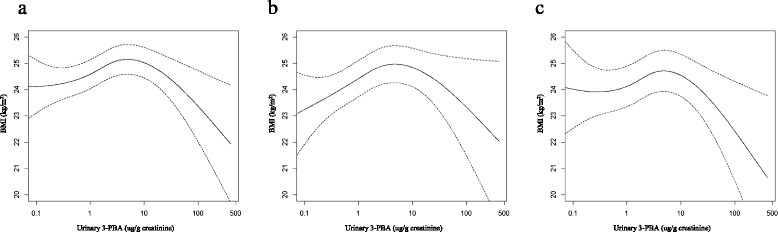
Log-transformed level of urinary 3-PBA had significantly positive association with BMI at the low-level range of exposure (p < 0.0001), and opposite associations were observed at the high level exposure (p = 0.04) after adjusting covariates. In piece-wise regression analysis, the flexion point that changes direction of the associations was at around 4 ug/g creatinine of urinary 3-PBA. As quintiles based on concentration of urinary 3-PBA increased to Q4, the ORs for prevalence of overweight (BMI ≥ 23 kg/m(2)) were increased, and the OR of Q5 was lower than that of Q4 (OR = 1.810 for Q4; OR = 1.483 for Q5). In the analysis using obesity (BMI ≥ 25 kg/m(2)) as outcome variable, significant associations were observed between obesity and quintiles of 3-PBA, however, there were no differences between the OR of Q5 and that of Q4 (OR = 1.659 for Q4; OR = 1.666 for Q5).
Our analysis suggested that low-level of pyrethroid exposure has positive association with BMI, however, there is an inverse relationship above the urinary 3-PBA level at 4 ug/g creatinine.
根据美国环境保护局(US-EPA)的报告,在过去十年中,除虫菊酯和拟除虫菊酯的使用有所增加,其使用范围不仅包括农业环境,还包括商业和家庭。已知拟除虫菊酯的主要代谢产物尿中3-PBA(3-苯氧基苯甲酸)与神经和内分泌系统的健康效应存在一定关联,然而,尚无证据表明尿中3-PBA与肥胖有关。
我们使用了2009 - 2011年韩国国家环境卫生调查中3671名19岁以上参与者的数据。在分析中,采用多元分段回归和逻辑回归分析来研究尿中3-PBA(3-苯氧基苯甲酸)与体重指数(BMI)之间的关联。
在调整协变量后,尿中3-PBA的对数转换水平在低暴露范围内与BMI呈显著正相关(p < 0.0001),而在高暴露水平下观察到相反的关联(p = 0.04)。在分段回归分析中,关联方向发生变化的转折点约为尿中3-PBA 4微克/克肌酐。随着基于尿中3-PBA浓度的五分位数增加到Q4,超重(BMI≥23千克/米²)患病率的比值比(OR)增加,而Q5的OR低于Q4(Q4的OR = 1.810;Q5的OR = 1.483)。在以肥胖(BMI≥25千克/米²)作为结局变量的分析中,观察到肥胖与3-PBA五分位数之间存在显著关联,然而,Q5的OR与Q4之间没有差异(Q4的OR = 1.659;Q5的OR = 1.666)。
我们的分析表明,低水平的拟除虫菊酯暴露与BMI呈正相关,然而,在尿中3-PBA水平高于4微克/克肌酐时存在负相关关系。