Almasaudi Saad B, El-Shitany Nagla A, Abbas Aymn T, Abdel-dayem Umama A, Ali Soad S, Al Jaouni Soad K, Harakeh Steve
Biology Department, Faculty of Science, King Abdulaziz University, Jeddah 21589, Saudi Arabia.
Department of Pharmacology and Toxicology, Faculty of Pharmacy, King Abdulaziz University, Jeddah 21589, Saudi Arabia; Department of Pharmacology and Toxicology, Faculty of Pharmacy, Tanta University, Tanta 31111, Egypt.
Oxid Med Cell Longev. 2016;2016:3643824. doi: 10.1155/2016/3643824. Epub 2015 Dec 7.
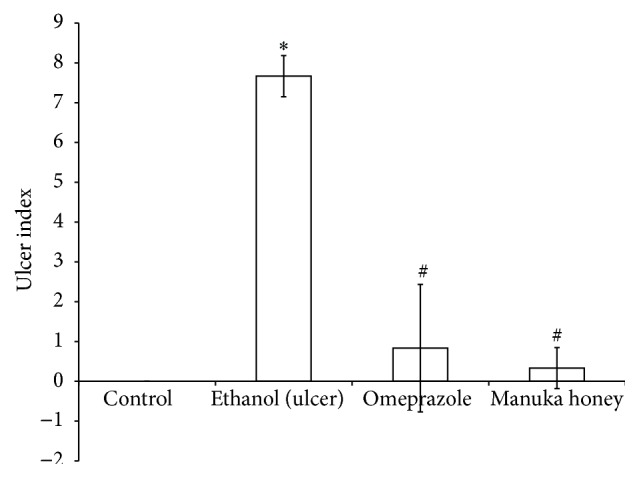
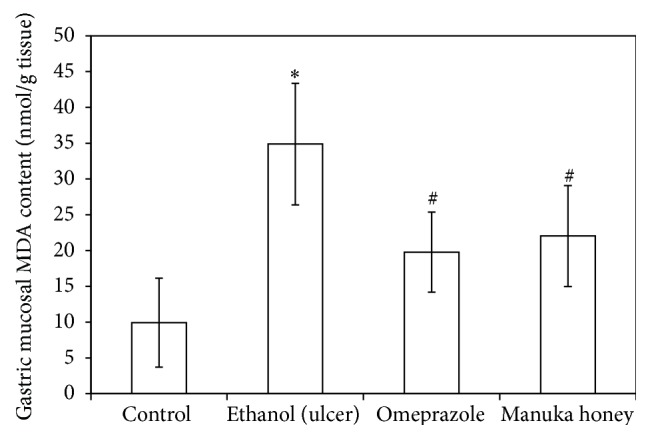
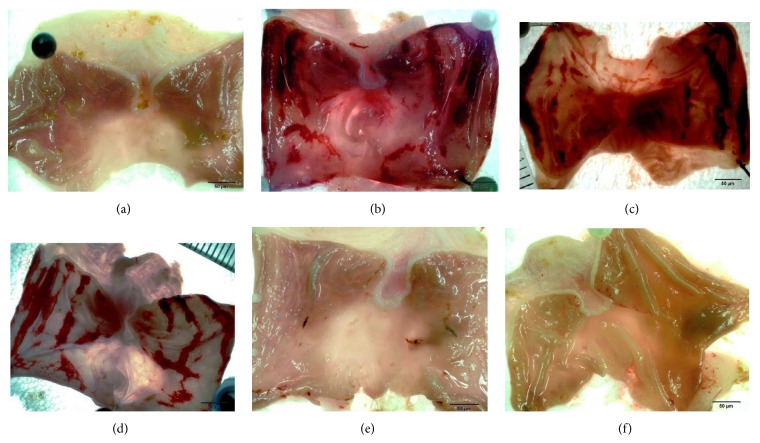
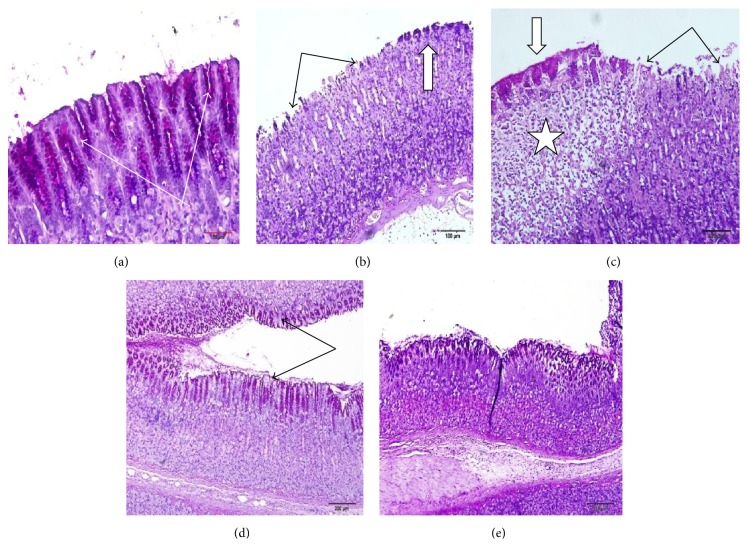
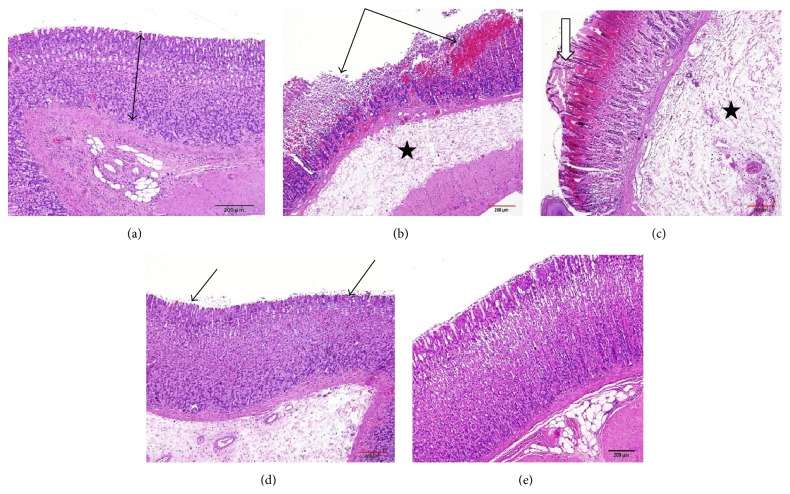
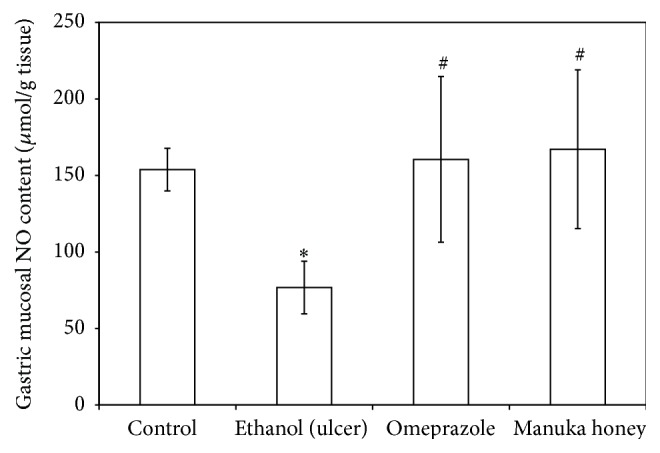
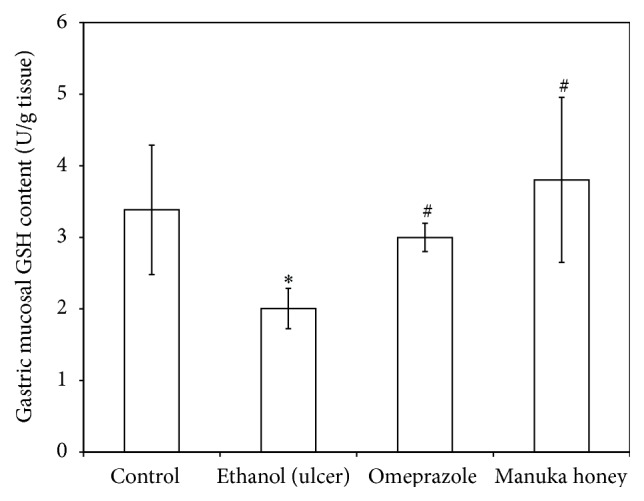
Gastric ulcers are among the most common diseases affecting humans. This study aimed at investigating the gastroprotective effects of manuka honey against ethanol-induced gastric ulcers in rats. The mechanism by which honey exerts its antiulcer potential was elucidated. Four groups of rats were used: control, ethanol (ulcer), omeprazole, and manuka honey. Stomachs were examined macroscopically for hemorrhagic lesions in the glandular mucosa, histopathological changes, and glycoprotein detection. The effects of oxidative stress were investigated using the following indicators: gastric mucosal nitric oxide (NO), reduced glutathione (GSH), lipid peroxide (MDA, measured as malondialdehyde) glutathione peroxidase (GPx), superoxide dismutase (SOD), and catalase. Plasma tumour necrosis factor-α, interleukin-1β, and IL-6 were also measured. Manuka honey significantly decreased the ulcer index, completely protected the mucosa from lesions, and preserved gastric mucosal glycoprotein. It significantly increased gastric mucosal levels of NO, GSH, GPx, and SOD. Manuka honey also decreased gastric mucosal MDA and plasma TNF-α, IL-1β, and IL-6 concentrations. In conclusion, manuka honey likely exerted its antiulcer, effect by keeping enzymatic (GPx and SOD) and nonenzymatic (GSH and NO) antioxidants as well as inflammatory cytokines (TNF-α, IL-1β, and IL-6) in a reduced form, inhibited lipid peroxidation (MDA), and preserved mucous glycoproteins levels.
胃溃疡是影响人类的最常见疾病之一。本研究旨在探讨麦卢卡蜂蜜对大鼠乙醇诱导的胃溃疡的胃保护作用。阐明了蜂蜜发挥其抗溃疡潜力的机制。使用了四组大鼠:对照组、乙醇(溃疡组)、奥美拉唑组和麦卢卡蜂蜜组。对胃进行宏观检查,以观察腺黏膜的出血性病变、组织病理学变化和糖蛋白检测。使用以下指标研究氧化应激的影响:胃黏膜一氧化氮(NO)、还原型谷胱甘肽(GSH)、脂质过氧化物(以丙二醛衡量的MDA)、谷胱甘肽过氧化物酶(GPx)、超氧化物歧化酶(SOD)和过氧化氢酶。还测量了血浆肿瘤坏死因子-α、白细胞介素-1β和IL-6。麦卢卡蜂蜜显著降低溃疡指数,完全保护黏膜免受损伤,并保留胃黏膜糖蛋白。它显著提高了胃黏膜中NO、GSH、GPx和SOD的水平。麦卢卡蜂蜜还降低了胃黏膜MDA以及血浆TNF-α、IL-1β和IL-6的浓度。总之,麦卢卡蜂蜜可能通过使酶性(GPx和SOD)和非酶性(GSH和NO)抗氧化剂以及炎性细胞因子(TNF-α、IL-1β和IL-6)处于还原形式、抑制脂质过氧化(MDA)并保留黏液糖蛋白水平来发挥其抗溃疡作用。