Wójciak-Kosior Magdalena, Sowa Ireneusz, Blicharski Tomasz, Strzemski Maciej, Dresler Sławomir, Szymczak Grażyna, Wnorowski Artur, Kocjan Ryszard, Świeboda Ryszard
Department of Analytical Chemistry, Medical University of Lublin, Chodźki 4a, Lublin 20-093, Poland.
Orthopaedics and Rehabilitation Clinic, Medical University Lublin, Chodźki 4a, Lublin 20-093, Poland.
Molecules. 2016 Jan 14;21(1):90. doi: 10.3390/molecules21010090.
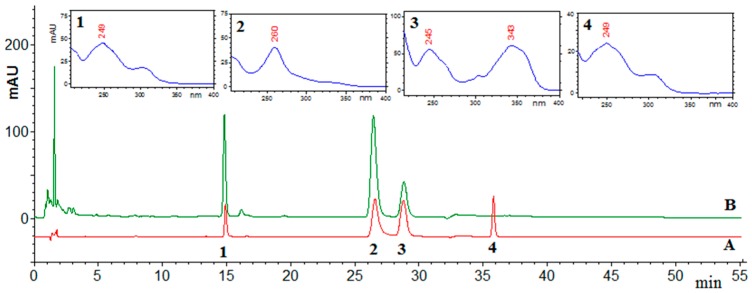
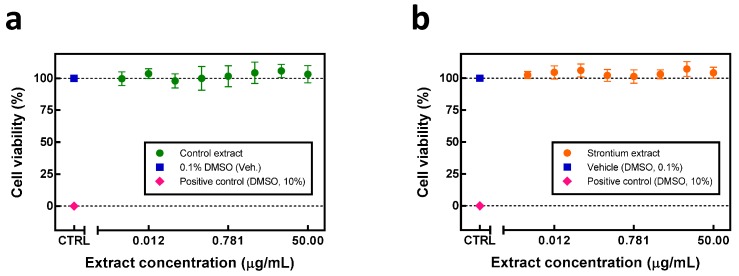
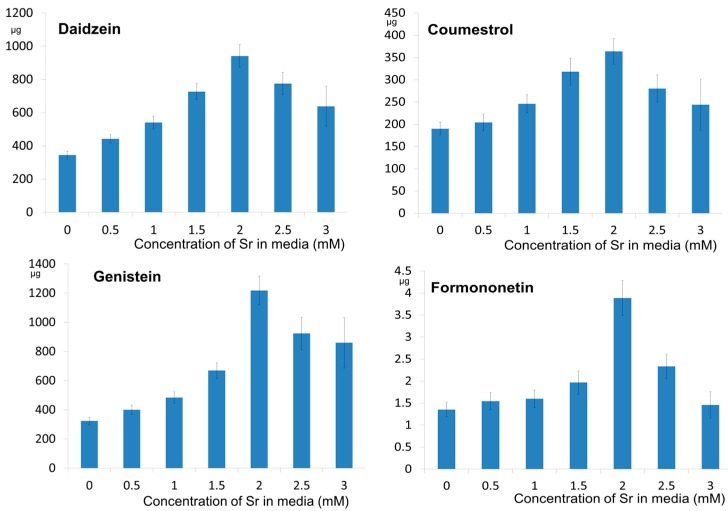
The amount of secondary metabolites in plants can be enhanced or reduced by various external factors. In this study, the effect of strontium ions on the production of phytoestrogens in soybeans was investigated. The plants were treated with Hoagland's solution, modified with Sr(2+) with concentrations ranging from 0.5 to 3.0 mM, and were grown for 14 days in hydroponic cultivation. After harvest, soybean plants were separated into roots and shoots, dried, and pulverized. The plant material was extracted with methanol and hydrolyzed. Phytoestrogens were quantified by HPLC. The significant increase in the concentration of the compounds of interest was observed for all tested concentrations of strontium ions when compared to control. Sr(2+) at a concentration of 2 mM was the strongest elicitor, and the amount of phytoestrogens in plant increased ca. 2.70, 1.92, 3.77 and 2.88-fold, for daidzein, coumestrol, genistein and formononetin, respectively. Moreover, no cytotoxic effects were observed in HepG2 liver cell models after treatment with extracts from 2 mM Sr(2+)-stressed soybean plants when compared to extracts from non-stressed plants. Our results indicate that the addition of strontium ions to the culture media may be used to functionalize soybean plants with enhanced phytoestrogen content.
植物中次生代谢产物的含量可因各种外部因素而增加或减少。在本研究中,研究了锶离子对大豆中植物雌激素产生的影响。用浓度范围为0.5至3.0 mM的Sr(2+)修饰的霍格兰氏溶液处理植物,并在水培条件下培养14天。收获后,将大豆植株分为根和地上部分,干燥并粉碎。用甲醇提取植物材料并进行水解。通过高效液相色谱法定量植物雌激素。与对照相比,在所有测试的锶离子浓度下均观察到目标化合物浓度的显著增加。浓度为2 mM的Sr(2+)是最强的诱导剂,植物中大豆苷元、香豆雌酚、染料木黄酮和芒柄花素的植物雌激素含量分别增加了约2.70、1.92、3.77和2.88倍。此外,与未受胁迫植物的提取物相比,用2 mM Sr(2+)胁迫的大豆植物提取物处理后,在HepG2肝细胞模型中未观察到细胞毒性作用。我们的结果表明,向培养基中添加锶离子可用于使大豆植株功能化,提高植物雌激素含量。