Agebratt Christian, Ström Edvin, Romu Thobias, Dahlqvist-Leinhard Olof, Borga Magnus, Leandersson Per, Nystrom Fredrik H
Department of Medical and Health Sciences, Faculty of Medicine and Health Sciences, Linköping University, Linköping, Sweden.
Center for Medical Image Science and Visualization, Faculty of Medicine and Health Sciences, Linköping University, Linköping, Sweden.
PLoS One. 2016 Jan 20;11(1):e0147149. doi: 10.1371/journal.pone.0147149. eCollection 2016.
Fruit has since long been advocated as a healthy source of many nutrients, however, the high content of sugars in fruit might be a concern.
To study effects of an increased fruit intake compared with similar amount of extra calories from nuts in humans.
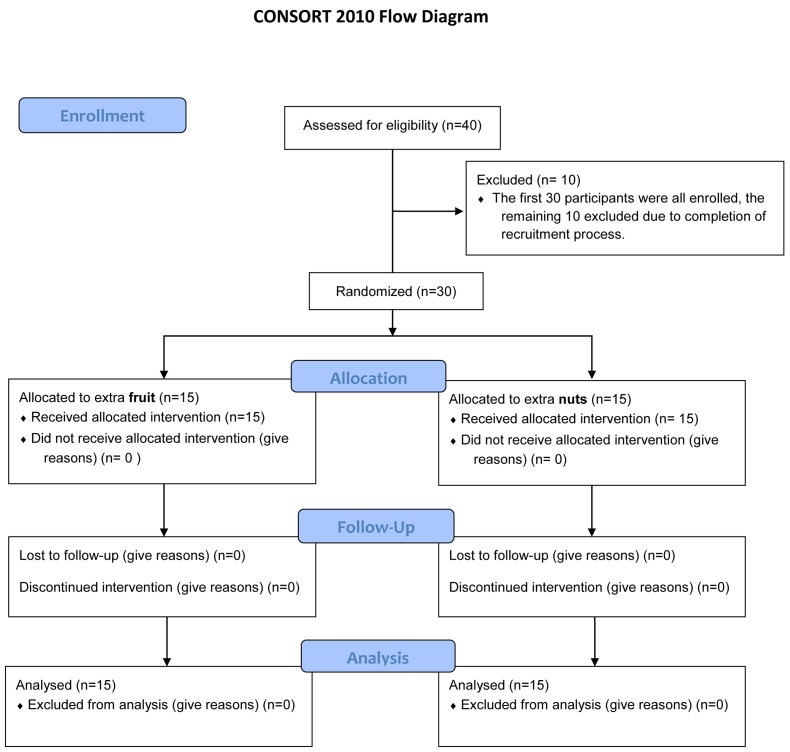
Thirty healthy non-obese participants were randomized to either supplement the diet with fruits or nuts, each at +7 kcal/kg bodyweight/day for two months. Major endpoints were change of hepatic fat content (HFC, by magnetic resonance imaging, MRI), basal metabolic rate (BMR, with indirect calorimetry) and cardiovascular risk markers.
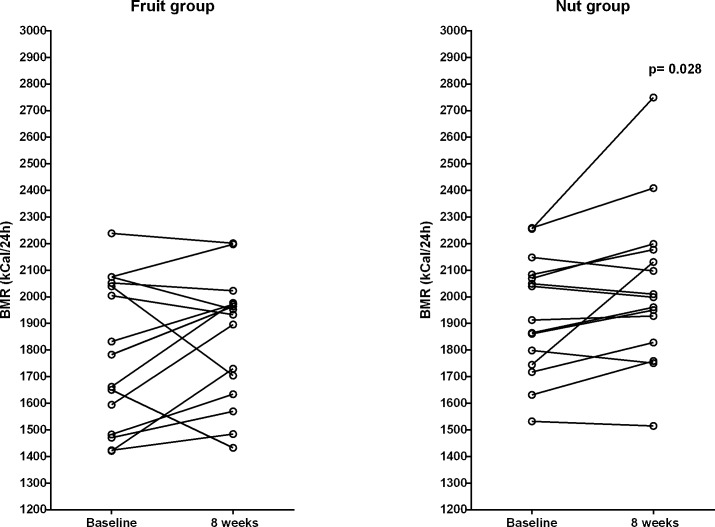
Weight gain was numerically similar in both groups although only statistically significant in the group randomized to nuts (fruit: from 22.15 ± 1.61 kg/m(2) to 22.30 ± 1.7 kg/m(2), p = 0.24 nuts: from 22.54 ± 2.26 kg/m(2) to 22.73 ± 2.28 kg/m(2), p = 0.045). On the other hand BMR increased in the nut group only (p = 0.028). Only the nut group reported a net increase of calories (from 2519 ± 721 kcal/day to 2763 ± 595 kcal/day, p = 0.035) according to 3-day food registrations. Despite an almost three-fold reported increased fructose-intake in the fruit group (from 9.1 ± 6.0 gram/day to 25.6 ± 9.6 gram/day, p<0.0001, nuts: from 12.4 ± 5.7 gram/day to 6.5 ± 5.3 gram/day, p = 0.007) there was no change of HFC. The numerical increase in fasting insulin was statistically significant only in the fruit group (from 7.73±3.1 mIE/L to 8.81±2.9 mIE/L, p = 0.018, nuts: from 7.29±2.9 mIE/L to 8.62±3.0 mIE/L, p = 0.14). Levels of vitamin C increased in both groups while α-tocopherol/cholesterol-ratio increased only in the fruit group.
Although BMR increased in the nut-group only this was not linked with differences in weight gain between groups which potentially could be explained by the lack of reported net caloric increase in the fruit group. In healthy non-obese individuals an increased fruit intake seems safe from cardiovascular risk perspective, including measurement of HFC by MRI.
ClinicalTrials.gov NCT02227511.
长期以来,水果一直被视为许多营养物质的健康来源,然而,水果中高含量的糖分可能令人担忧。
研究与摄入等量来自坚果的额外热量相比,增加水果摄入量对人体的影响。
30名健康的非肥胖参与者被随机分为两组,一组通过水果补充饮食,另一组通过坚果补充饮食,每组每天每千克体重额外摄入7千卡热量,为期两个月。主要终点指标为肝脏脂肪含量(通过磁共振成像,即MRI测量)、基础代谢率(通过间接测热法测量)和心血管风险标志物的变化。
两组体重增加的数值相似,但仅随机分配到坚果组的体重增加具有统计学意义(水果组:从22.15±1.61kg/m²增至22.30±1.7kg/m²,p = 0.24;坚果组:从22.54±2.26kg/m²增至22.73±2.28kg/m²,p = 0.045)。另一方面,仅坚果组的基础代谢率有所增加(p = 0.028)。根据3天的食物记录,只有坚果组报告热量净增加(从2519±721千卡/天增至2763±595千卡/天,p = 0.035)。尽管水果组报告的果糖摄入量几乎增加了三倍(从9.1±6.0克/天增至25.6±9.6克/天,p<0.0001;坚果组:从12.4±5.7克/天降至6.5±5.3克/天,p = 0.007),但肝脏脂肪含量没有变化。空腹胰岛素的数值增加仅在水果组具有统计学意义(从7.73±3.1mIE/L增至8.81±2.9mIE/L,p = 0.018;坚果组:从7.29±2.9mIE/L增至8.62±3.0mIE/L,p = 0.14)。两组的维生素C水平均升高,而α-生育酚/胆固醇比值仅在水果组升高。
尽管只有坚果组的基础代谢率增加,但这与两组之间体重增加的差异无关,这可能是因为水果组报告的热量没有净增加。从心血管风险角度来看,在健康的非肥胖个体中增加水果摄入量似乎是安全的,包括通过MRI测量肝脏脂肪含量。
ClinicalTrials.gov NCT02227511。