Daubois Laurence, Beaudet Denis, Hijri Mohamed, de la Providencia Ivan
Institut de Recherche en Biologie Végétale, Université de Montréal, 4101 Sherbrooke Est, Montréal, H1X 2B2, QC, Canada.
BMC Microbiol. 2016 Jan 23;16:11. doi: 10.1186/s12866-016-0627-5.
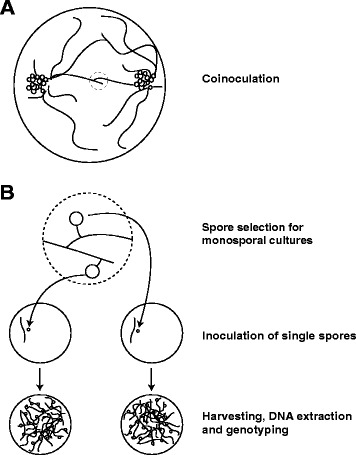
Arbuscular mycorrhizal fungi (AMF) are members of the phylum Glomeromycota, an early divergent fungal lineage that forms symbiotic associations with the large majority of land plants. These organisms are asexual obligate biotrophs, meaning that they cannot complete their life cycle in the absence of a suitable host. These fungi can exchange genetic information through hyphal fusions (i.e. anastomosis) with genetically compatible isolates belonging to the same species. The occurrence of transient mitochondrial length-heteroplasmy through anastomosis between geographically distant Rhizophagus irregularis isolates was previously demonstrated in single spores resulting from crossing experiments. However, (1) the persistence of this phenomenon in monosporal culture lines from crossed parental isolates, (2) its correlation with nuclear exchanges and (3) the potential mechanisms responsible for mitochondrial inheritance are still unknown. Using the AMF model organism R. irregularis, we tested whether the presence of a heteroplasmic state in progeny spores was linked to the occurrence of nuclear exchanges and whether the previously observed heteroplasmic state persisted in monosporal in vitro crossed-culture lines. We also investigated the presence of a putative mitochondrial segregation apparatus in Glomeromycota by identifying proteins similar to those found in other fungal groups.
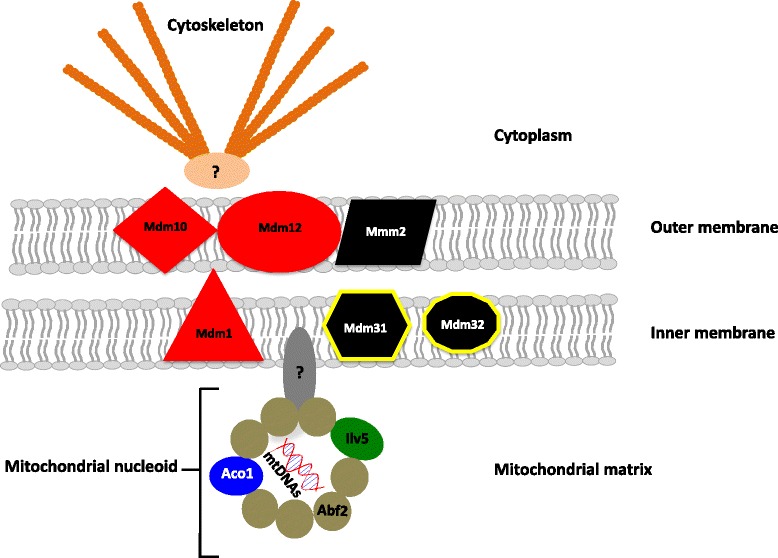
We observed the occurrence of biparental inheritance both for mitochondrial and nuclear markers tested in single spores obtained from crossed-isolates. However, only one parental mitochondrial DNA and nuclear genotype were recovered in each monosporal crossed-cultures, with an overrepresentation of certain mitochondrial haplotypes. These results strongly support the presence of a nuclear-independent mitochondrial segregation mechanism in R. irregularis. Furthermore, a nearly complete set of genes was identified with putative orthology to those found in other fungi and known to be associated with the mitochondrial segregation in Saccharomyces cerevisiae and filamentous fungi.
Our findings suggest that mitochondrial segregation might take place either during spore formation or colony development and that it might be independent of the nuclear segregation machinery. We present the basic building blocks for a better understanding of the mitochondrial inheritance process and segregation in these important symbiotic fungi. The comprehension of these processes is of great importance since it has been shown that different segregated lines of the same isolate can have variable effects on the host plant.
丛枝菌根真菌(AMF)是球囊菌门的成员,这是一个早期分化的真菌谱系,与绝大多数陆地植物形成共生关系。这些生物是无性专性生物营养体,这意味着它们在没有合适宿主的情况下无法完成其生命周期。这些真菌可以通过菌丝融合(即吻合)与属于同一物种的基因兼容分离株交换遗传信息。先前在杂交实验产生的单个孢子中证明了地理上遥远的不规则根孢霉分离株之间通过吻合出现短暂的线粒体长度异质性。然而,(1)这种现象在杂交亲本分离株的单孢培养系中的持续性,(2)其与核交换的相关性,以及(3)负责线粒体遗传的潜在机制仍然未知。使用AMF模式生物不规则根孢霉,我们测试了子代孢子中异质状态的存在是否与核交换的发生有关,以及先前观察到的异质状态是否在单孢体外杂交培养系中持续存在。我们还通过鉴定与其他真菌类群中发现的蛋白质相似的蛋白质,研究了球囊菌门中假定的线粒体分离装置的存在。
我们观察到在从杂交分离株获得的单个孢子中测试的线粒体和核标记都出现了双亲遗传。然而,在每个单孢杂交培养物中仅回收了一个亲本的线粒体DNA和核基因型,某些线粒体单倍型的比例过高。这些结果有力地支持了不规则根孢霉中存在独立于核的线粒体分离机制。此外,鉴定出了一组几乎完整的基因,它们与其他真菌中发现的基因具有假定的直系同源性,并且已知与酿酒酵母和丝状真菌中的线粒体分离有关。
我们的研究结果表明,线粒体分离可能发生在孢子形成或菌落发育过程中,并且可能独立于核分离机制。我们提供了基本组成部分,以便更好地理解这些重要共生真菌中的线粒体遗传过程和分离。理解这些过程非常重要,因为已经表明同一分离株的不同分离系对宿主植物可能有不同的影响。