Jiang Miao, Zha Qinglin, Zhang Chi, Lu Cheng, Yan Xiaoping, Zhu Wanhua, Liu Wei, Tu Shenghao, Hou Liping, Wang Chengwu, Zhang Wandong, Liang Qinghua, Fan Bing, Yu Jiangping, Zhang Weidong, Liu Xinru, Yang Jing, He Xiaojuan, Li Li, Niu Xuyan, Liu Yan, Guo Hongtao, He Bing, Zhang Ge, Bian Zhaoxiang, Lu Aiping
Institute of Basic Research in Clinical Medicine, China Academy of Chinese Medical Sciences, Beijing 100700, P.R. China.
School of Chinese Medicine, Hong Kong Baptist University, Kowloon Tong, Kowloon 999077, Hong Kong.
Sci Rep. 2015 Apr 15;5:9700. doi: 10.1038/srep09700.
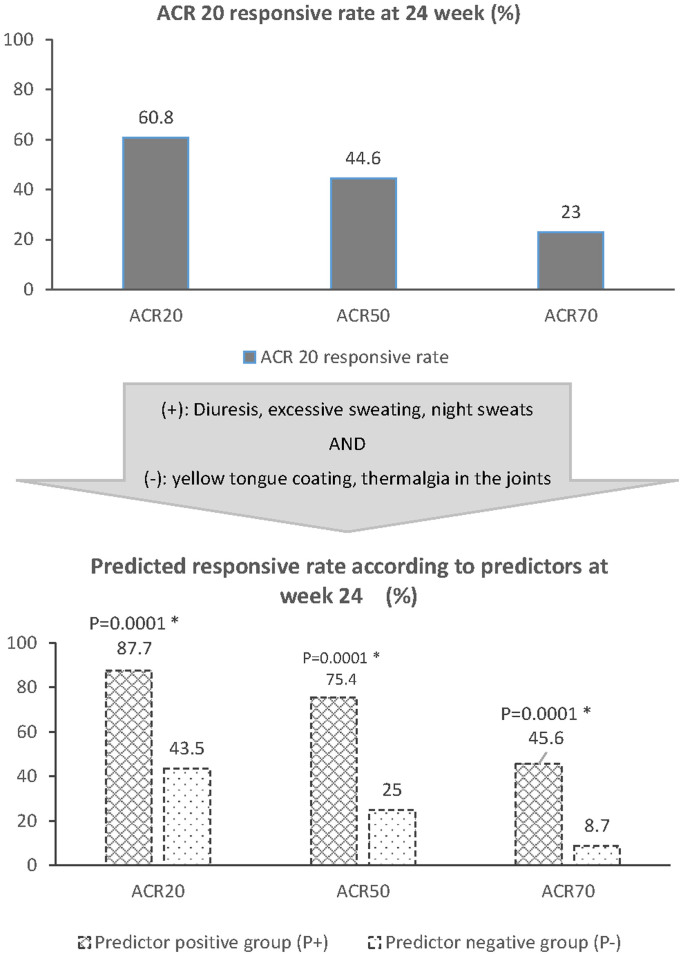
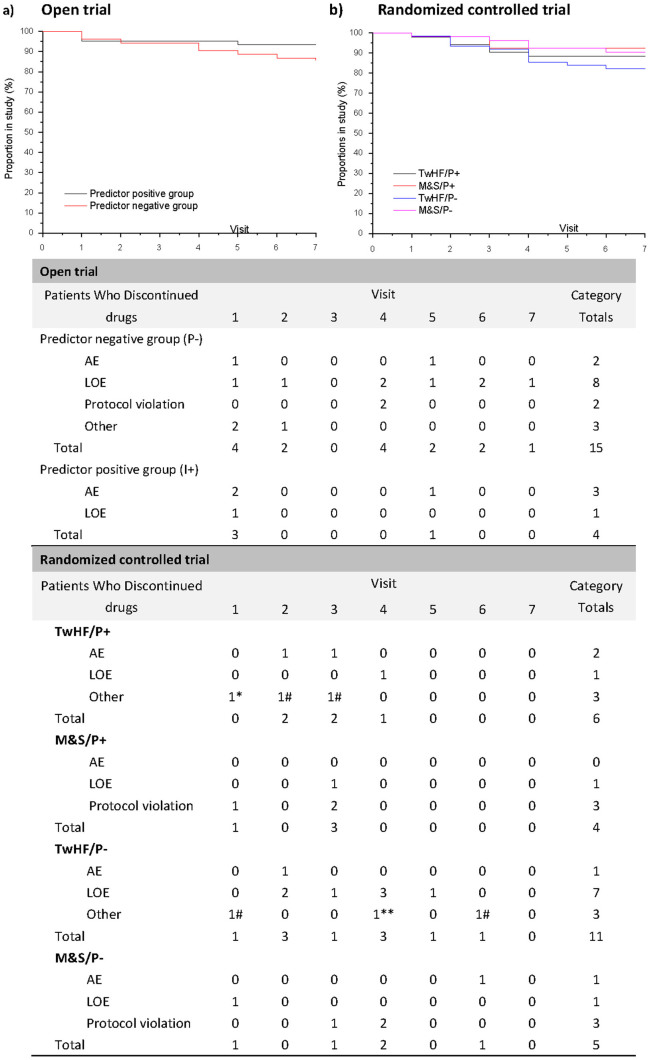
Tripterygium wilfordii Hook F. (TwHF) based therapy has been proved as effective in treating rheumatoid arthritis (RA), yet the predictors to its response remains unclear. A two-stage trial was designed to identify and verify the baseline symptomatic predictors of this therapy. 167 patients with active RA were enrolled with a 24-week TwHF based therapy treatment and the symptomatic predictors were identified in an open trial; then in a randomized clinical trial (RCT) for verification, 218 RA patients were enrolled and classified into predictor positive (P+) and predictor negative (P-) group, and were randomly assigned to accept the TwHF based therapy and Methotrexate and Sulfasalazine combination therapy (M) for 24 weeks, respectively. Five predictors were identified (diuresis, excessive sweating, night sweats for positive; and yellow tongue-coating, thermalgia in the joints for negative). In the RCT, The ACR 20 responses were 82.61% in TwHF/P+ group, significantly higher than that in TwHF/P- group (P = 0.0001) and in M&S/P+ group (P < 0.05), but not higher than in M&S/P- group. Similar results were yielded in ACR 50 yet not in ACR 70 response. No significant differences were detected in safety profiles among groups. The identified predictors enable the TwHF based therapy more efficiently in treating RA subpopulations.
雷公藤多苷(TwHF)疗法已被证明对类风湿关节炎(RA)有效,但其疗效的预测因素尚不清楚。一项两阶段试验旨在识别和验证该疗法的基线症状预测因素。167例活动期RA患者接受了为期24周的基于TwHF的治疗,并在一项开放试验中确定了症状预测因素;然后在一项随机临床试验(RCT)中进行验证,招募了218例RA患者,分为预测因素阳性(P+)组和预测因素阴性(P-)组,并随机分配分别接受基于TwHF的治疗和甲氨蝶呤与柳氮磺胺吡啶联合治疗(M)24周。确定了五个预测因素(多尿、多汗、盗汗为阳性;舌苔黄、关节热痛为阴性)。在RCT中,TwHF/P+组的美国风湿病学会(ACR)20反应率为82.61%,显著高于TwHF/P-组(P = 0.0001)和M&S/P+组(P < 0.05),但不高于M&S/P-组。ACR 50反应也有类似结果,但ACR 70反应无此结果。各组间安全性方面未检测到显著差异。所确定的预测因素使基于TwHF的疗法能更有效地治疗RA亚群。