Jeong Woon Kyung, Baek Seong Kyu, Kim Mi Kyung, Kwon Sun Young, Kim Hye Soon
Department of Surgery, Keimyung University Dongsan Medical Center, Keimyung University School of Medicine, Daegu, Korea.
Department of Internal Medicine, Keimyung University Dongsan Medical Center, Keimyung University School of Medicine, Daegu, Korea.
Ann Coloproctol. 2015 Dec;31(6):222-7. doi: 10.3393/ac.2015.31.6.222. Epub 2015 Dec 31.
Leptin is encoded by the ob gene and is involved in the control of food intake and energy expenditure. Recent studies have implicated leptin expression to be an indicator of tumor features and prognosis. The purpose of this study was to investigate the association of tissue expression of leptin with the clinicopathological characteristics and clinical outcomes in colorectal cancer patients.
Patients who had undergone a curative surgical resection for a colorectal adenocarcinoma from 2000 to 2004 were included in the study. Immunohistochemical analyses of leptin expression were performed, and clinicopathological parameters were evaluated.
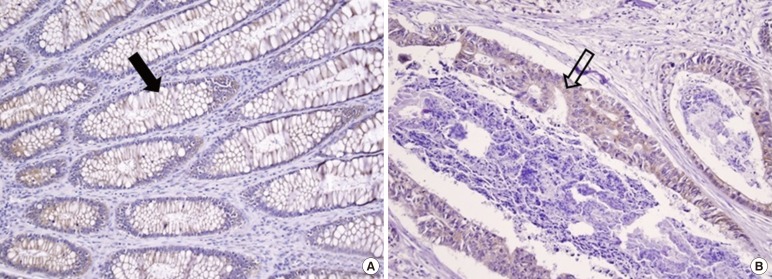
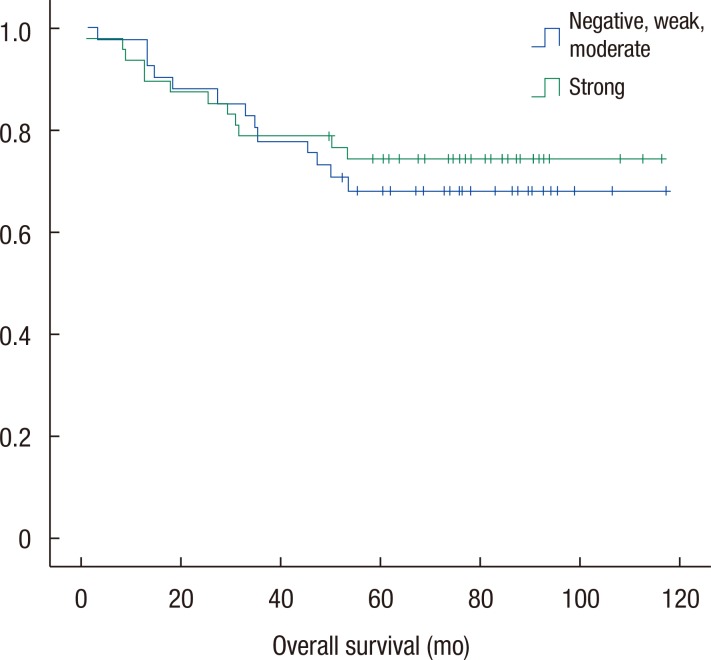
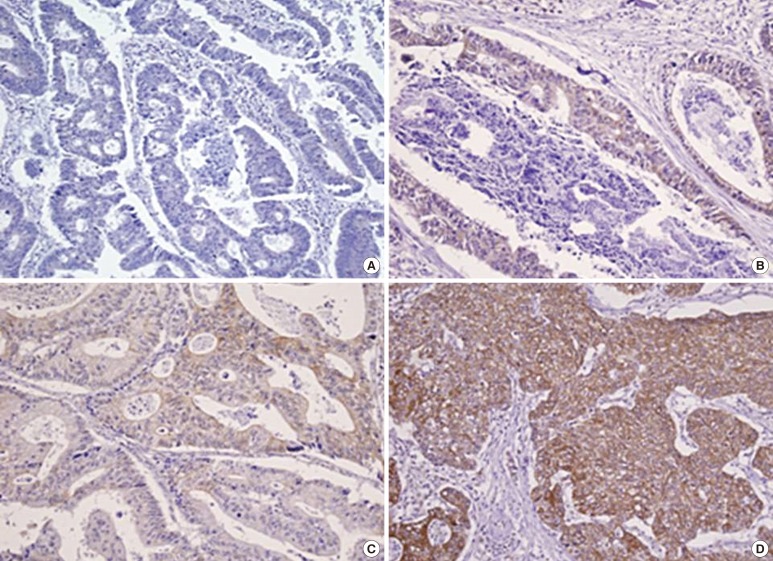
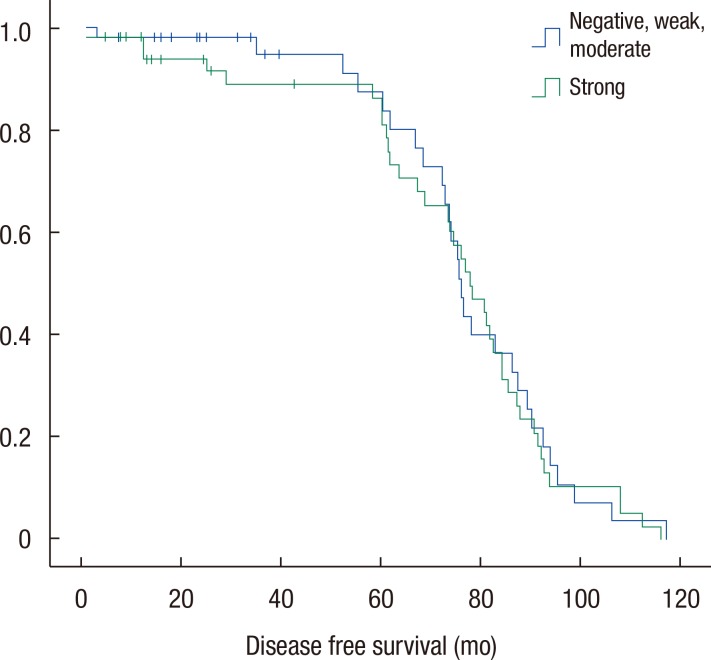
Clinical data and tumor tissues of 146 patients were evaluated. The mean age was 68.6 ± 11.3 years, and 61.0% were men. Immunohistochemically, the rates of negative, weak, moderate, and strong leptin expression were 2.7% (4 of 146), 5.5% (8 of 146), 43.2% (63 of 146), and 48.6% (71 of 146), respectively. We compared the negative, weak, and moderate expression group (group A) with the strong expression group (group B). Leptin expression was inversely associated with nodal stage (P = 0.007) between the two groups. Leptin expression was not significantly associated with differentiation (P = 0.37), T stage (P = 0.16), and American Joint Committee on Cancer stage (P = 0.49), and no significant differences in the disease-free and the overall survivals (P = 0.78 and P = 0.61) were observed.
Results demonstrated an inverse association of nodal stage with high leptin expression. Higher leptin expression level might predict better oncologic outcome. However, further studies are warranted to identify the exact role of leptin expression in colorectal cancer.
瘦素由ob基因编码,参与食物摄入和能量消耗的调控。近期研究表明,瘦素表达是肿瘤特征和预后的一个指标。本研究旨在探讨结直肠癌患者中瘦素组织表达与临床病理特征及临床结局的相关性。
纳入2000年至2004年间因结直肠腺癌接受根治性手术切除的患者。进行瘦素表达的免疫组化分析,并评估临床病理参数。
对146例患者的临床资料和肿瘤组织进行了评估。平均年龄为68.6±11.3岁,男性占61.0%。免疫组化结果显示,瘦素阴性、弱阳性、中度阳性和强阳性表达率分别为2.7%(146例中的4例)、5.5%(146例中的8例)、43.2%(146例中的63例)和48.6%(146例中的71例)。我们将阴性、弱阳性和中度阳性表达组(A组)与强阳性表达组(B组)进行比较。两组之间瘦素表达与淋巴结分期呈负相关(P = 0.007)。瘦素表达与分化程度(P = 0.37)、T分期(P = 0.16)及美国癌症联合委员会分期(P = 0.49)无显著相关性,且在无病生存期和总生存期方面未观察到显著差异(P = 0.78和P = 0.61)。
结果表明淋巴结分期与高瘦素表达呈负相关。较高的瘦素表达水平可能预示着更好的肿瘤学结局。然而,有必要进一步研究以明确瘦素表达在结直肠癌中的确切作用。