Li Jun, Zhu Wenhua, Liu Wenhui, Wu Yingqiao, Wu Benyan
From the Department of Gastroenterology, Chinese PLA General Hospital, Fuxing Road (JL, WL, YW, BW); and Department of Oncology, Chinese 309th Hospital of PLA, Hei Shan Hu Road, Beijing, China (WZ).
Medicine (Baltimore). 2016 Jan;95(4):e2534. doi: 10.1097/MD.0000000000002534.
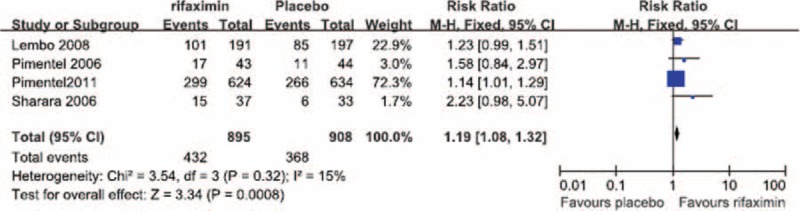
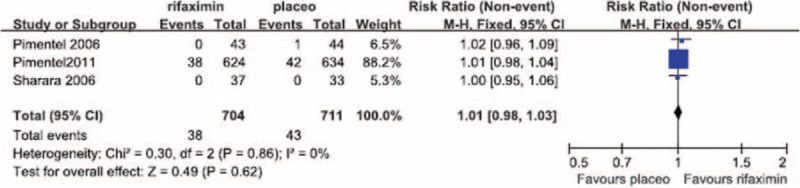
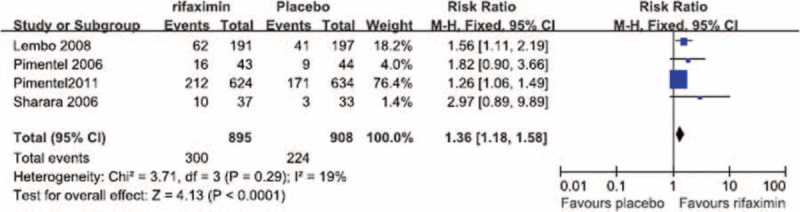
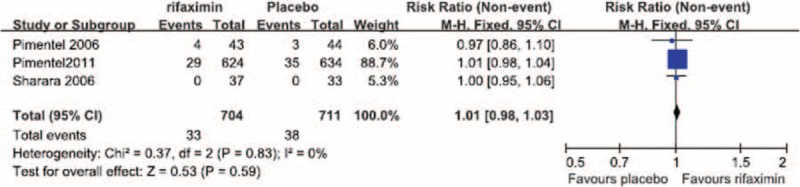
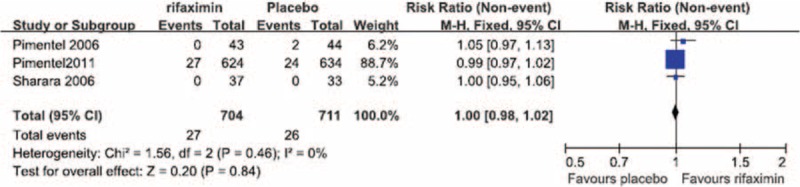
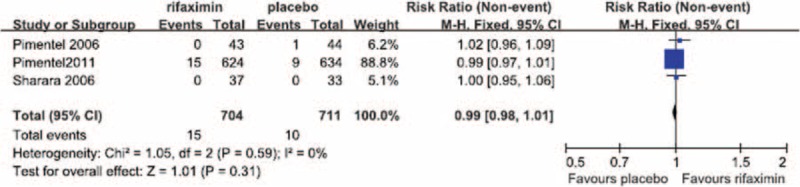
The current treatments for irritable bowel syndrome (IBS) are suboptimal. The findings of previous studies of rifaximin treatment for IBS may have differed due to variations in study design. Our study aimed to determine the therapeutic and adverse effects of rifaximin treatment for IBS based on a meta-analysis of published randomized controlled trials (RCTs). We searched the MEDLINE, EMBASE, EBSCO, Springer, Ovid, and Cochrane Library databases for RCTs investigating the effects of rifaximin on IBS. Data from each selected RCT was evaluated individually based on an intention-to-treat analysis, and a meta-analysis was performed in which the odds ratios (ORs) and 95% confidence intervals (CIs) of clinical outcomes and adverse events were calculated using fixed-effects models. Four eligible studies were identified. Overall relief of IBS symptoms in the rifaximin groups was greater than that in the placebo groups at the ends of both the treatment and follow-up periods (OR = 1.19; 95% CI: 1.08-1.32 and OR = 1.36; 95% CI: 1.18-1.58, respectively, P < 0.05 for both). Significant relief of abdominal distention was observed at the follow-up endpoint (OR = 1.69; 95% Cl: 1.27-2.23; P < 0.05), but not at the treatment endpoint (OR = 1.19; 95% CI: 0.96-1.49; P > 0.05). Abdominal pain (OR = 1.01; 95% CI: 0.98-1.03; P > 0.05), nausea (OR = 1.00; 95% CI: 0.98-1.02; P > 0.05), vomiting (OR: 0.99; 95% CI: 0.98-1.01; P > 0.05), and headache (OR = 1.01; 95% CI: 0.98-1.03; P > 0.05) did not differ significantly between the rifaximin and placebo groups. In the RCTs selected, our meta-analysis showed that the efficacy of rifaximin for the resolution of overall IBS symptoms was greater than that of the placebos, and that rifaximin was well-tolerated. The course of relief from abdominal distention in IBS patients treated with rifaximin may be delayed in some patients, compared with that of overall IBS symptom relief.
目前对肠易激综合征(IBS)的治疗并不理想。先前关于利福昔明治疗IBS的研究结果可能因研究设计的差异而有所不同。我们的研究旨在通过对已发表的随机对照试验(RCT)进行荟萃分析,确定利福昔明治疗IBS的疗效和不良反应。我们在MEDLINE、EMBASE、EBSCO、Springer、Ovid和Cochrane图书馆数据库中搜索了调查利福昔明对IBS影响的RCT。根据意向性分析对每个入选RCT的数据进行单独评估,并进行荟萃分析,使用固定效应模型计算临床结局和不良事件的优势比(OR)和95%置信区间(CI)。确定了四项符合条件的研究。在治疗期和随访期结束时,利福昔明组IBS症状的总体缓解情况均优于安慰剂组(OR分别为1.19;95%CI:1.08 - 1.32和OR为1.36;95%CI:1.18 - 1.58,两者P均<0.05)。在随访终点观察到腹胀有显著缓解(OR = 1.69;95%Cl:1.27 - 2.23;P < 0.05),但在治疗终点未观察到(OR = 1.19;95%CI:0.96 - 1.49;P > 0.05)。腹痛(OR = 1.01;95%CI:0.98 - 1.03;P > 0.05)、恶心(OR = 1.00;95%CI:0.98 - 1.02;P > 0.05)、呕吐(OR:0.99;95%CI:0.98 - 1.01;P > 0.05)和头痛(OR = 1.01;95%CI:0.98 - 1.03;P > 0.05)在利福昔明组和安慰剂组之间无显著差异。在所选的RCT中,我们的荟萃分析表明,利福昔明缓解IBS总体症状的疗效优于安慰剂,且耐受性良好。与IBS总体症状缓解相比,一些接受利福昔明治疗的IBS患者腹胀缓解的过程可能会延迟。