Weldon Brittany A, Shubin Sara Pacheco, Smith Marissa N, Workman Tomomi, Artemenko Alexander, Griffith William C, Thompson Beti, Faustman Elaine M
Institute for Risk Analysis and Risk Communication, University of Washington, Seattle, WA, United States; Department of Environmental and Occupational Health Sciences, University of Washington, Seattle, WA, United States.
Fred Hutchinson Cancer Research Center, Seattle, WA, United States.
Toxicol Appl Pharmacol. 2016 Dec 1;312:19-25. doi: 10.1016/j.taap.2016.01.018. Epub 2016 Jan 27.
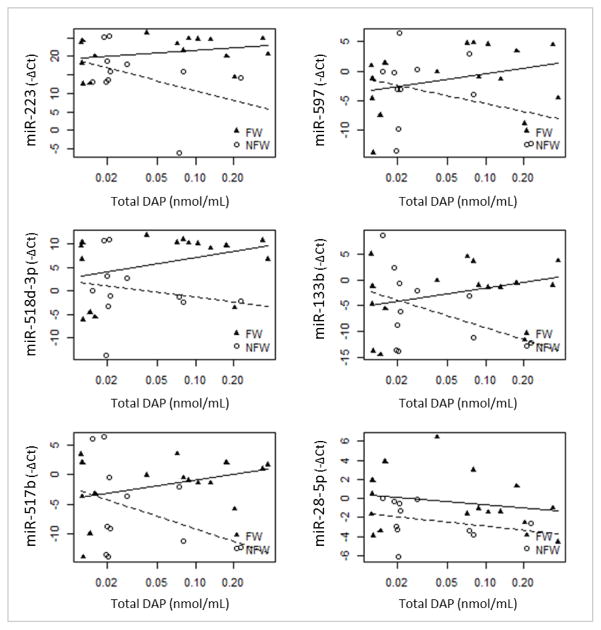
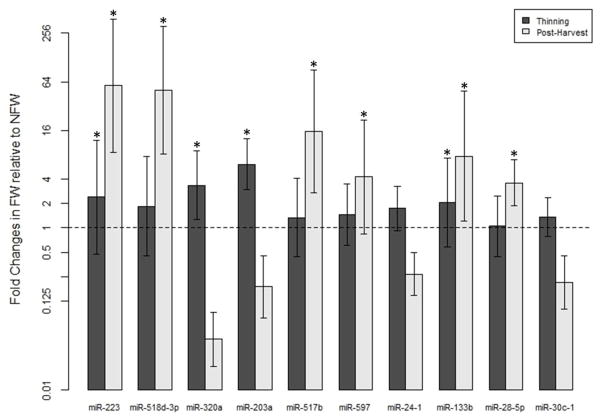
MicroRNAs (miRNAs) are post-transcriptional regulators that silence messenger RNAs. Because miRNAs are stable at room temperature and long-lived, they have been proposed as molecular biomarkers to monitor disease and exposure status. While urinary miRNAs have been used clinically as potential diagnostic markers for kidney and bladder cancers and other diseases, their utility in non-clinical settings has yet to be fully developed. Our goal was to investigate the potential for urinary miRNAs to act as biomarkers of pesticide exposure and early biological response by identifying the miRNAs present in urine from 27 parent/child, farmworker/non-farmworker pairs (16FW/11NFW) collected during two agricultural seasons (thinning and post-harvest) and characterizing the between- and within-individual variability of these miRNA epigenetic regulators. MiRNAs were isolated from archived urine samples and identified using PCR arrays. Comparisons were made between age, households, season, and occupation. Of 384 miRNAs investigated, 297 (77%) were detectable in at least one sample. Seven miRNAs were detected in at least 50% of the samples, and one miRNA was present in 96% of the samples. Principal components and hierarchical clustering analyses indicate significant differences in miRNA profiles between farmworker and non-farmworker adults as well as between seasons. Six miRNAs were observed to be positively associated with farmworkers status during the post-harvest season. Expression of five of these miRNA trended towards a positive dose response relationship with organophosphate pesticide metabolites in farmworkers. These results suggest that miRNAs may be novel biomarkers of pesticide exposure and early biological response.
微小RNA(miRNA)是使信使RNA沉默的转录后调节因子。由于miRNA在室温下稳定且寿命长,它们被提议作为监测疾病和暴露状况的分子生物标志物。虽然尿miRNA已在临床上用作肾癌、膀胱癌和其他疾病的潜在诊断标志物,但其在非临床环境中的效用尚未得到充分开发。我们的目标是通过鉴定在两个农业季节(疏果期和收获后)收集的27对父母/子女、农场工人/非农场工人(16名农场工人/11名非农场工人)尿液中存在的miRNA,并表征这些miRNA表观遗传调节因子的个体间和个体内变异性,来研究尿miRNA作为农药暴露和早期生物学反应生物标志物的潜力。从存档的尿液样本中分离出miRNA,并使用PCR阵列进行鉴定。对年龄、家庭、季节和职业进行了比较。在研究的384种miRNA中,至少在一个样本中可检测到297种(77%)。在至少50%的样本中检测到7种miRNA,在96%的样本中存在1种miRNA。主成分分析和层次聚类分析表明,农场工人和非农场工人成年人之间以及不同季节之间的miRNA谱存在显著差异。在收获后季节,观察到6种miRNA与农场工人身份呈正相关。其中5种miRNA的表达与农场工人体内有机磷农药代谢物呈正剂量反应关系趋势。这些结果表明,miRNA可能是农药暴露和早期生物学反应的新型生物标志物。