Miloff Alexander, Lindner Philip, Hamilton William, Reuterskiöld Lena, Andersson Gerhard, Carlbring Per
Department of Psychology, Stockholm University, Frescati Hagväg 8, 106 91, Stockholm, Sweden.
Department of Clinical Neuroscience, Karolinska Institutet, Stockholm, Sweden.
Trials. 2016 Feb 2;17:60. doi: 10.1186/s13063-016-1171-1.
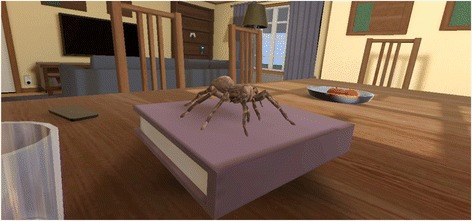
Traditional one-session exposure therapy (OST) in which a patient is gradually exposed to feared stimuli for up to 3 h in a one-session format has been found effective for the treatment of specific phobias. However, many individuals with specific phobia are reluctant to seek help, and access to care is lacking due to logistic challenges of accessing, collecting, storing, and/or maintaining stimuli. Virtual reality (VR) exposure therapy may improve upon existing techniques by facilitating access, decreasing cost, and increasing acceptability and effectiveness. The aim of this study is to compare traditional OST with in vivo spiders and a human therapist with a newly developed single-session gamified VR exposure therapy application with modern VR hardware, virtual spiders, and a virtual therapist.
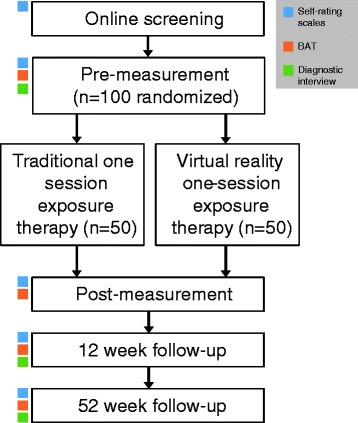
METHODS/DESIGN: Participants with specific phobia to spiders (N = 100) will be recruited from the general public, screened, and randomized to either VR exposure therapy (n = 50) or traditional OST (n = 50). A behavioral approach test using in vivo spiders will serve as the primary outcome measure. Secondary outcome measures will include spider phobia questionnaires and self-reported anxiety, depression, and quality of life. Outcomes will be assessed using a non-inferiority design at baseline and at 1, 12, and 52 weeks after treatment.
VR exposure therapy has previously been evaluated as a treatment for specific phobias, but there has been a lack of high-quality randomized controlled trials. A new generation of modern, consumer-ready VR devices is being released that are advancing existing technology and have the potential to improve clinical availability and treatment effectiveness. The VR medium is also particularly suitable for taking advantage of recent phobia treatment research emphasizing engagement and new learning, as opposed to physiological habituation. This study compares a market-ready, gamified VR spider phobia exposure application, delivered using consumer VR hardware, with the current gold standard treatment. Implications are discussed.
ClinicalTrials.gov identifier NCT02533310. Registered on 25 August 2015.
传统的单次暴露疗法(OST),即让患者在一次治疗中逐渐暴露于恐惧刺激下长达3小时,已被证明对治疗特定恐惧症有效。然而,许多患有特定恐惧症的人不愿寻求帮助,并且由于获取、收集、储存和/或维持刺激物存在后勤挑战,难以获得治疗。虚拟现实(VR)暴露疗法可能通过便于获取、降低成本、提高可接受性和有效性来改进现有技术。本研究的目的是将传统的针对蜘蛛和人类治疗师的现场暴露疗法与一种新开发的使用现代VR硬件、虚拟蜘蛛和虚拟治疗师的单次游戏化VR暴露疗法应用进行比较。
方法/设计:从普通公众中招募100名对蜘蛛有特定恐惧症的参与者,进行筛选并随机分为VR暴露疗法组(n = 50)或传统OST组(n = 50)。使用现场蜘蛛进行的行为接近测试将作为主要结局指标。次要结局指标将包括蜘蛛恐惧症问卷以及自我报告的焦虑、抑郁和生活质量。将采用非劣效性设计在基线以及治疗后1周、12周和52周对结局进行评估。
VR暴露疗法此前已被评估用于治疗特定恐惧症,但缺乏高质量的随机对照试验。新一代现代的、面向消费者的VR设备正在推出,这些设备推动了现有技术的发展,并有潜力提高临床可用性和治疗效果。VR媒介也特别适合利用近期强调参与和新学习而非生理习惯化的恐惧症治疗研究。本研究将使用消费级VR硬件提供的、已上市的游戏化VR蜘蛛恐惧症暴露应用与当前的金标准治疗方法进行比较。并讨论了其意义。
ClinicalTrials.gov标识符NCT02533310。于2015年8月25日注册。