Moors Pieter, Wagemans Johan, de-Wit Lee
Department of Brain & Cognition, Katholieke Universiteit Leuven , Leuven , Belgium.
PeerJ. 2016 Jan 14;4:e1565. doi: 10.7717/peerj.1565. eCollection 2016.
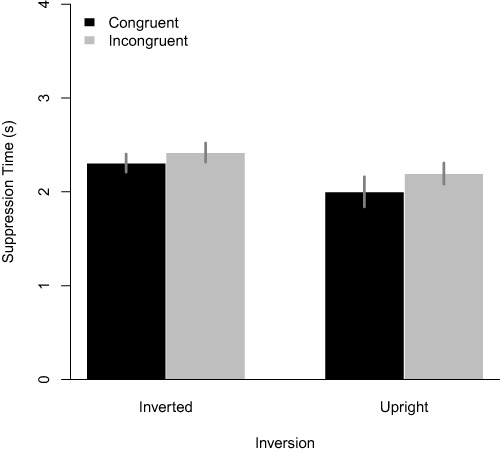
The extent to which perceptually suppressed face stimuli are still processed has been extensively studied using the continuous flash suppression paradigm (CFS). Studies that rely on breaking CFS (b-CFS), in which the time it takes for an initially suppressed stimulus to become detectable is measured, have provided evidence for relatively complex processing of invisible face stimuli. In contrast, adaptation and neuroimaging studies have shown that perceptually suppressed faces are only processed for a limited set of features, such as its general shape. In this study, we asked whether perceptually suppressed face stimuli presented in their commonly experienced configuration would break suppression faster than when presented in an uncommonly experienced configuration. This study was motivated by a recent neuroimaging study showing that commonly experienced face configurations are more strongly represented in the fusiform face area. Our findings revealed that faces presented in commonly experienced configurations indeed broke suppression faster, yet this effect did not interact with face inversion suggesting that, in a b-CFS context, perceptually suppressed faces are potentially not processed by specialized (high-level) face processing mechanisms. Rather, our pattern of results is consistent with an interpretation based on the processing of more basic visual properties such as convexity.
使用连续闪烁抑制范式(CFS),人们对感知上被抑制的面部刺激仍会在多大程度上得到处理进行了广泛研究。依赖打破CFS(b-CFS)的研究,即测量最初被抑制的刺激变得可检测所需的时间,为不可见面部刺激的相对复杂处理提供了证据。相比之下,适应和神经成像研究表明,感知上被抑制的面部仅针对有限的一组特征进行处理,例如其大致形状。在本研究中,我们探讨了以常见构型呈现的感知上被抑制的面部刺激是否比以不常见构型呈现时更快打破抑制。这项研究的动机来自最近一项神经成像研究,该研究表明常见的面部构型在梭状回面部区域有更强的表征。我们的研究结果显示,以常见构型呈现的面部确实更快地打破了抑制,但这种效应与面部倒置没有相互作用,这表明,在b-CFS情境中,感知上被抑制的面部可能不会由专门的(高级)面部处理机制进行处理。相反,我们的结果模式与基于对诸如凸性等更基本视觉属性的处理的解释一致。