Tromp Marilou Dp, Donners Anouk Amt, Garssen Johan, Verster Joris C
Division of Pharmacology, Utrecht Institute for Pharmaceutical Sciences, Utrecht University, Utrecht, the Netherlands.
Division of Pharmacology, Utrecht Institute for Pharmaceutical Sciences, Utrecht University, Utrecht, the Netherlands; Nutricia Research, Utrecht, the Netherlands.
Nat Sci Sleep. 2016 Jan 18;8:35-40. doi: 10.2147/NSS.S97574. eCollection 2016.
To investigate the relationship between eating disorders, body mass index (BMI), sleep disorders, and daytime functioning.
Survey.
The Netherlands.
N=574 Dutch young adults (18-35 years old).
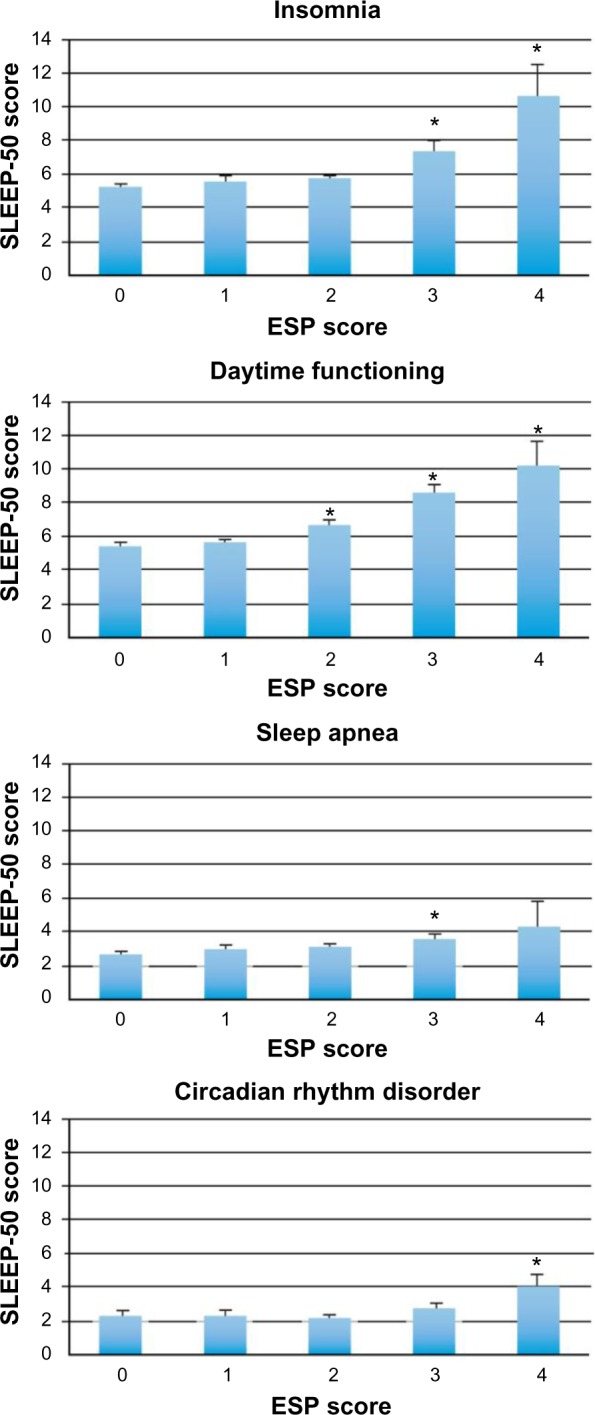
Participants completed a survey on eating and sleep habits including the Eating Disorder Screen for Primary care (ESP) and SLEEP-50 questionnaire subscales for sleep apnea, insomnia, circadian rhythm disorder (CRD), and daytime functioning. SLEEP-50 outcomes of participants who screened negative (≤2) and positive (>2) on the ESP were compared. In addition, SLEEP-50 scores of groups of participants with different ESP scores (0-4) and different BMI groups (ie, underweight, healthy weight, overweight, and obese) were compared using nonparametric statistics.
Almost 12% (n=67) of participants screened positive for having an eating disorder. Relative to participants without eating disorders, participants who screened positive for eating disorders reported significantly higher scores on sleep apnea (3.7 versus 2.9, P=0.012), insomnia (7.7 versus 5.5, P<0.0001), CRD (2.9 versus 2.3, P=0.011), and impairment of daytime functioning (8.8 versus 5.8, P=0.0001). ESP scores were associated with insomnia (r=0.117, P=0.005), sleep apnea (r=0.118, P=0.004), sleep quality (r=-0.104, P=0.012), and daytime functioning (r=0.225, P<0.0001), but not with CRD (r=0.066, P=0.112). BMI correlated significantly with ESP scores (r=0.172, P<0.0001) and scores on sleep apnea (r=0.171, P<0.0001). When controlling for BMI, the partial correlation between ESP and sleep apnea remained significant (r=0.10, P=0.015).
Participants who score positive for eating disorders scored significantly higher on sleep disorder scales, and reported significantly more impairment of daytime functioning.
探讨饮食失调、体重指数(BMI)、睡眠障碍与日间功能之间的关系。
调查。
荷兰。
N = 574名荷兰年轻人(18 - 35岁)。
参与者完成了一项关于饮食和睡眠习惯的调查,包括初级保健饮食失调筛查量表(ESP)以及用于睡眠呼吸暂停、失眠、昼夜节律紊乱(CRD)和日间功能的SLEEP - 50问卷子量表。比较了在ESP筛查中呈阴性(≤2)和阳性(>2)的参与者的SLEEP - 50结果。此外,使用非参数统计方法比较了具有不同ESP分数(0 - 4)的参与者组和不同BMI组(即体重过轻、健康体重、超重和肥胖)的SLEEP - 50分数。
近12%(n = 67)的参与者筛查出饮食失调呈阳性。与没有饮食失调的参与者相比,饮食失调筛查呈阳性的参与者在睡眠呼吸暂停(3.7对2.9,P = 0.012)、失眠(7.7对5.5,P < 0.0001)、CRD(2.9对2.3,P = 0.011)以及日间功能损害(8.8对5.8,P = 0.0001)方面的得分显著更高。ESP分数与失眠(r = 0.117,P = 0.005)、睡眠呼吸暂停(r = 0.118,P = 0.004)、睡眠质量(r = -0.104,P = 0.012)和日间功能(r = 0.225,P < 0.0001)相关,但与CRD无关(r = 0.066,P = 0.112)。BMI与ESP分数(r = 0.172,P < 0.0001)和睡眠呼吸暂停得分(r = 0.171,P < 0.0001)显著相关。在控制BMI后,ESP与睡眠呼吸暂停之间的偏相关仍然显著(r = 0.10,P = 0.015)。
饮食失调筛查呈阳性的参与者在睡眠障碍量表上的得分显著更高,并且报告的日间功能损害也显著更多。