van Dijk Albert, van Eldik Mandy, Veldhuizen Edwin J A, Tjeerdsma-van Bokhoven Hanne L M, de Zoete Marcel R, Bikker Floris J, Haagsman Henk P
Division of Molecular Host Defence, Department of Infectious Diseases and Immunology, Faculty of Veterinary Medicine, Utrecht University, Utrecht, The Netherlands.
Department of Immunobiology, Yale School of Medicine, New Haven, Connecticut, United States of America.
PLoS One. 2016 Feb 5;11(2):e0147919. doi: 10.1371/journal.pone.0147919. eCollection 2016.
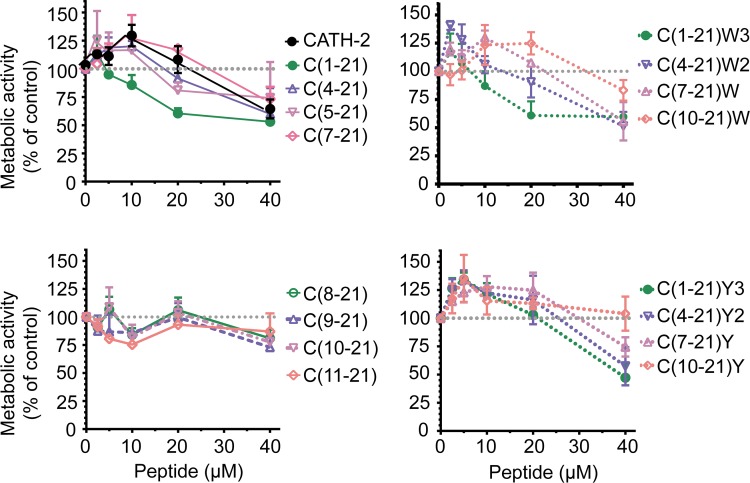
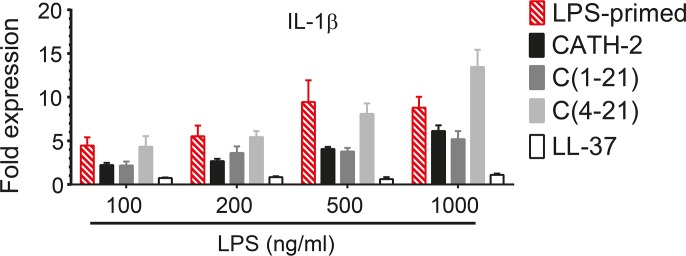
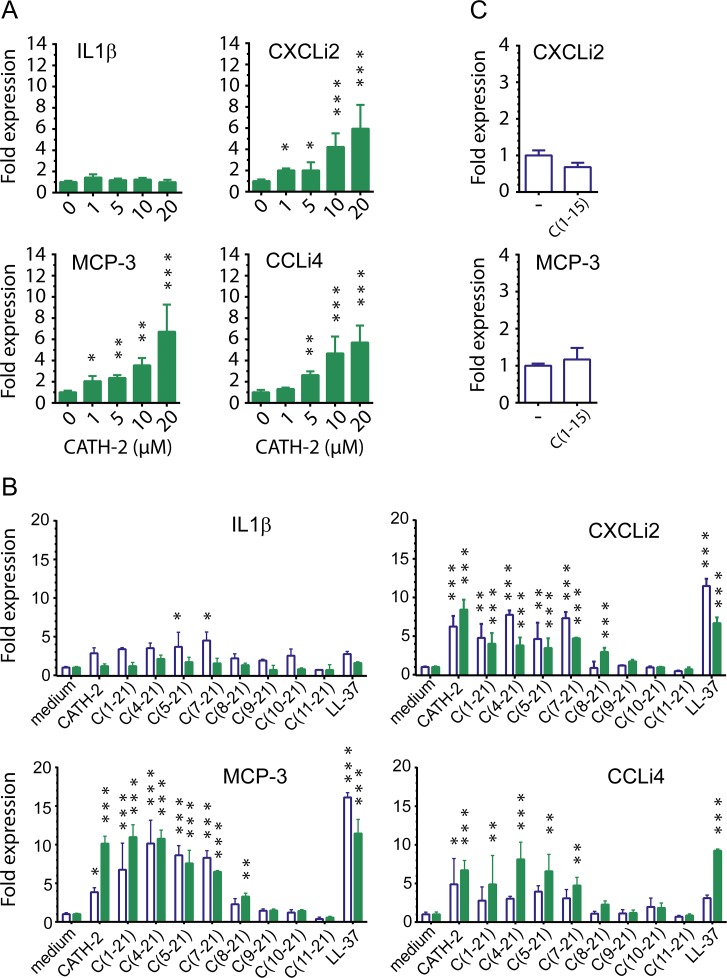
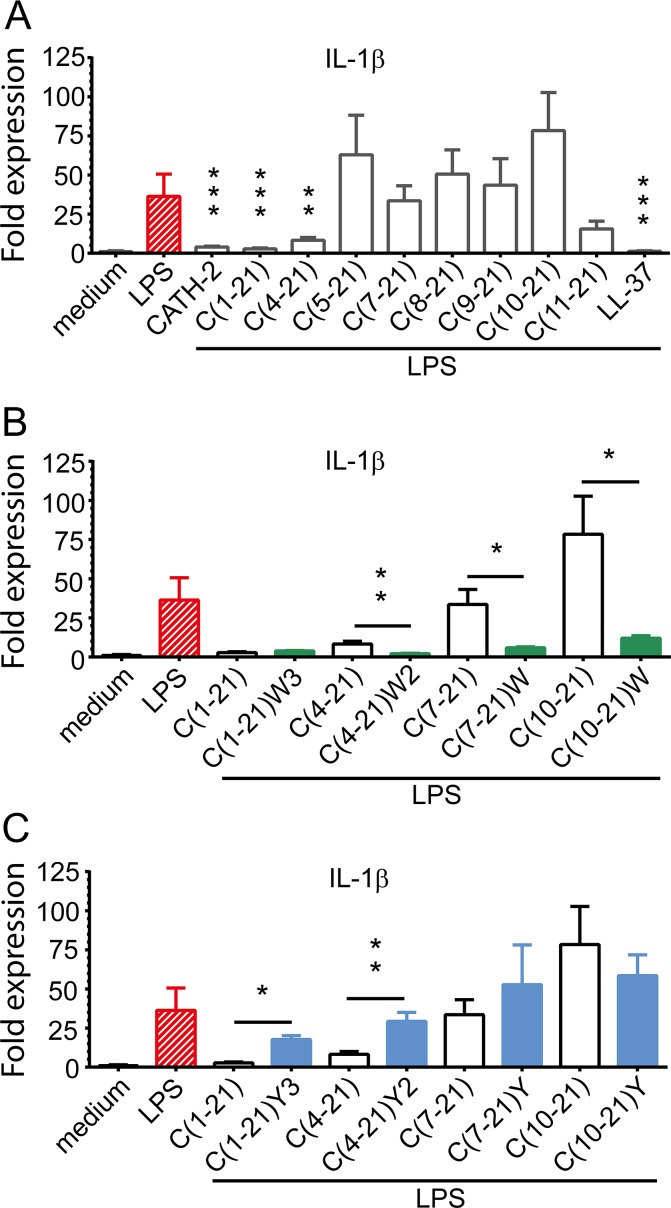
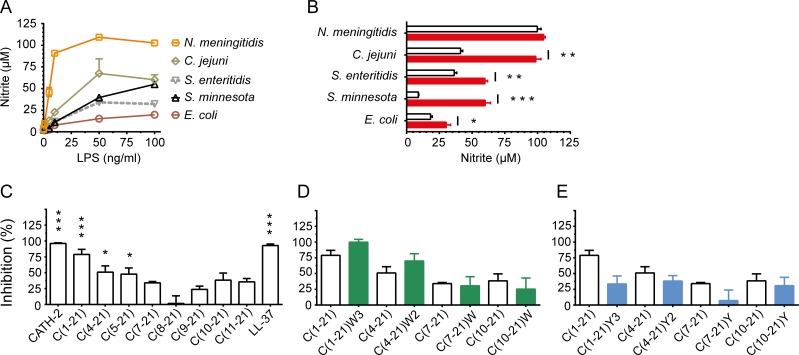
Host Defence Peptides and derived peptides are promising classes of antimicrobial and immunomodulatory lead compounds. For this purpose we examined whether chicken cathelicidin-2 (CATH-2)-derived peptides modulate the function and inflammatory response of avian immune cells. Using a chicken macrophage cell line (HD11) we found that full-length CATH-2 dose-dependently induced transcription of chemokines CXCLi2/IL-8, MCP-3 and CCLi4/RANTES, but not of pro-inflammatory cytokine IL-1β. In addition, CATH-2 efficiently inhibited IL-1β and nitric oxide production by HD11 cells induced by different sources of lipopolysaccharides (LPS). N-terminal truncated CATH-2 derived peptides maintained the capacity to selectively induce chemokine transcription, but despite their high LPS affinity several analogs lacked LPS-neutralizing capacity. Substitution of phenylalanine residues by tryptophan introduced endotoxin neutralization capacity in inactive truncated CATH-2 derived peptides. In contrast, amino acid substitution of phenylalanine by tyrosine abrogated endotoxin neutralization activity of CATH-2 analogs. These findings support a pivotal role for aromatic residues in peptide-mediated endotoxin neutralization by CATH-2 analogs and were shown to be independent of LPS affinity. The capacity to modulate chemokine production and dampen endotoxin-induced pro-inflammatory responses in chicken immune cells implicates that small CATH-2 based peptides could serve as leads for the design of CATH-2 based immunomodulatory anti-infectives.
宿主防御肽及其衍生肽是很有前景的抗菌和免疫调节先导化合物类别。为此,我们研究了鸡cathelicidin-2(CATH-2)衍生肽是否能调节禽类免疫细胞的功能和炎症反应。使用鸡巨噬细胞系(HD11),我们发现全长CATH-2剂量依赖性地诱导趋化因子CXCLi2/IL-8、MCP-3和CCLi4/RANTES的转录,但不诱导促炎细胞因子IL-1β的转录。此外,CATH-2有效抑制了不同来源脂多糖(LPS)诱导的HD11细胞产生IL-1β和一氧化氮。N端截短的CATH-2衍生肽保持了选择性诱导趋化因子转录的能力,但尽管它们对LPS有高亲和力,一些类似物却缺乏LPS中和能力。用色氨酸取代苯丙氨酸残基可使无活性的截短CATH-2衍生肽具有内毒素中和能力。相反,用酪氨酸取代苯丙氨酸的氨基酸替换消除了CATH-2类似物的内毒素中和活性。这些发现支持了芳香族残基在CATH-2类似物介导的肽内毒素中和中起关键作用,并且表明这与LPS亲和力无关。调节鸡免疫细胞趋化因子产生并减轻内毒素诱导的促炎反应的能力表明,基于CATH-2的小肽可作为设计基于CATH-2的免疫调节抗感染药物的先导。