Wei Chunhua, Chen Jiongjiong, Kuang Hanhui
Key Laboratory of Horticultural Plant Biology, Ministry of Education, and Key Laboratory of Horticultural Crop Biology and Genetic improvement (Central Region), MOA, College of Horticulture and Forestry Sciences, Huazhong Agricultural University, Wuhan, P.R. China, 430070.
College of Horticulture, Northwest A&F University, Yangling, Shanxi, China, 712100.
PLoS One. 2016 Feb 5;11(2):e0148708. doi: 10.1371/journal.pone.0148708. eCollection 2016.
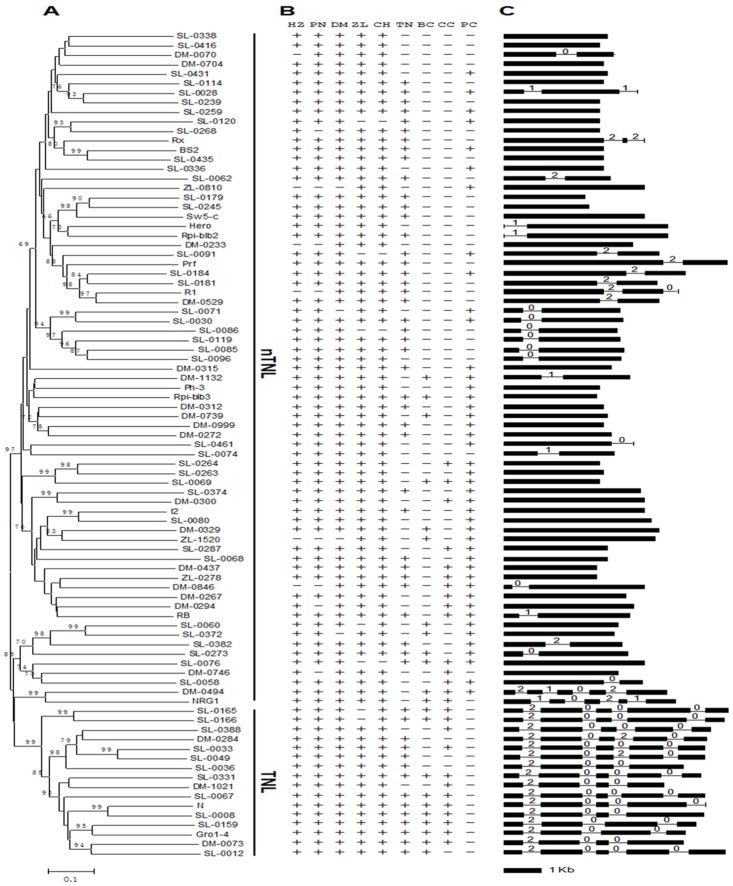
Most disease resistance genes encode nucleotide-binding-site (NBS) and leucine-rich-repeat (LRR) domains, and the NBS-LRR encoding genes are often referred to as R genes. Using newly developed approach, 478, 485, 1,194, 1,665, 2,042 and 374 R genes were identified from the genomes of tomato Heinz1706, wild tomato LA716, potato DM1-3, pepper Zunla-1 and wild pepper Chiltepin and tobacco TN90, respectively. The majority of R genes from Solanaceae were grouped into 87 subfamilies, including 16 TIR-NBS-LRR (TNL) and 71 non-TNL subfamilies. Each subfamily was annotated manually, including identification of intron/exon structure and intron phase. Interestingly, TNL subfamilies have similar intron phase patterns, while the non-TNL subfamilies have diverse intron phase due to frequent gain of introns. Prevalent presence/absence polymorphic R gene loci were found among Solanaceae species, and an integrated map with 427 R loci was constructed. The pepper genome (2,042 in Chiltepin) has at least four times of R genes as in tomato (478 in Heinz1706). The high number of R genes in pepper genome is due to the amplification of R genes in a few subfamilies, such as the Rpi-blb2 and BS2 subfamilies. The mechanism underlying the variation of R gene number among different plant genomes is discussed.
大多数抗病基因编码核苷酸结合位点(NBS)和富含亮氨酸重复序列(LRR)结构域,编码NBS-LRR的基因通常被称为R基因。利用新开发的方法,分别从番茄Heinz1706、野生番茄LA716、马铃薯DM1-3、辣椒Zunla-1和野生辣椒Chiltepin以及烟草TN90的基因组中鉴定出478、485、1194、1665、2042和374个R基因。茄科的大多数R基因被分为87个亚家族,包括16个TIR-NBS-LRR(TNL)亚家族和71个非TNL亚家族。每个亚家族都进行了手动注释,包括内含子/外显子结构和内含子相位的鉴定。有趣的是,TNL亚家族具有相似的内含子相位模式,而非TNL亚家族由于内含子的频繁获得而具有多样的内含子相位。在茄科物种中发现了普遍存在的R基因位点的存在/缺失多态性,并构建了一个包含427个R基因位点的综合图谱。辣椒基因组(Chiltepin中有2042个)中的R基因数量至少是番茄(Heinz1706中有478个)的四倍。辣椒基因组中R基因数量众多是由于少数亚家族中R基因的扩增,如Rpi-blb2和BS2亚家族。本文讨论了不同植物基因组中R基因数量变化的潜在机制。