Björnson Elias, Borén Jan, Mardinoglu Adil
Department of Biology and Biological Engineering, Chalmers University of TechnologyGothenburg, Sweden; Department of Molecular and Clinical Medicine/Wallenberg Laboratory, University of GothenburgGothenburg, Sweden.
Department of Molecular and Clinical Medicine/Wallenberg Laboratory, University of Gothenburg Gothenburg, Sweden.
Front Physiol. 2016 Jan 26;7:2. doi: 10.3389/fphys.2016.00002. eCollection 2016.
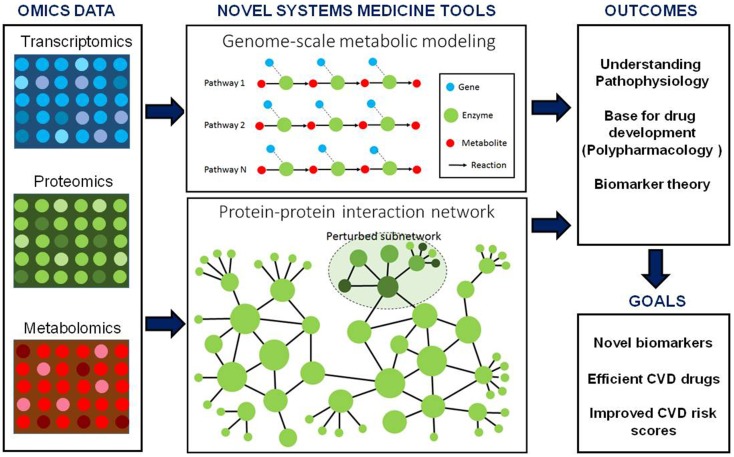
Cardiovascular disease (CVD) continues to constitute the leading cause of death globally. CVD risk stratification is an essential tool to sort through heterogeneous populations and identify individuals at risk of developing CVD. However, applications of current risk scores have recently been shown to result in considerable misclassification of high-risk subjects. In addition, despite long standing beneficial effects in secondary prevention, current CVD medications have in a primary prevention setting shown modest benefit in terms of increasing life expectancy. A systems biology approach to CVD risk stratification may be employed for improving risk-estimating algorithms through addition of high-throughput derived omics biomarkers. In addition, modeling of personalized benefit-of-treatment may help in guiding choice of intervention. In the area of medicine, realizing that CVD involves perturbations of large complex biological networks, future directions in drug development may involve moving away from a reductionist approach toward a system level approach. Here, we review current CVD risk scores and explore how novel algorithms could help to improve the identification of risk and maximize personalized treatment benefit. We also discuss possible future directions in the development of effective treatment strategies for CVD through the use of genome-scale metabolic models (GEMs) as well as other biological network-based approaches.
心血管疾病(CVD)仍然是全球主要的死因。CVD风险分层是一种重要工具,用于区分异质人群并识别有患CVD风险的个体。然而,最近的研究表明,当前风险评分的应用会导致对高风险受试者的大量误分类。此外,尽管目前的CVD药物在二级预防中具有长期的有益效果,但在一级预防中,就延长预期寿命而言,其益处并不显著。可以采用系统生物学方法进行CVD风险分层,通过添加高通量衍生的组学生物标志物来改进风险评估算法。此外,个性化治疗益处的建模可能有助于指导干预措施的选择。在医学领域,认识到CVD涉及大型复杂生物网络的扰动,药物开发的未来方向可能是从还原论方法转向系统水平方法。在此,我们回顾当前的CVD风险评分,并探讨新算法如何有助于改进风险识别并最大化个性化治疗益处。我们还讨论了通过使用基因组规模代谢模型(GEM)以及其他基于生物网络的方法,在开发有效的CVD治疗策略方面可能的未来方向。