Ray Sandipan, Reddy Akhilesh B
Department of Clinical Neurosciences, University of Cambridge Metabolic Research Laboratories, National Institutes of Health Biomedical Research Centre, Wellcome Trust-Medical Research Council Institute of Metabolic Science, University of Cambridge, Addenbrooke's Hospital, Cambridge, United Kingdom.
Bioessays. 2016 Apr;38(4):394-405. doi: 10.1002/bies.201500056. Epub 2016 Feb 11.
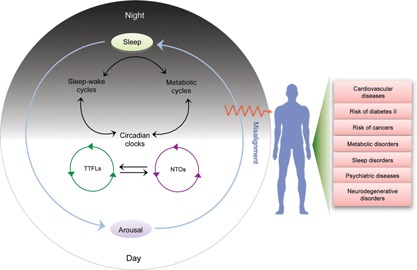
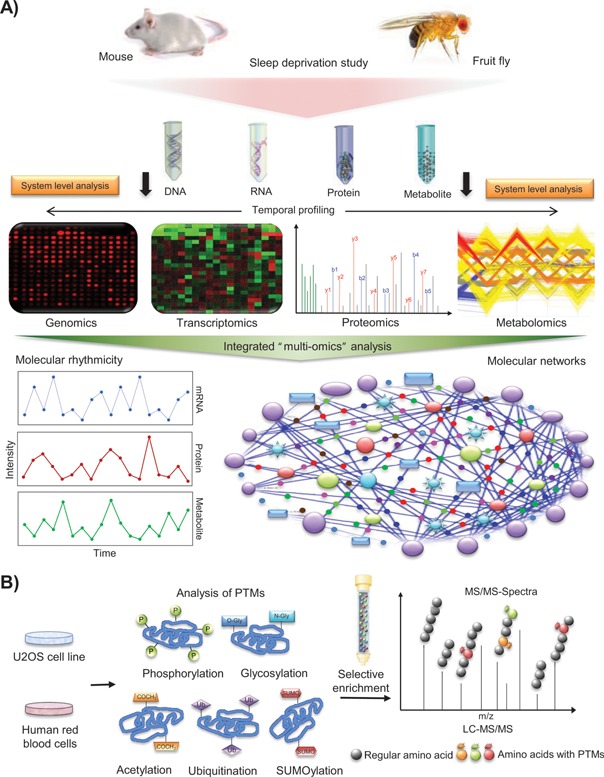
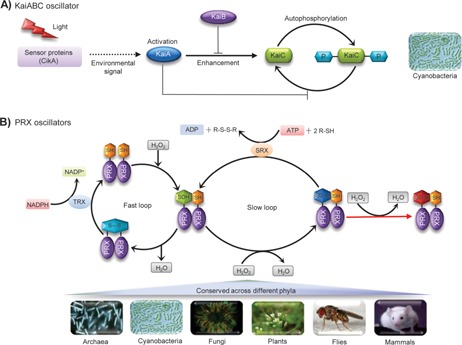
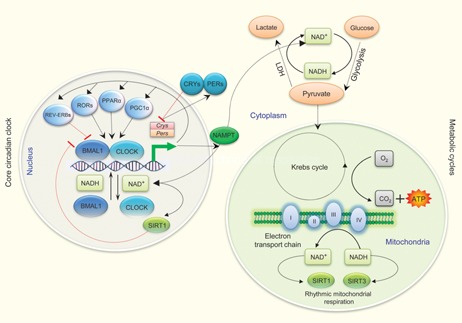
Integration of knowledge concerning circadian rhythms, metabolic networks, and sleep-wake cycles is imperative for unraveling the mysteries of biological cycles and their underlying mechanisms. During the last decade, enormous progress in circadian biology research has provided a plethora of new insights into the molecular architecture of circadian clocks. However, the recent identification of autonomous redox oscillations in cells has expanded our view of the clockwork beyond conventional transcription/translation feedback loop models, which have been dominant since the first circadian period mutants were identified in fruit fly. Consequently, non-transcriptional timekeeping mechanisms have been proposed, and the antioxidant peroxiredoxin proteins have been identified as conserved markers for 24-hour rhythms. Here, we review recent advances in our understanding of interdependencies amongst circadian rhythms, sleep homeostasis, redox cycles, and other cellular metabolic networks. We speculate that systems-level investigations implementing integrated multi-omics approaches could provide novel mechanistic insights into the connectivity between daily cycles and metabolic systems.
整合有关昼夜节律、代谢网络和睡眠-觉醒周期的知识对于揭示生物周期及其潜在机制的奥秘至关重要。在过去十年中,昼夜生物学研究取得了巨大进展,为生物钟的分子结构提供了大量新见解。然而,最近在细胞中发现的自主氧化还原振荡扩展了我们对生物钟机制的认识,超越了自果蝇中首次发现昼夜节律突变体以来一直占主导地位的传统转录/翻译反馈环模型。因此,有人提出了非转录计时机制,并且抗氧化过氧化物酶蛋白已被确定为24小时节律的保守标志物。在这里,我们综述了我们对昼夜节律、睡眠稳态、氧化还原循环和其他细胞代谢网络之间相互依存关系理解的最新进展。我们推测,采用综合多组学方法进行的系统水平研究可以为日常周期与代谢系统之间的联系提供新的机制性见解。